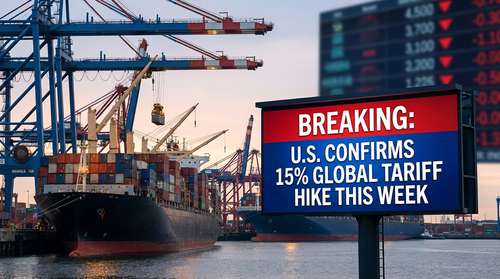
In a decisive move that is set to reshape the global economic landscape, U.S. Treasury Secretary Scott Bessent confirmed on Wednesday that the administration will implement a 15% global tariff increase as early as this week. This escalation from the current temporary 10% rate marks a significant pivot in Scott Bessent trade policy following a landmark legal battle. As Washington scrambles to reconstruct its trade barriers after a stunning Supreme Court defeat, the new US import duties 2026 regime threatens to send shockwaves through international markets and consumer wallets alike.
Treasury Secretary Bessent Signals Imminent Rate Hike
Speaking to reporters and in televised interviews on Wednesday, Treasury Secretary Scott Bessent left little room for ambiguity: the hike to a 15% universal import levy is imminent. "That's likely sometime this week," Bessent stated when pressed on the implementation timeline. This move comes less than two weeks after the administration invoked Section 122 of the Trade Act of 1974 to impose a stopgap 10% tariff, a direct response to the judicial invalidation of previous duties.
The decision to raise the rate to 15%—the maximum allowed under this specific statute—signals the White House's aggressive stance on protecting domestic industries despite legal headwinds. Bessent emphasized that while these specific Section 301 tariffs and Section 122 measures are temporary, designed to last only 150 days, they serve as a critical bridge. The administration's ultimate goal is to reinstate the full weight of the prior tariff regime using more durable legal authorities within the next five months.
Supreme Court Ruling Triggers 'Tariff Whiplash'
The current volatility in US economic policy traces back to February 20, 2026, when the Supreme Court delivered a 6-3 ruling that struck down the administration's use of the International Emergency Economic Powers Act (IEEPA) to impose sweeping "reciprocal" tariffs. The Court found that the executive branch had exceeded its statutory authority, a decision that initially sparked relief rallies across financial markets.
However, that relief was short-lived. In what industry analysts are calling "tariff whiplash," the administration pivoted within days to Section 122, a rarely used provision allowing for temporary surcharges to address balance-of-payments deficits. While the National Retail Federation (NRF) initially welcomed the clarity provided by the Court's decision, the swift imposition of new duties has reintroduced profound uncertainty. Retailers who had just begun to calculate refunds from invalidated tariffs are now scrambling to price in a new, higher 15% cost floor.
The Path to August: Reinstating Sections 232 and 301
Bessent outlined a strategic roadmap that extends beyond the current 150-day window. "It's my strong belief that the tariff rates will be back to their old rate within five months," he asserted. The Treasury is actively working with the U.S. Trade Representative to reconstruct the tariff wall using Section 301 tariffs (targeting unfair trade practices) and Section 232 (national security) authorities. These mechanisms require lengthy investigation periods, but Bessent described them as "more robust" and legally defensible than the IEEPA measures struck down by the Court.
Retail Inflation Impact: Consumers to Bear the Brunt
The economic implications of a 15% global tariff are stark, particularly for American households already navigating a complex inflationary environment. Economists warn that unlike targeted duties, a universal tariff acts as a broad-based consumption tax. With the effective tariff rate potentially hitting levels not seen since the 1970s, the retail inflation impact is expected to be immediate and tangible.
Analysts project that the hike could push CPI (Consumer Price Index) higher in 2026, with some estimates suggesting a rise to 2.7% or more. Major retailers, including those in the apparel and consumer electronics sectors—companies like Nike and Gap heavily rely on global supply chains—face a difficult choice: absorb the costs and watch margins erode, or pass them on to shoppers. Early indications suggest the latter, with price tags likely to swell on everything from imported avocados to smartphones as the new duties take effect at ports of entry.
Global Trade War Risks Intensify
The specter of a renewed global trade war looms large as trading partners digest the news. Unlike the previous country-specific tariffs, this blanket 15% rate hits allies and adversaries indiscriminately. The European Union and key Asian manufacturing hubs are reportedly weighing their options, with retaliation a distinct possibility.
By leveraging Section 122, the U.S. has bypassed the need for immediate Congressional approval, but the clock is ticking. As the 150-day deadline approaches in August, the transition to permanent Section 232 and 301 duties will likely spark fresh diplomatic frictions. For now, businesses must navigate a chaotic interim period where the only certainty is higher costs and shifting rules.