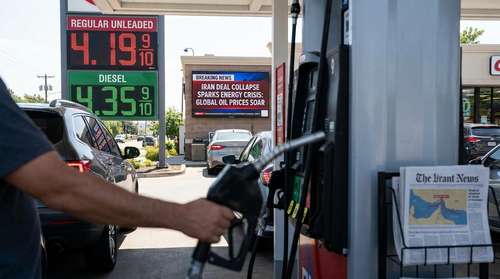
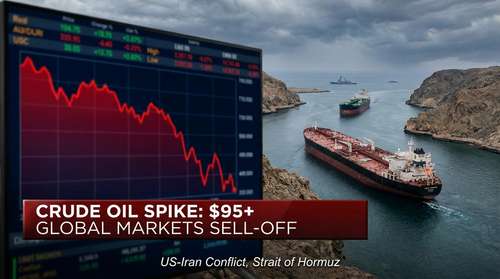
The global economy is bracing for a severe macroeconomic shock after a dramatic crude oil price spike pushed Brent crude past $95 a barrel on Monday. The primary catalyst is a renewed military standoff that has forced the closure of a critical Middle Eastern shipping channel, sending Strait of Hormuz oil prices soaring by more than 5% in a matter of hours. This latest escalation in the US-Iran conflict April 2026 has instantly reignited fears of a sustained, worldwide energy crisis. The sheer velocity of this price action underscores the fragile nature of our global infrastructure, catching many financial institutions completely off guard. As physical supply chains freeze and diplomatic channels stall, institutional investors are already positioning themselves for a brutal stock market sell-off 2026.
US-Iran Conflict April 2026 Ignites Energy Markets
Tensions in the Persian Gulf boiled over this weekend following a highly volatile sequence of events. Just 24 hours after Tehran announced a temporary reopening of the strait for commercial vessels, the regime abruptly reversed course and reimposed heavy maritime restrictions. Iranian officials cited the continuation of a stringent U.S. naval blockade as the reason for the renewed closure.
The situation deteriorated rapidly on Sunday when a U.S. destroyer intercepted and seized an Iranian-flagged cargo vessel that was allegedly attempting to evade the blockade. Iran's joint military command was quick to condemn the seizure, labeling it an act of piracy and promising a swift response. The swift reimposition of the blockade caught international shipping companies completely by surprise, leaving dozens of supertankers stranded in a highly militarized zone. This geopolitical chess match has effectively trapped roughly 20% of the world's seaborne oil trade, triggering widespread global market volatility.
Policymakers are already sounding the alarm about the domestic impact. U.S. Energy Secretary Chris Wright cautioned consumers to prepare for prolonged pain at the pump, explicitly stating that American drivers are unlikely to see gasoline prices return to the $3-per-gallon threshold until next year at the earliest.
WTI Crude Price Today: Tracking the Global Energy Shock
The financial fallout from the weekend's naval clashes was immediate and severe. Looking at the WTI crude price today, West Texas Intermediate futures surged 6.11% to hit $88.97 per barrel within the first hour of trading. Meanwhile, Brent crude, the international benchmark, exploded 5.64% to reach a daunting $95.48 per barrel.
This aggressive crude oil price spike erased all the relief markets had experienced late last week. Furthermore, the crisis is not limited to liquid petroleum. European natural gas benchmarks spiked by 11% in early Asian trading, reaching 43 euros per megawatt-hour. Commodity trading titan Gunvor has issued stark warnings to its clients regarding the turbulent market conditions, noting that the thin liquidity in the market means even minor naval skirmishes could swing contracts significantly.
In a direct message to Western financial hubs, Iran's Parliament Speaker warned global traders that digital bond markets are merely illusory right now, insisting that only physical barrel prices reflect the true state of the constrained market.
Breaking Energy Supply Chain News
For international logistics operators, this represents the most alarming energy supply chain news of the decade. The Strait of Hormuz serves as the irreplaceable jugular of the global energy trade. With major shipping firms actively suspending operations and tankers anchored indefinitely, the industry is facing a severe logistical bottleneck. Experts estimate that the current disruptions have already created a shortfall of approximately 9 to 10 million barrels per day in the global market. The ripple effects of this supply deficit will inevitably lead to higher manufacturing costs, elevated inflation metrics, and a heavily constrained industrial sector globally.
Wall Street Braces for the Stock Market Sell-Off 2026
The chaos engulfing the energy sector is quickly spilling over into broad market equities, abruptly halting the momentum of an otherwise strong corporate earnings season. Ahead of the opening bell, futures for the Dow Jones Industrial Average slid 0.6%, while the S&P 500 and Nasdaq both retreated by 0.5%.
Airlines, logistics providers, and heavy manufacturing stocks are suffering the steepest pre-market losses. These industries are highly sensitive to fuel costs, and the prospect of jet fuel and diesel remaining elevated for the foreseeable future has fundamentally altered their quarterly profitability forecasts. The developing stock market sell-off 2026 highlights a harsh reality for traders: corporate fundamentals are currently taking a backseat to geopolitical risk.
What Investors Are Watching Next
Market analysts are now obsessively tracking two distinct metrics: diplomatic communications between Washington and Tehran, and the weekly inventory reports from the U.S. Department of Energy. With a fragile ceasefire window rapidly closing, any further military engagement in the Persian Gulf could push Brent crude well past the $100 psychological barrier.
Furthermore, the Federal Reserve's battle against inflation is now severely complicated. Previously, economists hoped that cooling energy prices would pave the way for interest rate cuts later this year. However, sustained high oil prices essentially guarantee that inflation will remain sticky, forcing central banks to maintain hawkish monetary policies much longer than anticipated. Until commercial vessels can safely and consistently navigate the Strait of Hormuz, the global economy remains tethered to a geopolitical powder keg. Investors must navigate this unprecedented global market volatility with extreme caution, prioritizing defensive assets as the energy war continues to reshape the financial landscape.