
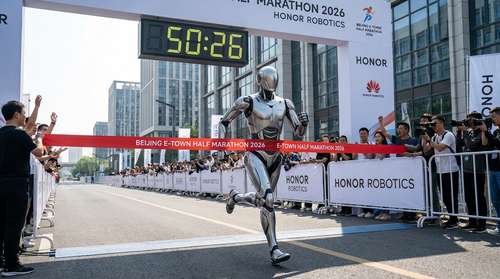
On Sunday, April 19, 2026, the boundaries of physical AI robotics were permanently redrawn. During the highly anticipated Beijing E-Town Half Marathon 2026, a bipedal machine developed by Chinese smartphone manufacturer Honor shattered the ultimate humanoid robot world record. The machine, known as "Lightning," navigated the 13.1-mile course fully autonomously in a blistering 50 minutes and 26 seconds. This historic performance eclipsed the elite human benchmark of 57:31 by roughly seven minutes, representing a monumental leap in robotic running performance and kinetic fluidity.
The Honor Humanoid Marathon Breakthrough
Operating entirely in autonomous navigation mode, Lightning maintained a relentless pace that left both human competitors and rival robotics teams far behind. The physical specifications of the robot underscore exactly how this feat was achieved. Standing 169 centimeters (about 5-foot-7) tall with an effective leg length of 95 centimeters, its chassis is meticulously engineered to mirror the biomechanics of elite long-distance runners.
The hardware generates an immense 400 newton-meters of peak torque to propel the machine forward with each stride. However, the true bottleneck for robotic endurance has historically been thermal management. According to Honor test development engineer Du Xiaodi, sustained dynamic locomotion over 21 kilometers generates extreme internal heat. To solve this, the engineering team integrated a proprietary liquid-cooling system adapted directly from the company's smartphone division, boasting a heat exchange flow rate exceeding four liters per minute.
Autonomous Navigation vs. Remote Control
This year's event introduced a rigorous new format to push the industry forward. Organizers applied a 1.2x time penalty to remotely piloted machines to incentivize true autonomous development. Remarkably, about 40 percent of the entrants tackled the course autonomously, relying entirely on multi-sensor fusion and real-time decision-making algorithms rather than human intervention. While a separate, remotely controlled Lightning unit crossed the finish line even faster at 48 minutes and 19 seconds, the autonomous model officially secured the championship under the weighted scoring rules.
Robot vs Human Marathon: Parallel Tracks in Beijing
The event itself was a spectacle unlike any other. Roughly 12,000 human runners competed alongside more than 100 robotic teams, racing on parallel tracks separated by metal barriers and green belts to ensure safety. The human side of the race was won by Zhao Haijie with a respectable time of 1 hour, 7 minutes, and 47 seconds.
Rather than viewing the event as a zero-sum competition against machines, athletes embraced the futuristic atmosphere. "The relationship between human runner and robot is not one replacing the other, but mutually promoting each other to reach a better stage," Zhao remarked after his victory.
Still, the contrast between the organic and synthetic competitors was stark. While human runners crossed the finish line exhausted and wrapped in foil blankets, the humanoid contingents stood tall and unscathed. The sheer velocity of progress becomes apparent when comparing Sunday's results to the inaugural 2025 event, where the winning robot took 2 hours, 40 minutes, and 42 seconds, and most competitors collapsed from battery exhaustion.
The Broader Impact of Embodied Intelligence Technology
The grueling 21.1-kilometer distance serves as an uncompromising stress test for power control, stability, and energy-management efficiency. In China, frontier technologies like advanced robotics are viewed as critical areas of global competition. The national five-year plan places a heavy emphasis on speeding up the commercialization of humanoid robotics by 2030, making public showcases like the E-Town marathon highly visible progress reports.
Beyond road racing, the weekend featured a "Robot Warrior Challenge"—essentially a Spartan Race for machines. In simulated disaster scenarios, robotic systems navigated uneven slopes, traversed pipes, and dodged swinging obstacles. Tang Jian, chief technical officer of the Beijing Innovation Center of Humanoid Robots, emphasized that robots possess unique advantages in physical durability, allowing them to undertake emergency rescue and industrial tasks that would be too dangerous for humans.
This weekend's events prove that embodied intelligence technology has rapidly transitioned from a theoretical concept into a highly capable reality. We have firmly entered an era where autonomous systems can consistently outpace our greatest endurance athletes, paving the way for applications that will soon reshape heavy industry, logistics, and emergency response.