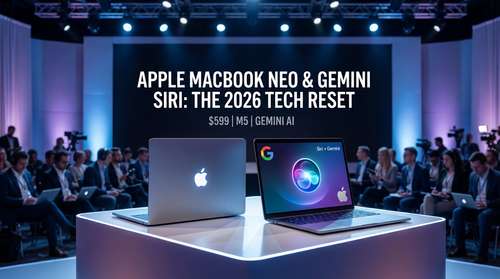
In a move that has effectively shattered the entry barrier to the macOS ecosystem, Apple has officially unveiled the MacBook Neo, a $599 laptop powered by the A18 Pro silicon. Unveiled alongside a landmark Apple Gemini Siri partnership during this week's "Apple Experience" events in New York, London, and Shanghai, the tech giant is pivoting aggressively to reclaim the education market while simultaneously overhauling its AI strategy. For the first time, Apple’s "walled garden" has opened its gates to Google’s Gemini models, promising a Siri 2.0 that finally delivers on a decade of promises.
The $599 MacBook Neo: A Chromebook Killer?
The headline of the Apple March event recap is undoubtedly the MacBook Neo price. At $599 (and an aggressive $499 for education customers), the Neo is not just a new product; it is a declaration of war on the premium Chromebook market. Replacing the long-serving M1 MacBook Air, the Neo makes a controversial but calculated hardware choice: it runs on the A18 Pro chip—the same silicon found in the iPhone 16 Pro lineage—rather than an M-series processor.
Critics initially scoffed at a "phone chip" in a laptop, but the specs tell a different story. The A18 Pro’s benchmarks reportedly outpace the base M1 chip in single-core performance, making it more than capable for the Neo’s target audience: students, writers, and web-based workers. The device features a 13-inch Liquid Retina display, Wi-Fi 6E, and a fanless aluminum chassis available in four fresh colors: Indigo, Blush, Citrus, and Silver. To hit that sub-$600 price point, Apple has made strategic cuts: there is no MagSafe (charging is via USB-C), the base model ships with 8GB of unified memory, and it lacks the Thunderbolt speeds of its Pro siblings.
Siri 2.0: The Apple Gemini Partnership Explained
While the hardware is disruptive, the software news is transformative. Ending months of speculation, executives confirmed the Apple Gemini Siri partnership. This integration marks a pivot from Apple's strict on-device-only dogma. Under the new "Hybrid Intelligence" framework, Siri 2.0 will utilize Apple Intelligence features 2026 for personal context—scanning your calendar, messages, and emails locally—while offloading complex world-knowledge queries to Google’s Gemini Advanced models via the cloud.
The demo showed Siri 2.0 Google AI integration in action with startling fluidity. In one example, a user asked Siri to "find that hiking trail Mike mentioned last week and draft an itinerary based on the weather." Siri used on-device intelligence to find the iMessage from Mike, then instantly pinged Gemini to pull real-time weather data and trail maps, synthesizing the result into a cohesive trip plan in Notes. This autonomous cross-app coordination and real-time on-screen awareness suggests that Siri is finally becoming the proactive assistant users have wanted for years.
M5 MacBook Pro Specs: Power at the High End
For professionals worried that Apple has gone fully budget, the event also introduced the next generation of power. The new M5 MacBook Pro specs are staggering. Built on a refined 2nm process, the M5 Max chip boasts an 18-core CPU and a massive 40-core GPU. The new Pros finally introduce Thunderbolt 5 connectivity, offering data transfer speeds that video editors and 3D artists have been clamoring for.
The contrast in Apple's 2026 lineup is now starker than ever. On one end, you have the budget Apple laptop, the Neo, bringing the Apple ecosystem to a mass audience. On the other, the M5 MacBook Pro pushes the envelope of what portable computing can do. This bifurcated strategy suggests Apple is no longer content with just the premium segment; it wants the whole pie.
Availability and Outlook
The MacBook Neo is available for pre-order starting today, Friday, March 6, with shipping set for next week. The Gemini-powered Siri update will roll out as part of macOS Tahoe 16.4 later this month. By undercutting Windows laptops and supercharging Siri with Google’s brain, Apple hasn't just released new products; it has reset the board for the rest of the year.