
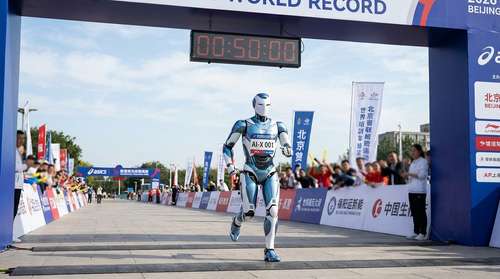
The boundary between biological limitation and machine performance was permanently redrawn this weekend. On Sunday, April 19, 2026, a groundbreaking autonomous machine established a new humanoid robot world record at the Beijing E-Town Half Marathon. Completing the 13.1-mile course in an astonishing 50 minutes and 26 seconds, the machine obliterated the human world record of roughly 57 minutes held by Ugandan long-distance runner Jacob Kiplimo. This watershed moment signals a massive leap forward in mobility and stamina, transforming what experts previously thought possible for mechanical athletes.
A Beijing Robotics Breakthrough in Speed and Agility
Developed by Chinese smartphone giant Honor, the winning half-marathon robot navigated the 21-kilometer course entirely autonomously. The event marks a dramatic evolution in AI bipedal locomotion. To put this explosive progress into perspective, the champion of the inaugural 2025 race stumbled across the finish line in a sluggish 2 hours, 40 minutes, and 42 seconds. Shaving nearly two hours off that time in a single year underscores the blistering pace of technological advancement in the sector.
Interestingly, an even faster remotely operated model from the same manufacturer crossed the finish line in a blistering 48 minutes and 19 seconds. However, race officials awarded the official championship to the 50-minute unit under weighted scoring rules explicitly designed to reward self-navigating systems. State broadcaster CCTV noted that the runner-up machines, also using autonomous navigation, finished in approximately 51 and 53 minutes respectively.
The Spectator Experience
The visual contrast on the track was stark. Machines and humans ran in parallel lanes to avoid collisions, but the mechanical sprinters rapidly pulled ahead of the elite human pack. Spectators lining the Beijing circuit expressed disbelief at the machines' capabilities. One attendee, Sun Zhigang, captured the crowd's sentiment by noting that seeing robots physically surpass humans was an unimaginable shift. The sheer velocity of the competitors completely changed the atmosphere of the traditional road race, drawing the lion's share of attention away from the biological athletes.
Mastering Robotics Endurance 2026
Running a long-distance race requires more than just rapid movement; it demands exceptional energy management, thermal regulation, and balance. The machines competing in the robotics endurance 2026 category relied on next-generation high-density solid-state batteries and advanced AI-driven gait stabilization to maintain their record-breaking pace. Sustaining high humanoid running speed over 13.1 miles means the onboard processors must execute thousands of micro-adjustments every second to absorb shock, adjust to uneven asphalt, and remain upright.
The scale of the Sunday event itself was unprecedented. With over 100 teams participating—a nearly fivefold increase from the previous year—roughly 40 percent of the competitors raced without any direct human intervention. The course even featured a specialized robotic traffic officer that used voice commands and mechanical arm gestures to direct runners through complex intersections.
Yet, the race proved that these machines are not infallible. The highly publicized spectacle included several visible mishaps. One competitor suffered a system error and fell flat on its face at the starting line. Another unit careened wildly into a trackside barrier moments after crossing the finish line, requiring engineers to manually hoist it back to its feet. These glitches serve as a reminder that while raw speed is now demonstrably superior to human capability, dynamic environmental adaptability still requires refinement.
The Uncharted Future of AI Athletes
While watching a machine outpace human marathoners is visually stunning, the implications of this Beijing robotics breakthrough extend far beyond competitive sports. The marathon acts as an ultimate stress test for embodied artificial intelligence. The technologies pioneered on the track—from dynamic balance recovery and real-time spatial mapping to highly efficient kinetic energy transfer—will eventually translate directly into industrial automation, disaster recovery operations, and everyday commercial applications.
This achievement also underscores an escalating global technology race. With major superpowers vying for dominance in artificial intelligence and advanced manufacturing, the public demonstration of such sophisticated hardware serves as both a consumer showcase and a geopolitical statement. China's latest five-year plan heavily targets these exact frontiers of science and technology, positioning humanoid robots as a foundational element of their future economic strategy. Companies worldwide are pouring billions into embodied AI, recognizing that the first nation to perfect reliable, general-purpose autonomous robots will secure a massive economic advantage.
As we look toward the future of AI athletes, the engineering focus will likely shift from achieving sheer maximum velocity to perfecting complex obstacle navigation, terrain versatility, and unassisted recovery from falls. The 2026 half-marathon proved that the foundational speed and stamina problems have largely been solved. The next great challenge will be taking these mechanical sprinters off the perfectly paved marathon tracks and into the chaotic, unpredictable environments of the real world.