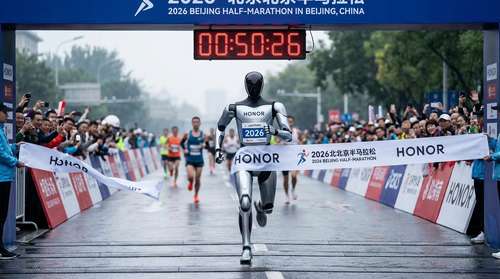
In a jaw-dropping display of synthetic endurance and speed, an Honor humanoid robot named "Lightning" has completely rewritten the boundaries of athletic performance. Competing at the second Beijing E-Town Half-Marathon on Sunday, April 19, 2026, the machine crossed the 13.1-mile finish line in a blistering 50 minutes and 26 seconds. The historic feat marks a monumental AI robotics breakthrough, decisively shattering the human world record of 57 minutes and 20 seconds set by Ugandan distance runner Jacob Kiplimo.
The event hosted 102 robotic teams running on parallel tracks alongside 12,000 human participants. It offered a startling visual for spectators: pristine mechanical athletes finishing unscathed while human runners battled the physical toll of the course. The sweeping victory by Honor's proprietary machine represents a quantum leap in the rapidly evolving landscape of autonomous robotics, signaling that the era of practical, high-performance mechanical counterparts has arrived.
Inside the Honor Lightning Robot Performance
Standing at 1.69 meters (about 5 feet 6 inches) tall, the Lightning robot boasts a sleek, mecha-style aesthetic engineered specifically for explosive speed and balance. Designers at the Chinese consumer tech giant modeled the machine's biomechanics after elite human track stars. They outfitted it with elongated legs measuring up to 95 centimeters to maximize stride length, closely mimicking the physiological advantages of top-tier professional athletes.
Sustaining a sub-four-minute mile pace over 21 kilometers generates immense heat within mechanical joints and computing processors. To combat this, the engineering team—dubbed "Qitian Dasheng"—integrated a state-of-the-art internal liquid-cooling system. Du Xiaodi, a test development engineer for Honor, explained that this proprietary thermal management technology was directly adapted from the company's smartphone division. This advanced cooling mechanism allowed the machine to operate at peak output continuously without thermal throttling, resolving a persistent engineering hurdle in the humanoid robot vs human dynamic.
The Dynamics of the Autonomous Robot Race
The Beijing half-marathon 2026 wasn't merely a brute-force sprint; it was an incredibly complex test of real-time processing and spatial awareness. Organizers split the mechanical entrants into two categories: remote-controlled and fully autonomous navigation. To ensure a fair comparison on the leaderboards, completion times for remote-controlled models were subjected to a 1.2 multiplier penalty.
Interestingly, a remote-controlled variant of the Lightning robot physically crossed the finish line first with a raw, unaided time of just 48 minutes and 19 seconds. However, in accordance with the strict weighting rules, an autonomous variant of the same model secured the official championship crown with its net time of 50 minutes and 26 seconds.
The sheer scale of the event highlighted a maturing industry that is moving far past the prototype phase. Official data indicated that more than 300 robots from 26 different brands hit the pavement. Nearly half of the field managed to complete the demanding course—dodging obstacles, maintaining balance on complex terrain, and resisting physical interference without a single handler needing to intervene.
An AI Robotics Breakthrough Years Ahead of Schedule
To fully grasp the magnitude of the Lightning robot world record, observers only need to look at the results from the inaugural race held just a year prior. In 2025, the winning machine stumbled across the line in an agonizing 2 hours, 40 minutes, and 42 seconds. Shaving nearly two hours off that time in a single 12-month development cycle reflects staggering, systemic advancements in battery power delivery, spatial perception, and dynamic decision-making.
Wang Peng, an associate research fellow at the Beijing Academy of Social Sciences, noted that the robotics sector has transitioned from "barely functional to rapidly approaching practical usability". Spectators along the southern Beijing route were equally stunned. Sun Zhigang, a local attendee who also witnessed the 2025 race, summarized the public sentiment: "It's the first time robots have surpassed humans, and that's something I never imagined".
From the Racetrack to the Factory Floor
While seeing an autonomous robot race crown a new king is a captivating spectacle, the ultimate goal of this technology extends far beyond athletics. The grueling 21.1-kilometer circuit serves as an extreme, public stress test for hardware that will eventually enter the global workforce.
- Industrial Applications: The structural reliability and shock absorption demonstrated over 13 miles of pavement translate directly to rugged manufacturing environments.
- Thermal Management: The liquid-cooling loops that kept Lightning from overheating could allow factory robotics to operate continuously across multiple shifts without required cool-down periods.
- Spatial Navigation: The autonomous dodging and complex pathfinding algorithms utilized to navigate around other runners are the exact safety systems required for seamless human-robot workplace collaboration.
As major tech firms continue to funnel billions into embodied AI, the line separating science fiction from daily reality is rapidly vanishing. Today, the Honor Lightning robot performance has redefined what machines can achieve on the track. Tomorrow, the very same underlying technology powering that record-breaking sprint may be managing our logistics, building our infrastructure, and fundamentally reshaping the modern economy.