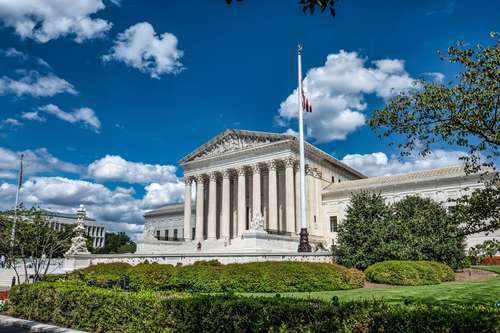
In a thunderous rebuke of executive overreach, the U.S. Supreme Court has declared President Donald Trump’s sweeping global tariffs illegal, ruling 6-3 that the White House lacks the authority to impose broad import taxes without Congressional approval. The landmark decision in Learning Resources v. Trump, delivered Friday morning, immediately invalidates the administration’s use of the International Emergency Economic Powers Act (IEEPA) to levy duties on foreign goods. However, the victory for free-trade advocates may be short-lived: President Trump slammed the ruling as a "disgrace" and immediately announced a new 10% global tariff under the seldom-used Section 122 of the Trade Act of 1974.
Supreme Court Trump Tariff Ruling: A Check on Executive Power
Chief Justice John Roberts authored the majority opinion, joined by Justices Sonia Sotomayor, Elena Kagan, Ketanji Brown Jackson, Neil Gorsuch, and Amy Coney Barrett. The Court held that while IEEPA grants the President significant powers to "regulate" international commerce during national emergencies, it does not explicitly authorize the imposition of tariffs—a power the Constitution reserves exclusively for Congress.
"The power to tax is not a tool to be seized by the executive branch through creative statutory interpretation," Roberts wrote in the majority opinion. "The text of IEEPA authorizes the President to regulate importation, but those words cannot bear the weight of a unilateral global tax regime."
The decision marks a pivotal moment in Trump vs SCOTUS 2026 legal battles, establishing a firm boundary on presidential executive authority trade powers. Justices Clarence Thomas, Samuel Alito, and Brett Kavanaugh dissented, arguing that the broad language of IEEPA should be deferred to the President’s national security judgment.
Trump Vows Defiance with Section 122 Trade Act Tariffs
Within hours of the ruling, President Trump appeared in the White House briefing room to denounce the Court and unveil his countermove. Calling the decision "a total disgrace" and "an attack on American sovereignty," Trump declared he would bypass IEEPA entirely.
"If the Supreme Court wants to play games, we will use the tools Congress actually gave us," Trump said. "Effective immediately, I am signing an order for a 10% universal tariff under Section 122 of the Trade Act of 1974 to stop the bleeding of our national wealth."
Section 122 Trade Act tariffs are designed to address "large and serious" balance-of-payments deficits. Unlike IEEPA, this statute explicitly mentions import surcharges of up to 15%. However, it comes with strict limitations: the tariffs can only remain in place for 150 days unless Congress votes to extend them. This pivot suggests the administration is buying time, potentially setting up a high-stakes showdown with lawmakers later this year.
The Battle Over Reciprocal Tariff Refunds
The ruling has triggered immediate chaos regarding the billions of dollars already collected under the now-illegal IEEPA framework. Importers and business groups are preparing to file for a reciprocal tariff refund, a process that could force the Treasury to pay back an estimated $142 billion collected in 2025.
In his dissent, Justice Kavanaugh warned of the economic shockwave this could cause. "The Court’s decision may require the federal government to refund billions of dollars to importers, creating a fiscal crisis out of a legal technicality," he wrote. The majority opinion did not explicitly order immediate refunds, leaving that complex question for lower courts to untangle in the coming months.
What Is the IEEPA Emergency Powers Court Case?
The IEEPA emergency powers court case focused on whether a 1977 law intended for sanctions could be repurposed for economic protectionism. By declaring Trump global tariffs unconstitutional under this specific act, the Court has forced future administrations to seek clear legislative backing for trade wars. However, the quick pivot to Section 122 shows that the executive branch still has other "break glass in case of emergency" levers to pull.
Economic Fallout and What Comes Next
Markets reacted firmly to the news, with the Dow Jones Industrial Average jumping 400 points on hopes of lower costs, only to pare gains after the Section 122 announcement. Trade experts warn that while the Supreme Court Trump tariff ruling is a constitutional victory, the practical reality for businesses remains volatile.
"The name of the statute has changed, but the tax remains," said Sarah Miller, a trade analyst at the Peterson Institute. "We are moving from an indefinite IEEPA tariff to a temporary Section 122 surcharge. The uncertainty for supply chains is far from over."
As the 150-day clock on the new tariffs begins ticking, all eyes will turn to Congress. Will lawmakers intervene to block the new levy, or will they allow the President's protectionist agenda to stand? The Trump vs SCOTUS 2026 saga may have ended one chapter, but the trade war is far from finished.