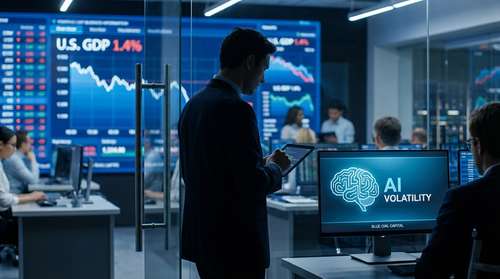
The U.S. economy slammed the brakes in the final quarter of 2025, expanding at a sluggish 1.4% annualized rate, the Commerce Department reported Friday. This sharp deceleration from the blistering 4.4% growth seen in the third quarter has sent shockwaves through global financial markets, already reeling from a deepening crisis in the private credit sector. As Wall Street digests the cooling economic data, a more specific panic is gripping investors: the realization that artificial intelligence may be rapidly making billions of dollars in software loans worthless.
Economic Engines Stall as AI Disruption Widens
The drop to 1.4% GDP growth marks the weakest economic performance since early 2025 and falls well below the 3% forecast by economists. While consumer spending remained positive, it decelerated significantly, weighed down by high borrowing costs and growing uncertainty in the labor market. However, the headline number is almost secondary to the structural tremors emerging in the financial system.
Friday’s report coincides with a massive sell-off in alternative asset managers, triggered by Blue Owl Capital (NYSE: OWL) halting redemptions in one of its flagship private credit funds. The move has crystallized fears of a so-called "SaaSpocalypse"—a scenario where legacy Software-as-a-Service (SaaS) companies, which borrowed heavily from private credit firms, see their business models cannibalized by cheap, autonomous AI agents.
Private Credit's $100 Billion Headache
For years, private credit firms viewed business-to-business software companies as the ultimate safe bet, thanks to their recurring revenue streams. That logic is now being violently tested. Blue Owl Capital, a titan in the direct lending space, found itself at the epicenter of the storm this week after freezing withdrawals for Blue Owl Capital Corp II (OBDC II) following a surge in redemption requests.
"The market is waking up to a terrifying reality: a significant chunk of the software sector is 'legacy' tech that AI renders obsolete overnight," said a senior credit analyst at UBS, which recently estimated that up to $120 billion in private credit assets could be at risk of distress. "Lenders are holding paper on companies whose terminal value might be zero."
Federal Reserve Face Tough Choice on Rate Path
The abrupt economic cooling puts the Federal Reserve in a precarious bind. With inflation largely tamed but growth collapsing, the central bank is under immense pressure to cut interest rates aggressively in 2026. Futures markets have arguably already priced in a panic-response, with traders now betting on a 50-basis-point cut as early as March to stave off a recession.
However, Fed officials have remained cautious. The collapse in tech valuations and the potential for a credit crunch in the shadow banking system complicate their calculus. If the Fed cuts too fast, they risk reigniting inflation; if they wait, the 1.4% growth rate could turn negative by mid-year. The "soft landing" narrative that dominated 2025 is rapidly being replaced by fears of a hard, AI-driven reset.
Blue Owl and the contagion Risk
Blue Owl's stock has plummeted over 16% this week as the firm scrambles to sell $1.4 billion in assets to meet liquidity demands. The contagion has spread to peers like Ares Management and Blackstone, both of which have seen their shares slide as investors scrutinize their exposure to software debt. The fear is not just about one fund, but about a systemic repricing of risk assets that were previously considered immune to economic cycles.
"This isn't just a Blue Owl problem; it's an industry-wide reckoning," noted a distressed debt investor. "When you have AI tools from Anthropic and OpenAI that can replicate a $50-million-a-year software platform for pennies, the debt backing that platform becomes toxic."
What This Means for Investors in 2026
As the dust settles on a chaotic week, the investment landscape for 2026 is shifting. The defensive play of moving into private credit is now fraught with new risks, specifically regarding tech industry disruption risks. Investors are being urged to look under the hood of credit funds to understand their exposure to AI-vulnerable sectors like customer support software, legal tech, and basic coding services.
Meanwhile, the broader economic slowdown suggests that the high-growth era of the post-pandemic recovery is officially over. With GDP growth barely keeping its head above water, cash preservation and exposure to AI-native infrastructure—rather than legacy software—may be the only safe harbors left in a storm that is just beginning to break.