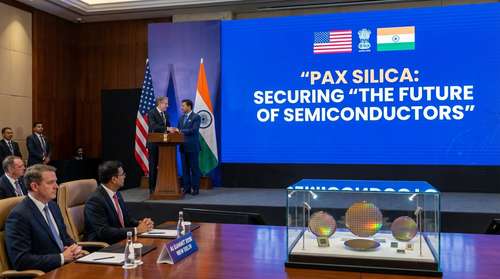
NEW DELHI — In a landmark shift for global technology geopolitics, India officially joined the U.S.-led "Pax Silica" initiative on Friday, cementing a strategic alliance designed to secure the semiconductor supply chain and curb reliance on China-dominated manufacturing. The agreement, signed at the India AI Impact Summit 2026 in New Delhi, marks a pivotal moment in Washington's efforts to build a "coalition of capabilities" with key democratic partners.
Securing the Silicon Stack: A New Era of Tech Diplomacy
The Pax Silica framework, originally launched by the U.S. State Department in late 2025, represents a comprehensive strategy to fortify the entire technology ecosystem—from critical mineral extraction to advanced chip fabrication and AI deployment. By signing the declaration, New Delhi has aligned itself with a bloc that includes Japan, South Korea, the United Kingdom, and Israel, effectively drawing a line in the sand against coercive tech dependencies.
"Pax Silica is not just an agreement; it is the infrastructure of freedom for the 21st century," said U.S. Ambassador to India Sergio Gor during the signing ceremony. "We are building a positive-sum alliance that secures the entire silicon stack—from the mines where we extract critical minerals to the data centers where we deploy frontier AI. India’s entry into this fold is not just symbolic; it is essential."
The deal comes at a critical time for global markets, which have been rattled by recent supply chain weaponization. Under the terms of the agreement, member nations commit to coordinating investment screening, aligning export controls, and jointly developing trusted AI infrastructure that is resilient against foreign interference.
India’s Role: From Consumer to Creator
For India, joining the U.S.-India tech alliance signals a maturation of its "Make in India" ambitions into a global "Design in India" reality. Speaking at the summit, Indian Minister of Electronics and IT Ashwini Vaishnaw highlighted the country's rapid strides in semiconductor engineering, revealing that Indian engineers are already contributing to next-generation 2-nanometer chip designs.
"We are moving beyond assembly. Today, we are partners in creation," Vaishnaw told the assembly of global tech leaders, including Google CEO Sundar Pichai. "This partnership ensures that India’s talent pool will power the democratic world’s AI future, free from the vulnerabilities of the past."
The alliance is expected to accelerate foreign direct investment into India’s burgeoning fab ecosystem. With the global chip manufacturing landscape shifting away from East Asia's concentration, India positions itself as the new trusted hub for logic and memory chip production.
Geopolitical Reset: Beyond the Oil Friction
The signing of the Pax Silica Declaration also serves as a significant diplomatic reset. Relations between Washington and New Delhi had faced strain over India's energy policies and tariff disputes. However, the Trump administration’s recent move to lower reciprocal import tariffs has paved the way for deeper technological integration.
Breaking Chinese Dominance
The core objective of Pax Silica is unmistakable: to dismantle the leverage held by adversaries over the semiconductor supply chain. Currently, China controls a vast share of the processing capacity for rare earth elements essential for chip production. Pax Silica aims to create alternative, secure corridors for these materials, linking Australian mines with Indian processing facilities and American, Korean, and Japanese manufacturing prowess.
U.S. Under Secretary of State for Economic Affairs Jacob Helberg, a key architect of the framework, emphasized the urgency of the mission. "We are replacing coercive dependencies with a coalition of trust," Helberg noted on the sidelines of the summit. "We cannot allow the commanding heights of the future economy—AI and semiconductors—to be held hostage by authoritarian regimes."
The Future of AI Infrastructure Security
Beyond hardware, the alliance places a heavy emphasis on AI infrastructure security. The New Delhi summit showcased joint initiatives to develop "sovereign AI" capabilities that respect data privacy and democratic values. With cyber threats escalating against critical infrastructure, the Pax Silica members have agreed to share threat intelligence and collaborate on standards for safe AI deployment.
As the New Delhi AI Summit 2026 concludes, the message is clear: the tech cold war has moved from rhetoric to rigid alliance structures. By integrating India into the core of Western tech strategy, the U.S. has secured a vital partner in the race for technological supremacy, ensuring that the silicon that powers the future remains in trusted hands.