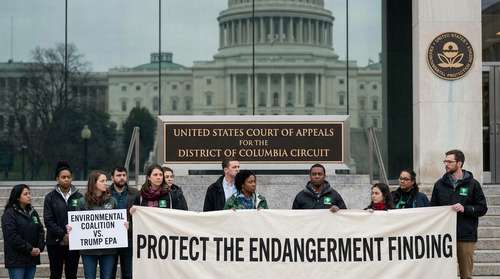
WASHINGTON, D.C. – A massive legal battle over the future of American climate policy began Wednesday as a coalition of 17 major public health and environmental organizations filed a lawsuit against the Environmental Protection Agency (EPA). The suit, filed in the U.S. Court of Appeals for the D.C. Circuit, challenges the Trump administration’s controversial decision to revoke the 2009 “endangerment finding”—the legal bedrock that requires the federal government to regulate greenhouse gas emissions under the Clean Air Act.
The legal challenge comes less than a week after EPA Administrator Lee Zeldin finalized the rescission rule, which he described as the “single largest deregulatory action in U.S. history.” The lawsuit alleges that the EPA’s move to strip away the scientific foundation for climate regulation is “arbitrary, capricious, and unlawful,” setting the stage for a high-stakes showdown that legal experts predict could return to the Supreme Court.
The ‘Nuclear Option’ on Climate Policy
The lawsuit targets what environmental advocates call the “nuclear option” of climate deregulation. On February 12, Administrator Zeldin signed a final rule formally revoking the 2009 endangerment finding, which had determined that six greenhouse gases—including carbon dioxide and methane—threaten public health and welfare. By rescinding this finding, the EPA has effectively removed its own legal authority and obligation to set emissions standards for vehicles, power plants, and industrial sources.
“The Trump EPA is attempting to rewrite history and ignore physics,” said a spokesperson for the Natural Resources Defense Council (NRDC), one of the lead plaintiffs. “The science that underpinned the 2009 finding has only become stronger. Revoking it doesn’t change the reality of the climate crisis; it simply abdicates the government’s responsibility to protect Americans from it.”
In his announcement last week, Zeldin framed the rollback as an economic liberation for American industry. “The endangerment finding has been the Holy Grail of the climate change religion for 16 years,” Zeldin stated at a White House press conference. “By eliminating it, we are saving American taxpayers over $1.3 trillion and restoring consumer choice to the auto market.”
Legal Arguments: Science vs. Statutory Authority
The coalition’s filing argues that the EPA’s action violates the Clean Air Act and ignores the Supreme Court’s landmark 2007 ruling in Massachusetts v. EPA. That ruling established that greenhouse gases fit the definition of an “air pollutant” under the Clean Air Act and that the EPA must regulate them if they are found to endanger public health.
Legal analysts suggest the Trump administration is trying to thread a narrow needle. Rather than attacking the climate science directly—a strategy that has failed in previous courts—the new Clean Air Act 2026 interpretation offered by the EPA argues that the agency lacks the congressional authority to address global climate change through the 1970 statute. The agency’s “Rescission Rule” claims that the 2009 finding relied on a “profound misreading” of the law.
However, the environmental groups contend that the EPA cannot simply choose to ignore the massive body of scientific evidence accumulated over the last two decades. The lawsuit asserts that the agency failed to provide a “reasoned explanation” for disregarding the health risks posed by rising temperatures, essentially arguing that the rollback is politically motivated rather than fact-based.
A Broad Coalition Takes Aim
The legal challenge represents a unified front of the nation's most powerful environmental and health advocacy groups. Plaintiffs include the Sierra Club, the Environmental Defense Fund (EDF), the Union of Concerned Scientists, and the American Lung Association. The inclusion of public health groups highlights the plaintiffs' strategy to frame the Trump EPA lawsuit as a matter of immediate public safety, not just abstract environmentalism.
“This isn’t just about polar bears or future generations anymore,” said Harold Wimmer of the American Lung Association in a statement Wednesday. “Repealing the endangerment finding weakens protections against air pollution that triggers asthma attacks, heart attacks, and premature deaths today. The EPA is legally required to protect human health, and they are walking away from that duty.”
Implications for the Auto Industry
The immediate impact of the environmental regulations rollback is most visible in the transportation sector. Along with the endangerment finding, the EPA has moved to nullify all federal greenhouse gas emission standards for vehicles from model years 2012 onward. This creates a chaotic landscape for automakers, who have spent billions transitioning to electric and hybrid fleets based on the previous regulatory regime.
While some industry voices have welcomed the deregulation, others fear it will lead to a fractured market. California, which has its own Clean Air Act waiver to set stricter standards, has already signaled it will join the legal fight. Governor Gavin Newsom stated last Thursday that California “will not stand by” and intends to defend its right to regulate vehicle emissions, potentially splitting the U.S. auto market into two separate regulatory standards.
What Comes Next in the D.C. Circuit
The D.C. Circuit Court climate suit is expected to be fast-tracked given the magnitude of the regulatory shift. The environmental groups are likely to seek an emergency stay to prevent the EPA from dismantling existing enforcement mechanisms while the case proceeds. Legal scholars anticipate that this battle will ultimately serve as a test case for the current Supreme Court’s willingness to revisit the Massachusetts v. EPA precedent.
For now, the filing of this massive lawsuit marks the beginning of a protracted legal war. As the Trump administration moves to dismantle the legacy of the last 16 years of climate policy, environmental groups are banking on the courts to uphold the scientific and legal consensus that greenhouse gases are a danger that the government cannot simply choose to ignore.