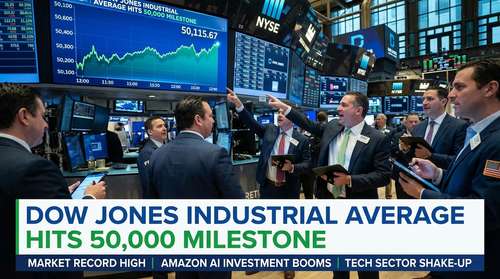
NEW YORK (Feb. 8, 2026) – The Dow Jones Industrial Average has officially shattered the 50,000 ceiling, a historic psychological barrier that underscores the resilience of the American economy despite lingering questions over Big Tech’s capital spending. The blue-chip index closed at a record 50,115.67 on Friday, capping a volatile week where old-economy stalwarts picked up the slack for stumbling tech giants.
A Historic Victory for Wall Street
The Dow Jones 50000 milestone marks a defining moment for the post-pandemic market, arriving faster than many analysts predicted. While the road to 40,000 was paved by rapid interest rate cuts, the push to 50,000 has been driven by a "broadening out" of the rally. Investors are increasingly rotating capital beyond the "Magnificent Seven" into industrial and financial sectors, betting on a sustained economic soft landing.
"At 50,000, the Dow grabs headlines, but it really reflects a market that is buying into the broader U.S. growth story," said Patrick O'Hare, an analyst at Briefing.com. The sentiment was echoed across the political spectrum, with President Donald Trump taking to social media to declare, "CONGRATULATIONS AMERICA!" as the ticker crossed the threshold.
Amazon's $200 Billion AI Gamble
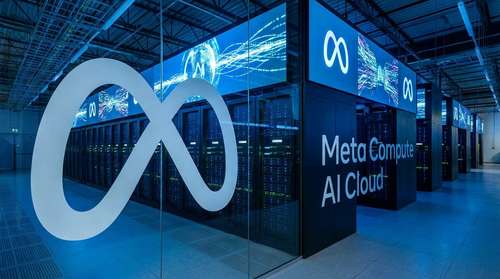
Ironically, the Dow's record-breaking run occurred despite a sharp sell-off in one of its newest and largest components. Amazon (AMZN) shares tumbled nearly 6% on Friday after the company announced a staggering $200 billion capital expenditure plan for 2026. The figure, which is roughly 50% higher than its 2025 spend, is almost entirely earmarked for Amazon AI investment infrastructure, including data centers and custom silicon.
CEO Andy Jassy defended the aggressive spending during the earnings call, framing it as a "unique opportunity to forever change the size of AWS." However, Wall Street signaled caution, fearing that the return on investment for such massive AI outlays remains years away. The divergence—Amazon falling while the Dow rises—highlights a shift in market dynamics where investors are no longer solely dependent on Big Tech to drive index gains.
Blue-Chip Tech Stocks and Industrial Leaders Rally
While Amazon stumbled, other Dow components surged to carry the index across the finish line. Nvidia (NVDA) rallied 8%, proving that appetite for AI chipmakers remains insatiable. Meanwhile, Caterpillar (CAT) jumped 7%, serving as a proxy for industrial strength and optimism about domestic construction and infrastructure projects.
Easing Inflation and the Fed's Next Move
Fueling the run to Dow 50k milestone is a stabilizing macroeconomic backdrop. Inflation has cooled to approximately 2.7%, down significantly from the highs of the early 2020s, allowing the Federal Reserve to maintain a target rate range of 3.5% to 3.75%. Although the Fed paused rate cuts in January 2026 to assess labor market data, the consensus is that the "emergency" phase of monetary policy is over.
"That tells us confidence is real, and 2026 will be less about the Fed and more about fundamentals," noted Gina Bolvin of Bolvin Wealth Management. With the 10-year Treasury yield stabilizing, equities have become increasingly attractive relative to bonds, pushing capital into blue-chip tech stocks and dividend-paying value names alike.
What Lies Ahead for the 2026 Business News Cycle?
As traders return to their desks this week, the question remains whether the stock market record high can hold. Some analysts warn that the 50,000 level is merely psychological and that valuations remain stretched. The S&P 500 and Nasdaq are also hovering near records, but the divergence in performance between hardware providers (like Nvidia) and software/cloud giants (like Amazon and Salesforce) suggests a more selective stock-picking environment is emerging.
For now, Wall Street is celebrating. The Dow has doubled in value in less than a decade, a testament to the compounding power of corporate earnings and the relentless innovation of the U.S. economy. As AI infrastructure spending ramps up to unprecedented levels, the market is betting that the productivity boom of the late 2020s is just getting started.