In every debate about AI and the future of work, there always comes a moment when someone in the room throws out the seemingly winning argument: "Relax, we've seen this movie before. It's called the Industrial Revolution."
They will mention with a patronizing smile the "Luddites"—those 19th-century textile workers who smashed weaving machines because they feared for their jobs. "History proved them wrong," they will say. "Technology may have killed old professions, but it created many new ones, increased productivity, and made us all richer. AI is just another fancy weaving machine."
On the surface, it sounds reassuring. Logical. Historical.
But this argument ignores the single difference that changes the entire picture. The difference that makes this revolution unlike anything we have ever known. And this difference is summed up in one chilling sentence by Nobel Prize-winning economist Wassily Leontief:
"The role of humans as the most important factor of production is bound to diminish in the same way that the role of horses in agricultural production was first diminished and then eliminated by the introduction of tractors."
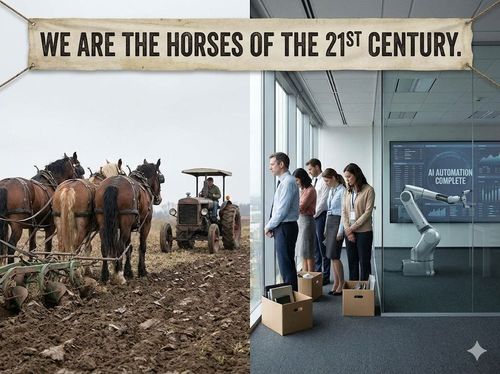
In 1900, the horse was the engine of the global economy. It plowed the fields, hauled the goods, and transported the people. If we could have asked an average horse what it thought about the invention of the internal combustion engine, it probably would have been optimistic: "This engine will help me! It will do the hard work, and I can focus on more complex tasks. Maybe I'll be a foreman for tractors."
We know how that ended. The horses didn't get better jobs. The horse population simply collapsed, and the survivors became pets for the rich. The tractor wasn't a "tool" for the horse; it was its replacement.
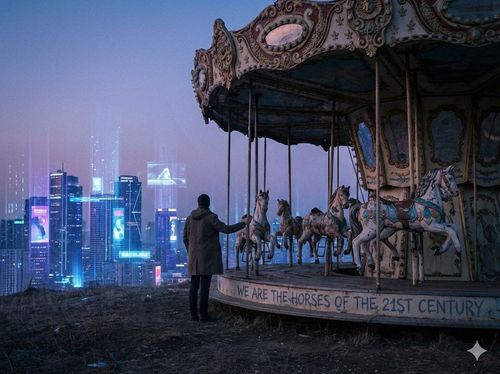
Today, we are the horses.
The Ladder is Gone: Why There is Nowhere to Run
The reason the Industrial Revolution succeeded in improving the human condition was that we had a distinct comparative advantage over the machine: The Brain.
When the machine replaced human muscle, humanity got an "Upgrade." We climbed a rung on the evolutionary ladder. Instead of digging ditches with a shovel, we learned to engineer tractors. Instead of copying books by hand, we learned to write journalism and develop software. We moved from manual labor to head labor (cognition).
But what happens when technology arrives to replace the brain itself?
Artificial Intelligence is not here to replace our hands, but to replace the last comparative advantage we have left: the ability to think, analyze, create, and plan. If the machine is physically stronger than us, and now also cognitively smarter than us—what rung of the ladder are we supposed to climb to?
We don't have a hidden "super-brain" that the machine lacks. When the machine takes over "thinking," the ladder ends. Humans are pushed into a corner, just like the horse before them.
The Valley of Death of the Transition Generation
But even if we assume, for the sake of argument, that the optimists are right. Let's assume that in 50 years humanity will reach a utopia of abundance where robots do everything and we live in paradise on earth. That still doesn't comfort us. Why? Because of "Engels' Pause."
Economic historians show that between 1790 and 1840—the first fifty years of the Industrial Revolution in Britain—the situation was catastrophic. National GDP soared and technology raced forward, but the real wages of workers froze and even declined. Living conditions in cities became a hell of overcrowding and disease, the life expectancy of the working class plummeted, and community security collapsed.
It took humanity two generations of suffering, pollution, and social alienation until it learned to build the institutions (labor laws, sewage systems, modern democracy) that would distribute the new wealth in a way that benefited everyone.
The grandfather suffered so the grandson could live in abundance.
Our tragic problem is that we are the grandfather. We are the transition generation.
We are the generation that must cross the "Valley of Death": the period when old systems (careers, pensions, professional identity) collapse under the burden of technology, and new systems have not yet been built. Even if AI cures cancer in 40 years, the road there is paved with economic and mental fractures that we will absorb in the here and now. Optimism about the distant future is a privilege of historians; survival in the present is our mission.
Speed Kills: No Time to Adapt
And this time, we have another enemy that the Industrial Revolution didn't have: Velocity.
The transition from agriculture to industry and then to services spanned nearly 100 years. There was time. A grandfather who was a farmer had a son who became a factory worker, and a grandson who became a lawyer. There was time for the education system to change, for society to adapt, and for the labor market to create new professions.
The AI revolution does not grant us this privilege. It is happening at an exponential rate of months and years. A 45-year-old truck driver losing his job to an autonomous vehicle, or a 30-year-old programmer losing his job to GitHub Copilot, cannot reinvent themselves within a year. Human biology and human society are linear and slow; technology is exponential and fast. This gap creates a social fracture unlike any other.
Moreover, software has a terrifying feature that no industrial machine had: Zero Marginal Cost.
In previous revolutions, technology was a "tool" that required an operator. A person was needed at the lathe. AI is an Agent. It acts alone. Once there is software that knows how to write code or diagnose a disease, the cost to replicate it is zero. You can create a million "virtual workers" with the push of a button for the cost of electricity alone. This creates a deflation of human labor value to a level we have never known.
Conclusion: Seizing the Future from the Few
So what is the difference between us and the horses?
The horses couldn't speak. They couldn't organize. They didn't have the right to vote. We do.
The greatest danger right now is not the technology itself, but the silence with which we accept it. We are allowing a tiny handful of CEOs in California to decide for 8 billion people what the future of the human species will look like, with no oversight, no public debate, and no democratic mandate.
The first step in survival is to bring this into the conversation.
We must take this discussion out of the server rooms and closed tech conferences. This issue must rise to the public agenda, to parliamentary votes, and to demands for regulation that protects the human, not just the profit.
We cannot allow the future of humanity to be determined as an afterthought by an algorithm or a P&L report. If we do not demand to take part in decision-making now, we will very quickly discover that the only decision left for us is what color our stable will be.