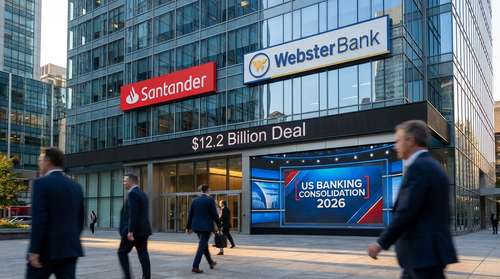
In a landmark move that signals a major shift in the American financial landscape, Santander Holdings USA has announced a definitive agreement to acquire Connecticut-based Webster Financial Corporation for approximately $12.2 billion. The deal, revealed earlier this week, represents one of the largest banking takeovers of 2026 and is set to catapult the Spanish banking giant’s US subsidiary into the top tier of American financial institutions.
The Santander Webster Bank merger will create a combined entity with approximately $327 billion in assets, effectively positioning the new organization as a top-10 retail and commercial bank in the United States. This aggressive expansion strategy underscores Santander’s renewed commitment to the US market at a time when US banking consolidation 2026 is accelerating rapidly. For investors and industry watchers, this acquisition is a clear signal that the "deal drought" of previous years has officially broken.
Inside the $12.2 Billion Acquisition Details
Under the terms of the agreement, shareholders of Webster Financial (NYSE: WBS) will receive a mix of cash and stock valued at approximately $75 per share. The consideration structure includes $48.75 in cash and 2.0548 Santander American Depositary Shares (ADS) for each Webster common share held. This offer represents a premium of approximately 14-16% over Webster’s volume-weighted average share price leading up to the announcement.
"This transaction is strategically significant for our U.S. business," stated Ana Botín, Executive Chair of Banco Santander, emphasizing that the deal will strengthen the bank's franchise in both scale and profitability. The transaction is expected to close in the second half of 2026, subject to customary regulatory approvals in both the US and Europe, as well as approval by Webster shareholders.
Leadership and Integration Plans
Upon closing, the leadership structure will blend talent from both organizations. Christiana Riley will continue to serve as Santander’s US Country Head and CEO of Santander Holdings USA. Meanwhile, Webster’s current CEO, John Ciulla, is slated to become the CEO of the combined Santander Bank N.A. entity. This move suggests Santander is keen to leverage Webster’s strong domestic management team to navigate the competitive US market.
Strategic Rationale: Why Webster?
For Santander, the Webster Financial takeover news is about more than just adding assets; it is about geographic dominance and diversification. Webster Bank has long been a powerhouse in the Northeast, with a dense network of over 200 banking centers across Connecticut, Massachusetts, Rhode Island, and the New York metro area. This footprint perfectly complements Santander’s existing presence, filling in key gaps and solidifying a massive regional stronghold.
Beyond geography, Webster brings specialized business lines that are highly attractive. The bank is a leader in Healthcare Financial Services and commercial banking, sectors where Santander is eager to expand. The companies project approximately $800 million in cost synergies, driven by the integration of technology systems and the optimization of branch networks.
The 2026 Banking Consolidation Wave
This deal is not happening in a vacuum. It is a headline event in a broader trend of US banking consolidation 2026. After a period of regulatory uncertainty and high interest rates that stifled deal-making in 2024 and 2025, the floodgates have opened. Mid-sized regional banks are increasingly seeking partners to manage rising technology costs and regulatory compliance burdens.
Analysts note that this acquisition could trigger a domino effect, prompting other mid-cap banks to seek mergers of equals or buyers to remain competitive against the "megabanks." With banking stocks to watch 2026 becoming a hot topic, investors are now scrutinizing other potential targets in the $50 billion to $100 billion asset range.
What This Means for Customers
For the immediate future, it is business as usual. Santander US expansion plans typically involve a careful, phased integration process. Until the deal formally closes later this year, Webster Bank branches and apps will operate independently. Post-closing, customers can expect a rebranding effort and access to a significantly larger network of ATMs and branches, along with Santander’s global banking capabilities.
This merger promises to bring the "best of both worlds"—Webster’s high-touch, community-focused service model combined with Santander’s global capital and digital infrastructure. However, as with any large-scale merger, customers will be watching closely for how service quality is maintained during the transition.