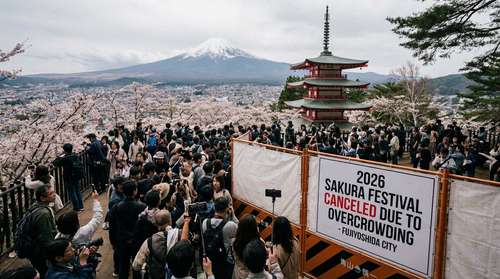
In a stunning blow to spring travel plans for thousands of international visitors, officials in Fujiyoshida have abruptly canceled the 2026 Arakurayama Sengen Park Cherry Blossom Festival. The decision, announced earlier this week by Mayor Shigeru Horiuchi, marks a significant escalation in Japan’s ongoing battle with overtourism. Citing unmanageable crowds that have "threatened the quiet lives of citizens," the city has pulled the plug on the decade-old event, leaving travelers scrambling to adjust their Japan travel 2026 itineraries.
The End of a Decade-Long Tradition
For the past ten years, the Arakurayama Sengen Park Cherry Blossom Festival has been the crown jewel of Yamanashi Prefecture’s spring calendar. The site is world-famous for its singular, postcard-perfect view: the five-story Chureito Pagoda floating above a sea of pink sakura, with the snow-capped majesty of Mount Fuji dominating the background. It is an image that has graced countless guidebooks and Instagram feeds, drawing over 270,000 visitors annually to a town of fewer than 50,000 people.
However, the city government revealed on Tuesday that the 2026 festival would not go ahead. "Behind Mount Fuji's beautiful landscape is the reality that the quiet lives of citizens are threatened," Mayor Horiuchi stated in a press conference. "We have a strong sense of crisis. To protect the dignity and living environment of our citizens, we have decided to bring the curtain down on the festival."
This cancellation effectively removes the organized infrastructure—including food stalls, stage events, and temporary tourist support—that typically accommodates the massive influx of visitors during the hanami (flower viewing) season.
"Defecating in Private Yards": The Reality of Overtourism in Japan
The reasons behind the cancellation paint a grim picture of the friction between mass tourism and local life. City officials detailed a litany of grievances that went far beyond simple overcrowding. As the yen remains weak, driving record numbers of foreign tourists to Japan, the behavior of some visitors has reportedly crossed the line into harassment and vandalism.
According to the city's statement, residents have been plagued by tourists trespassing on private property to find photo angles or shortcuts. More disturbingly, officials cited repeated incidents of visitors opening the doors of private homes to use the restrooms without permission. There were also reports of tourists "defecating in private yards" and "raising a fuss" when homeowners confronted them.
Traffic congestion has become chronic, paralyzing local roads and making it difficult for emergency vehicles to operate. In some cases, massive crowds on narrow sidewalks have physically pushed local schoolchildren into the street, creating dangerous safety hazards. The accumulation of these incidents led the municipal government to conclude that the city simply could not sustain the event any longer.
What This Means for Fujiyoshida Sakura Festival Visitors
For travelers planning to visit the Fujiyoshida sakura festival this spring, the situation is complex. While the "festival" is canceled, Arakurayama Sengen Park itself is a public space. However, the experience will be drastically different from previous years.
Expect Reduced Access and Strict Security
Without the festival designation, the festive atmosphere of food vendors and cultural performances will be absent. Instead, visitors can expect a heavy security presence aimed at enforcing rules and protecting local property. The city has indicated it will wipe the festival's name from official tourism websites to discourage attendance.
Despite the cancellation, officials privately acknowledge that Mount Fuji tourism restrictions may not stop everyone. "Mammoth crowds" are still anticipated, and queues for the famous observation deck could still stretch up to three hours. Travelers should be prepared for a less welcoming environment, with strictly enforced barriers and potentially limited access to public facilities like restrooms, which were previously supplemented by the festival organizers.
A Broader Trend of Restrictions
The situation in Fujiyoshida is not an isolated incident. It reflects a growing trend of overtourism in Japan leading to restrictive measures across the country. In Kyoto, the Gion district has banned tourists from certain private alleys to protect Geisha from harassment. Similarly, another town near Mount Fuji, Fujikawaguchiko, made headlines last year for erecting a black barrier to block a view of the mountain outside a Lawson convenience store that had become a chaotic photo spot.
These measures signal a shift in Japan's tourism strategy. The goal is moving away from sheer numbers toward sustainable tourism that respects local communities. For Japan spring travel 2026, this means visitors must be more mindful than ever. The "golden route" destinations are reaching breaking point, and local patience is wearing thin.
Alternatives for Spring 2026
If your heart was set on the Chureito Pagoda view, you might want to reconsider. The risk of long waits, hostility, and a lack of facilities could mar the experience. Fortunately, Japan is filled with breathtaking cherry blossom spots that are less overrun.
Consider visiting the Tohoku region in northern Japan, where cherry blossoms bloom later (mid-to-late April) and crowds are significantly thinner. Places like Hirosaki Castle offer spectacular sakura views with a fraction of the chaos found near Mount Fuji. Alternatively, the Izu Peninsula offers early-blooming Kawazu sakura in a more relaxed coastal setting. By stepping off the beaten path, you not only ensure a more peaceful trip but also help alleviate the pressure on Japan's most beleaguered communities.