For three decades, the Western world lived inside a bubble of one great promise: "Education is salvation." We were sold the "Great Lie of the Knowledge Economy," a narrative in which the world divides cruelly but "fairly": those who use their muscles are left behind; those who use their brains rule. Based on this assumption, we built our education systems, our expectations for our children, and our entire social ladder. We believed the keyboard was mightier than the hammer, and that code was stronger than concrete.
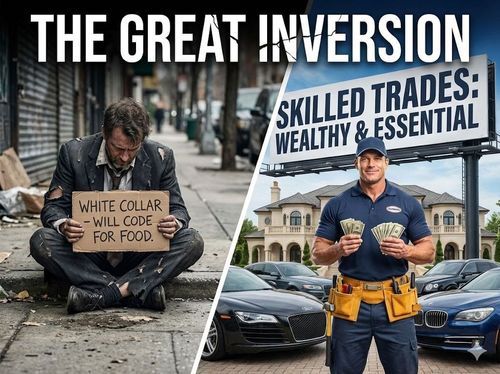
But in 2026, we stand stunned before "The Great Inversion."
Reality has flipped on its head. Artificial Intelligence did not arrive to take the "menial" and dangerous jobs as early science fiction promised. Robots are not cleaning streets, and AI is not washing dishes in restaurants. On the contrary: technology arrived first to take the most prestigious, desirable, and "Western" jobs of the middle class.
In the previous article, we asked, "What the hell is going on?" In this piece, we will try to understand who will survive what is going on, and why the global order, occupational, political, and mental, is about to be turned upside down.
The White-Collar Massacre: The Revenge of the Physical World
The tragic irony of history is that the very people who felt most protected, those who followed the "right path," earned advanced degrees, and secured spots in air-conditioned offices, are currently the most exposed to the digital guillotine.
This is the brutal realization of "Moravec’s Paradox": it is terrifyingly easy to teach a computer to perform complex cognitive tasks like winning at chess, drafting a legal contract, or writing code, but it is impossibly difficult to teach a robot to fold laundry or fix a leak under a sink. The physical world, with its chaos, dirt, and unpredictability, remains humanity's last fortress.
The result is an inversion of the social hierarchy. A lawyer charging hundreds of dollars an hour, a programmer writing algorithms, or an accountant analyzing reports, all discover at once that their skills have become a cheap and infinite commodity. Prestige is shifting from the keyboard to the screwdriver. Parents who pushed their children to study law and computer science prepared them for a world that no longer exists.
Techno-Feudalism: The Return of Lords and Serfs
But the occupational fracture is just the tip of the iceberg. Beneath the surface, the entire economic structure is shifting and reverting to the Middle Ages. If the primary "capital" of the middle class was its cognitive ability and professional knowledge, then the moment the value of that capital plummets to zero, the class itself effectively ceases to exist.
We are marching with eyes wide open into an era of Techno-Feudalism.
In this new society, humanity is re-dividing into two distinct classes: on one side, a tiny handful of "New Lords", the owners of the algorithms, server farms, and data, who hold the modern means of production. On the other side, a vast mass of "Digital Serfs", people who have lost their relative advantage. They are not unemployed in the old sense; they are simply "unneeded."
In this model, private ownership dies for the masses. We are moving to a life of "subscription fees." You don't buy a home, you rent "living space as a service"; you don't buy a car, you pay for usage; you don't buy software, you rent access. The economic fracture we discussed in the previous article ("The Asset-less Generation") is not a bug in the system, but its central feature. The new serf is entirely dependent on the system's grace and subsistence allowances, with no ability to accumulate real capital.

The Geopolitical Shift: Why Dictatorships Will Win
The greatest danger lurks for the political structure we are so proud of: Liberal Democracy. In the 20th century, Western democracies defeated fascism and communism for a simple economic reason: Efficiency.
The liberal system knew how to maximize Human Capital better than any other system. When a person has freedom of thought and rights, they are more creative, inventive, and productive. The human being was the most valuable asset ("Profit Center"), and democracy was the best business model for extracting that profit.
But what happens in the AI era, when this equation flips?
What happens when the average person turns from a "Profit Center" into a "Cost Center"? If Artificial Intelligence generates most of the economic value, the competitive advantage of freedom is erased. Suddenly, a democracy that grants individual rights, freedom of speech, minimum wage, and social benefits becomes "expensive maintenance" for unnecessary human capital.
In this state of affairs, dictatorships hold a terrifying advantage. Regimes like China’s, which are built from the start on top-down population management, strict surveillance, and obedience, are far better equipped to deal with masses of economically "redundant" people. Western democracy, built on the sacred assumption that every citizen has value and a unique contribution, may find itself collapsing under the economic and moral burden of its own citizens.

The Existential Conclusion: The Death of the Individual
And this is the deepest and most painful point of all. The Great Inversion strikes at the very core of Western identity and shatters it.
To understand the magnitude of the fracture, one must look at the abysmal difference between the West and the rest of the world in defining the "Self." The Western person defines themselves almost exclusively through their doing. The first question at any social gathering in New York, London, or Tel Aviv is, "So, what do you do?" Our identity is built layer upon layer on our education, our career, and our personal achievements. We are "individuals" who accumulate self-worth through utility and creation.
In contrast, the non-Western person (traditional or tribal) defines themselves through their belonging. "I am the son of...", "I belong to tribe X", "I believe in religion Y". Their value stems not from what they do, but from what they are part of.
The Tragedy of the Western Individual:
What happens to the Western individual when work is taken from them? When AI writes, diagnoses, analyzes, and creates better than them?
In an instant, the ground is pulled out from under their feet. They stand before an empty mirror with no answer to the question "Who am I?", because their whole life they were taught that they equal what they produce. When there is no production, there is no "I." This is why we see the dramatic spike in mental illness, suicide, and loss of direction in the West. It is not just economic unemployment; it is a bankruptcy of the soul.
The inevitable conclusion is that we are facing The Death of the Individual.
The short era in history where a person could define themselves in isolation from their community, relying only on their talent and money, has ended. In a world without personal economic value, a person has no right to exist as a solitary individual. The only value one can receive is Group Value.
To survive the chaos of the coming decade, both mentally and physically, humans will have to give up the individual ego and return to the old, safe structures: the community, the extended family, religion, and the political tribe. Only the group can grant a person meaning ("You matter because you are part of us"), and only the group can grant them protection against the New Lords.
The era of the "I" is over. But here lies the final warning: history teaches us that when a person gives up the self, and seeks meaning solely through the group, dark times are sure to follow.