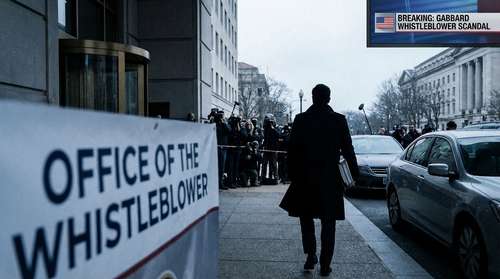
A massive political firestorm has erupted in Washington this week as details emerge regarding a high-stakes Tulsi Gabbard whistleblower scandal that reaches the highest levels of the U.S. intelligence community. A top-secret whistleblower complaint, suppressed for nearly eight months, alleges that Director of National Intelligence (DNI) Tulsi Gabbard personally intervened to block the dissemination of critical intelligence involving Iran and a member of the Trump inner circle. The explosive report, which involves intercepted communications from May 2025, has triggered an immediate crisis within the Capitol, prompting the Senate Intelligence Committee to demand answers regarding what critics are calling a calculated effort to suppress vital national security information.
The Core Allegation: DNI Intelligence Complaint on Iran
At the heart of the controversy is a classified intercept captured by the National Security Agency (NSA) in May 2025. According to reports surfacing in the last 48 hours, the intelligence captures a conversation between two foreign nationals discussing an individual described as a close associate of President Trump. The dialogue explicitly referenced DNI intelligence complaint Iran matters during a volatile period when the administration was weighing military strikes on Iranian nuclear facilities.
Sources familiar with the whistleblower’s disclosure allege that rather than following standard distribution protocols, DNI Gabbard took the unprecedented step of physically removing the report from normal channels. It is alleged that she hand-delivered a paper copy directly to White House Chief of Staff Susie Wiles and subsequently instructed NSA officials to halt any further circulation of the material. This direct intervention effectively buried the intelligence for eight months, shielding it from congressional oversight committees that are legally entitled to such "urgent concern" disclosures.
Gabbard Whistleblower Lawyer Andrew Bakaj Strikes Back
The disclosure has been brought to light largely through the aggressive legal maneuvering of Gabbard whistleblower lawyer Andrew Bakaj, a veteran attorney who previously represented the whistleblower in the first Trump impeachment. Bakaj, representing the anonymous intelligence official, has publicly accused the Office of the Director of National Intelligence (ODNI) of stonewalling and violating federal law by failing to transmit the complaint to Congress within the statutory seven-day window.
"The law is clear," Bakaj stated in a letter to congressional leadership. "When a whistleblower makes a complaint of urgent concern, the system is designed to ensure Congress is informed. That process was hijacked." On February 4, 2026, Bakaj escalated the standoff by threatening to provide an unclassified briefing to lawmakers if Gabbard’s office did not provide the necessary security guidance. This ultimatum appears to have forced the hand of the Inspector General, leading to the sudden release of the complaint to the "Gang of Eight" late Tuesday night.
Classified Intelligence Suppression 2026: A Partisan Battleground
The revelation of classified intelligence suppression 2026 has instantly polarized the Senate Intelligence Committee. Following a classified review of the documents, the reaction has been split sharply down party lines, foreshadowing a brutal confirmation battle and potential oversight hearings. Senator Mark Warner (D-VA), Chairman of the Senate Intelligence Committee, described the eight-month delay as an "effort to bury" the complaint, questioning why a report filed in May 2025 is only reaching oversight bodies in February 2026.
Conversely, Republican allies have rallied around the DNI. Senator Tom Cotton (R-AR) dismissed the allegations after reviewing the materials, asserting that the complaint was "not credible" and politically motivated. The ODNI has officially denied any wrongdoing, with a spokesperson stating that "every single action taken by DNI Gabbard was fully within her legal and statutory authority." They argue the delay was due to complex executive privilege concerns and the highly sensitive nature of the intercepts.
Trump Inner Circle Iran Probe: The Stakes
The timing of the suppressed intelligence adds a layer of extreme sensitivity to the Trump inner circle Iran probe. The intercepted call occurred just weeks before the U.S. launched strikes against Iranian nuclear infrastructure—a decision that was reportedly contested within the administration. The fact that foreign actors were discussing a Trump associate in the context of these tensions raises serious counterintelligence questions: Was sensitive operational information being discussed? Was a member of the President's orbit compromised?
Intelligence analysts point out that the suppression of this report denied policymakers a full picture of the geopolitical landscape during a critical military engagement. If the U.S. Director of National Intelligence controversy is proven to involve the protection of political allies over national security interests, it could represent one of the most significant breaches of the intelligence community's independence in decades.
What Comes Next?
As the Senate Intelligence Committee hearing 2026 cycle heats up, pressure is mounting for a public testimony. While the "Gang of Eight" has seen the documents, the rank-and-file members of the intelligence committees are demanding full access. The Inspector General, Christopher Fox, finds himself in the crosshairs, having to explain why his office administratively closed the case last June before reopening it under intense legal pressure. With the whistleblower determined to speak and Congress demanding answers, Washington is bracing for a prolonged and damaging showdown over the politicization of American intelligence.