February 19, 2026 – A massive surge in corporate spending on artificial intelligence infrastructure is driving the US stock market toward uncharted territory. Led by a new strategic alliance between Nvidia and Meta Platforms, the S&P 500 rallied significantly on Wednesday, closing just points away from a fresh all-time high. The catalyst: updated projections indicating that Big Tech’s collective capital expenditure (CapEx) for 2026 will exceed a staggering $650 billion, a figure that has ignited both investor euphoria and deep-seated concerns over market sustainability.
The $650 Billion Infrastructure Spree
The scale of investment currently being deployed by the industry's four largest players—Amazon, Microsoft, Alphabet, and Meta—is unprecedented in modern economic history. New filings and analyst reports confirm that these "hyperscalers" are on track to spend over $650 billion combined this year, primarily to build the data centers and power grids required to run next-generation AI models. This represents a roughly 60% increase from 2025 levels.
Amazon leads the pack with a projected $200 billion earmarked for logistics and cloud infrastructure, followed closely by Alphabet at $185 billion and Meta at roughly $135 billion. "We are witnessing an industrial revolution in code," said Gil Luria, a senior technology analyst. "These companies view this spending not as a choice, but as an existential necessity. To stop building is to concede the future."
Nvidia and Meta: A Titan Partnership
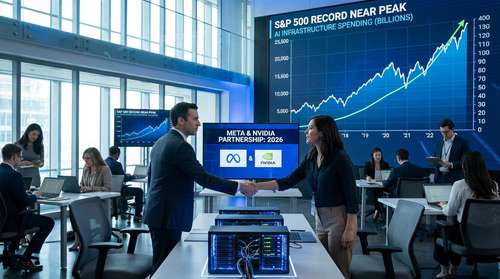
Fueling the immediate market rally was the February 18 announcement of a deepened multi-year partnership between Meta and Nvidia. The agreement will see Meta integrating Nvidia’s full technology stack—including the highly anticipated Rubin and Blackwell GPUs—into its "Meta Superintelligence Labs."
Meta CEO Mark Zuckerberg stated the collaboration aims to deliver "personal superintelligence" to billions of users. For investors, the deal served as a concrete signal that demand for Nvidia’s hardware remains insatiable. Nvidia stock climbed over 2.3% following the news, acting as the primary engine lifting the broader S&P 500 index to approximately 6,900 points.
Hardware Booms, Software Stalls?
While the hardware sector celebrates, a distinct divide is emerging in the market. The massive capital inflows are benefitting chipmakers and data center constructors, but software companies are facing intensified scrutiny. Investors are increasingly asking when the massive infrastructure build-out will translate into profitable software applications.
This "capital misallocation" fear has caused volatility for pure-play software stocks, which have lagged behind their hardware counterparts. Market analysts note that while Nvidia and Broadcom are trading near record highs, software indices remain mixed as Wall Street waits for evidence of AI-driven revenue expansion beyond the cloud providers themselves.
Bubble Concerns and Market Realities
Despite the rally, the mood on Wall Street is not without caution. The sheer velocity of spending has drawn comparisons to previous market bubbles. Economists at firms like Capital Economics have warned that while the AI narrative is powerful, the disconnect between infrastructure spending and immediate revenue generation could lead to a correction later in 2026.
However, the prevailing sentiment for February remains bullish. The "FOMO" (fear of missing out) trade is alive and well, with institutional investors unwilling to bet against a technology wave that is reshaping the global economy. As of today, the S&P 500 stands resilient, buoyed by the belief that Big Tech’s $650 billion bet is the down payment on a more productive global economy.
"The market is pricing in a transformation, not just a trend," noted a strategist from Wedbush Securities. "Volatility is the price of admission, but the direction of travel—toward a more automated, AI-driven world—is undeniable."