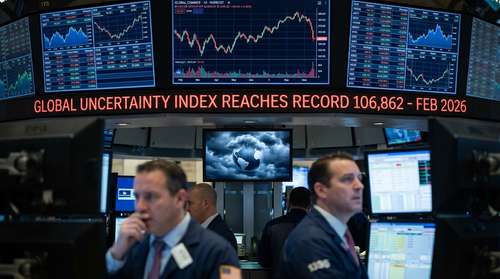
The global economic landscape entered uncharted territory today as the World Uncertainty Index (WUI) shattered all previous records, hitting a staggering 106,862 in February 2026. This unprecedented reading signals a level of global instability that dwarfs the peaks observed during the COVID-19 pandemic and the 2008 financial crisis. Economists and policymakers are grappling with a "polycrisis" scenario—a convergence of deepening trade fragmentation, escalating geopolitical conflicts, and monetary policy shifts—that has sent shockwaves through institutional risk models, even as equity markets largely shrug off the warning signs.
The Numbers Behind the Anxiety: A Historic Surge
The World Uncertainty Index 2026 reading of 106,862 is not just a statistical outlier; it represents a fundamental shift in the global risk environment. For context, the index, which tracks the frequency of uncertainty-related terms in country reports across 143 economies, peaked at approximately 50,000 during the height of the pandemic lockdowns. The current level is more than double that figure.
Unlike previous crises, which were often triggered by a single dominant shock—such as a virus or a subprime mortgage collapse—the current spike is structural. The data reflects a simultaneous breakdown in multiple pillars of the global order. Reports from the Economist Intelligence Unit (EIU) indicate that trade policy uncertainty alone has tripled since late 2025, driven by aggressive tariff regimes and retaliatory measures between major economic blocs.
Trade Wars and Geopolitical "Stacking"
A primary driver of this volatility is the renewed intensity of trade war news. New tariffs implemented earlier this month on steel, aluminum, and critical technology components have upended supply chains that were already fragile. The "geoeconomic confrontation" identified in the 2026 Global Risks Report has moved from theoretical risk to tangible reality, with manufacturing sectors in export-heavy nations bearing the brunt of the disruption.
Compounding the economic friction is the phenomenon of geopolitical "risk stacking." Security concerns in Eastern Europe have entered a fifth year of grinding conflict, while fresh tensions in the Middle East and the Korean peninsula are forcing nations to prioritize defense spending over economic stimulus. This layering of conflicts means there is no single diplomatic lever to pull that can de-escalate the global tension, leaving markets without a clear roadmap for resolution.
The Divergence: Markets vs. Reality
Perhaps the most perplexing aspect of the current landscape is the disconnect between the WUI and traditional market gauges. While the WUI is screaming caution, major equity indices like the S&P 500 and NASDAQ remain near all-time highs, buoyed by the relentless momentum of the AI sector and continued liquidity injections. This divergence has created a fragile paradox where market volatility today is masked by narrow leadership in tech stocks, while the broader economy flashes warning signs.
However, cracks are appearing. While equities remain resilient, the price of gold has surged past $5,500 per ounce, acting as the true "fear gauge" in this environment. Institutional investors are quietly hedging their portfolios, moving into defensive assets even as they ride the tech rally. This behavior suggests a lack of conviction in the durability of the current economic expansion.
Recession Indicators and the "Jobless Expansion"
Beneath the surface of the stock market rally, recession indicators 2026 are flashing yellow. Despite robust GDP prints in the US and parts of Asia, the underlying data points to a "jobless expansion." Businesses, paralyzed by the record-high uncertainty, are delaying capital expenditure and slowing hiring rates. The logic is simple: when the rules of global trade could change overnight, the safest move is to wait.
This hesitation is evident in the divergence between consumer confidence and corporate earnings. While companies continue to report profits through efficiency gains—often AI-driven—household sentiment is eroding under the weight of sticky inflation and perceived instability. If this trend continues, the consumer spending that has held up the global economy could buckle, turning the WUI's warning into a self-fulfilling prophecy of economic contraction.
Global Financial Stability at a Crossroads
The implications for global financial stability are profound. Central banks are caught in a bind: raising rates to combat lingering inflation risks choking off growth in an already uncertain environment, while cutting them could reignite currency volatility. The US Dollar Index has shown weakness recently, falling toward multi-year lows, which complicates the picture for emerging markets reliant on dollar-denominated trade.
As we move further into 2026, the question remains whether this record-breaking uncertainty will resolve through policy clarity or precipitate a market correction. For now, the world is operating in a high-stakes fog, where the old playbooks for navigating risk no longer apply. Investors and business leaders alike must remain agile, as the only certainty in this new era is uncertainty itself.