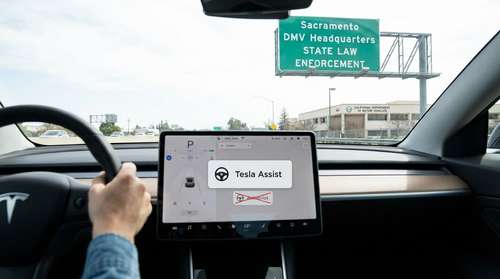
In a landmark concession to state regulators, Tesla has officially retired its controversial 'Autopilot' branding in California, effectively ending a years-long standoff with the Department of Motor Vehicles (DMV). The move, confirmed late Tuesday by DMV Director Steve Gordon, allows the electric vehicle giant to avoid a crippling 30-day suspension of its manufacturing and dealer licenses in its largest U.S. market.
DMV Ultimatum Forces Hand
The decision comes just hours before the expiration of a 60-day compliance window issued by the DMV in December 2025. Following a grueling legal battle that culminated in an administrative law judge ruling against the automaker, Tesla was faced with a binary choice: rebrand its driver-assistance features or halt all sales and production in the state for a month.
"The department is pleased that Tesla took the required action to remain in compliance with the State of California's consumer protections," Gordon stated in a press release. "California has zero tolerance for misleading advertising that puts safety at risk."
For years, the Tesla Autopilot California ban saga has centered on the DMV's assertion that the terms "Autopilot" and "Full Self-Driving" deceptively implied autonomous capabilities that the vehicles did not possess. While Tesla had previously tweaked its top-tier package to "Full Self-Driving (Supervised)," it had steadfastly clung to the "Autopilot" moniker for its standard Tesla ADAS safety standards suite until this week.
The Road to Rebranding
This development is the climax of a regulatory dispute that began in earnest in 2021. The California DMV formally filed accusations against Tesla in 2023, alleging the company violated state regulations prohibiting the marketing of vehicles as autonomous when they require active driver supervision. The case gained legislative weight with the passage of Senate Bill 1398, which explicitly banned deceptive naming of partial automation features.
In November 2025, Administrative Law Judge Juliet Cox issued a proposed decision finding that Tesla's marketing was indeed misleading under California law. Cox recommended the severe penalty of a license suspension, a move the DMV adopted but stayed conditionally to give Tesla a final chance to cure the violations.
Legal experts view this as a significant capitulation for CEO Elon Musk, who has frequently clashed with California regulators. By dropping the branding, Tesla acknowledges that its standard driver-assist system—which controls speed and steering on highways—is a Level 2 system under SAE standards, not a fully autonomous pilot.
Implications for Tesla and the Industry
The immediate impact of this Tesla rebranding driver-assist effort is visible on the company's California-specific order pages. References to "Autopilot" have been replaced with descriptive language such as "Standard Driver Assist" and "Traffic-Aware Cruise Control." The change ensures that new buyers are not given the impression of hands-free capability.
Regulatory Ripple Effects
This outcome sets a powerful precedent for autonomous vehicle marketing laws nationwide. Other states often look to California's strict automotive regulations as a bellwether. If other jurisdictions follow suit, Tesla may be forced to fragment its global marketing strategy or retire the Autopilot brand entirely.
"This is a victory for truth in advertising and roadway safety," said industry analyst Sarah Jenkins. "Consumers need to understand that despite the futuristic names, these vehicles still require human eyes on the road 100% of the time."
What's Next for Tesla in 2026?
Despite this regulatory hurdle, Tesla 2026 regulatory news hasn't all been negative. The company continues to push forward with its robotaxi ambitions, a separate endeavor from its consumer vehicles. However, the loss of the "Autopilot" trade name in the state where the company was founded marks the end of an era.
Investors seem relieved that operations will continue uninterrupted. Tesla shares remained stable Wednesday morning, as the market priced in the resolution of the Elon Musk California DMV battle. With the license suspension threat removed, Tesla can focus on ramping up production of its latest models at the Fremont factory, ensuring that the manufacturing pause—which would have cost the company billions—remains a hypothetical scenario.