
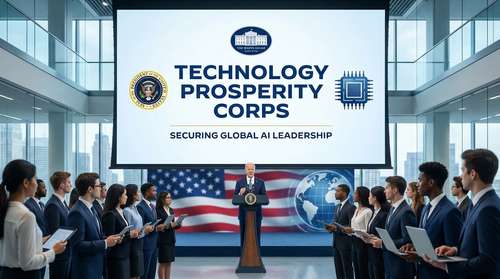
In a bold move to cement American leadership in the digital age, the Trump administration has officially announced the launch of the Technology Prosperity Corps, a groundbreaking initiative designed to deploy 5,000 American science and technology graduates to partner nations over the next five years. Described by officials as a "Peace Corps for the AI era," this program aims to counter China's growing technological influence in the developing world by providing boots-on-the-ground technical expertise and promoting the adoption of U.S.-made artificial intelligence systems.
A New Front in the US-China AI Rivalry
The announcement, made on Friday, marks a significant escalation in the technological rivalry between Washington and Beijing. For years, China has expanded its global footprint through the Digital Silk Road, exporting telecommunications infrastructure, surveillance technology, and digital services to emerging economies in Africa, South America, and Southeast Asia. The Technology Prosperity Corps represents a direct American answer to this challenge.
By sending cohorts of top-tier U.S. graduates to work alongside local governments and businesses, the administration hopes to create a long-term preference for American technology standards and hardware. "This isn't just about aid; it's about strategic partnerships," said a senior administration official during the briefing. "We are offering a transparent, secure, and values-driven alternative to the authoritarian digital models being exported by our competitors."
Strategic Goals of the Initiative
The core mission of the Technology Prosperity Corps is threefold:
- Talent Diplomacy: Leveraging America's advantage in higher education to build lasting relationships with future leaders in partner nations.
- Market Creation: Facilitating the adoption of U.S. technology stacks, creating new export markets for American tech giants.
- Digital Sovereignty: Helping developing nations build independent, secure digital infrastructures that are resilient to external coercion.
How the Program Will Work
Modeled after the Peace Corps founded by President John F. Kennedy in 1961, the new initiative will recruit recent graduates with degrees in computer science, data analytics, engineering, and artificial intelligence. Participants will serve two-year tours in designated partner countries, working on projects ranging from digitizing public health records to optimizing agricultural yields using machine learning.
Unlike the traditional Peace Corps, which focuses heavily on grassroots community development, the Technology Prosperity Corps will operate at a higher technical level. Volunteers will be embedded within government ministries, universities, and technology incubators. The program is expected to roll out its first cohort of 500 volunteers by late 2026, with a target of reaching full strength—5,000 active corps members—by 2030.
This international effort is distinct from the domestic "US Tech Force," a separate initiative launched earlier this year to modernize federal agencies. While the Tech Force focuses on fixing government technology at home, the Prosperity Corps is purely outward-facing, functioning as a soft-power tool to win the "hearts and minds" of the global digital workforce.
Target Regions and Global Impact
The administration has identified key regions for the initial deployment, with a heavy focus on the Global South. Nations in Sub-Saharan Africa and Latin America—areas where Huawei and other Chinese firms have established deep roots—are expected to be the primary beneficiaries. By offering high-level technical training and access to superior U.S. cloud computing resources, the White House aims to tilt the playing field back in America's favor.
Industry analysts have reacted positively to the news, noting that the human element has been a missing piece in U.S. tech strategy. "You can't just sell software and walk away," notes Sarah Jenkins, a senior fellow at the Center for Digital Diplomacy. "Having American engineers on the ground, solving local problems side-by-side with local partners, builds a level of trust that no trade deal can replicate."
Industry and International Reaction
The initiative complements the broader "Technology Prosperity Deals" recently signed with allies like the United Kingdom, Japan, and South Korea. These high-level agreements focus on research collaboration and supply chain security, while the Corps focuses on implementation and adoption in developing markets.
Beijing has yet to issue an official response to the specific program, but state media has previously criticized U.S. efforts to "encircle" China technologically. However, for many developing nations caught in the middle of this great power competition, the arrival of thousands of skilled American technologists represents a welcome infusion of talent. As the global race for AI leadership intensifies, the Technology Prosperity Corps signals that the U.S. is ready to compete not just with dollars and drones, but with its most valuable asset: its people.