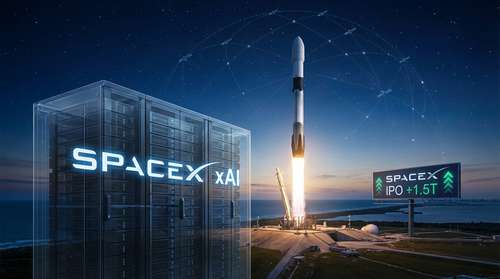
In a move that promises to reshape the global financial landscape, Elon Musk’s SpaceX has officially set its sights on what could be the largest IPO in U.S. history. Following the blockbuster acquisition of xAI earlier this month, the aerospace giant is reportedly targeting a mid-June 2026 public listing with a staggering SpaceX valuation of $1.5 trillion. As Wall Street prepares for this seismic event, the integration of Starlink’s satellite network with advanced artificial intelligence has investors scrambling for details on the upcoming SpaceX IPO 2026.
A New Era: The SpaceX-xAI Merger News
The convergence of space exploration and artificial intelligence is no longer science fiction. The recent Elon Musk xAI merger news has confirmed that SpaceX formally acquired the AI startup in an all-stock deal, valuing the combined entity at approximately $1.25 trillion pre-IPO. This strategic consolidation brings Musk’s disjointed empire under one roof, creating a vertically integrated juggernaut capable of deploying "space-based AI data centers."
By absorbing xAI, SpaceX aims to leverage its Starlink infrastructure to power the next generation of machine learning. The vision is audacious: putting high-compute data centers into orbit to reduce latency and bypass terrestrial energy constraints. This merger isn't just corporate housekeeping; it represents a fundamental shift in how Musk plans to dominate the future of technology.
Targeting the Largest IPO in U.S. History
Financial analysts are already drawing comparisons to Saudi Aramco’s record-breaking debut. If the SpaceX valuation hits $1.5 trillion, it would shatter previous records for a U.S. listing. Reports indicate the company aims to raise nearly $50 billion, with major banking institutions like Goldman Sachs and Morgan Stanley lining up to lead the underwriting process.
The timing is specific and characteristically Muskian. Sources suggest the IPO is penciled in for mid-June 2026, potentially aligning with a rare planetary alignment of Jupiter and Venus—and conveniently close to Musk’s birthday on June 28. While the spectacle is guaranteed, the financials appear equally robust. Revenue projections for 2026 are soaring past $24 billion, driven largely by the explosive growth of the Starlink constellation.
Space-Based AI Data Centers: The Game Changer
The core narrative of this IPO pitch is the creation of space-based AI data centers. With terrestrial power grids straining under the demand of AI model training, putting compute resources in orbit offers access to unlimited solar energy and radiant cooling. The merger allows SpaceX to natively integrate xAI’s Grok models into its satellite network, potentially offering an AI layer to the global internet service provided by Starlink.
Starlink Stock Ticker Price and Market Impact
For years, retail investors have searched for a Starlink stock ticker price, hoping the satellite internet arm would spin off as a separate public company. However, this merger confirms that Starlink will remain the cash-flow engine within the broader SpaceX entity. Investors looking to buy into the satellite network will need to purchase SpaceX stock directly once it hits the ticker tape.
This consolidated structure serves two purposes: it uses Starlink’s reliable revenue to fund ambitious Mars colonization goals, and it provides the immediate capital needed to build out the orbital AI infrastructure. Analysts predict that Starlink alone contributes over 70% of the company's current revenue, making it the financial backbone of the $1.5 trillion valuation claim.
How to Buy SpaceX Stock
With the hype building, the most common question is how to buy SpaceX stock right now. As of today, February 19, 2026, the company remains private. Retail investors cannot simply log into their brokerage accounts and place an order yet. However, the path to ownership is clearing.
Here is what prospective investors need to know:
- Wait for the IPO: The public offering is expected in June 2026. Once listed, shares will be available on major exchanges (likely NASDAQ or NYSE).
- Pre-IPO Funds: Accredited investors may still find access through secondary market funds or private equity platforms, though premiums are currently at all-time highs following the merger announcement.
- ETF Exposure: Some tech-focused ETFs, such as the ARK Venture Fund or specific AI holdings like the AGIX ETF, have managed to secure small private stakes, offering indirect exposure before the bell rings.
Risks and Regulatory Hurdles
Despite the optimism, the road to a $1.5 trillion valuation is paved with regulatory speed bumps. The Federal Aviation Administration (FAA) and the SEC are likely to scrutinize the merger’s implications for competition and safety. Furthermore, the sheer scale of deploying orbital data centers raises questions about space debris and international orbital rights.
Yet, the momentum seems unstoppable. With a $3 billion injection from Saudi AI firm Humain just prior to the merger and a revenue growth rate exceeding 50% year-over-year, Musk’s bet on a space-faring AI future is attracting the capital to match his ambitions. As June approaches, the world isn't just watching a stock launch; it’s witnessing the financial inception of a space-based economy.