Global trade relations plunged into chaos this week after President Donald Trump issued an unprecedented ultimatum to eight European nations: support the U.S. acquisition of Greenland or face punitive economic sanctions. The announcement, made via Truth Social on Saturday, has triggered a diplomatic firestorm at the World Economic Forum in Davos, with European Commission President Ursula von der Leyen condemning the move as a betrayal of trust between historic allies.
The "Greenland or Bust" Ultimatum
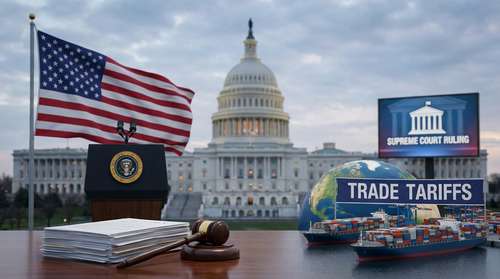
In a move that has stunned geopolitical analysts, President Trump threatened to impose a blanket 10% import tax on goods from Denmark, Norway, Sweden, France, Germany, the United Kingdom, the Netherlands, and Finland starting February 1, 2026. The President warned that these tariffs would escalate to a crippling 25% by June 1 if Copenhagen continues to refuse his offer to purchase the semi-autonomous Arctic territory.
Trump justified the aggressive maneuver by citing national security, specifically linking control of Greenland to the efficacy of the U.S. "Golden Dome" missile defense system. "Greenland is imperative for National and World Security. There can be no going back," he declared, characterizing the European refusal to negotiate as a "very dangerous game" that threatens global stability.
The inclusion of staunch NATO allies like the UK and Germany on the tariff list signals a dramatic shift in U.S. foreign policy, moving from transactional diplomacy to what critics are calling outright economic coercion. The eight targeted nations had recently conducted joint military exercises in the Arctic, a move Trump reportedly interpreted as a direct challenge to American interests in the region.
Davos Revolt: Von der Leyen Draws a Red Line
The response from the World Economic Forum in Davos was swift and furious. In a keynote address on Tuesday, European Commission President Ursula von der Leyen broke diplomatic protocol to directly challenge the U.S. President. Labeling the tariffs a "mistake," she reminded the White House of the fragile trade truce established only months prior.
"The European Union and the United States agreed to a trade deal last July," von der Leyen stated, her tone steelier than usual. "In politics, as in business, a deal is a deal. When friends shake hands, it must mean something."
She went further, questioning American reliability and warning that the EU would not be bullied into ceding territory. "Plunging us into a downward spiral would only aid the very adversaries we are both so committed to keeping out of the strategic landscape," she cautioned. The Commission President vowed that any economic aggression would be met with an "unflinching, united, and proportional" response, hinting that the EU is prepared to activate its own counter-measures against U.S. exports if the February 1 tariffs go into effect.
Allies in Disbelief
British officials were equally vocal, with sources in London calling the inclusion of the UK—a "special relationship" partner—on the tariff list an act of "diplomatic vandalism." NATO Secretary General Mark Rutte has reportedly been engaged in frantic back-channel talks to de-escalate the situation, though Trump's public dismissal of these efforts suggests a hardening of the American position.
Global Markets Slump as Trade War Looms
Financial markets reacted violently to the prospect of a transatlantic trade war in 2026. Major European indices suffered their sharpest single-day losses in months immediately following the announcement.
- The FTSE 100 dropped 1% in early trading.
- Germany's DAX plummeted 1.5% as its export-heavy auto sector braced for impact.
- France's CAC 40 fell 1.1%, driven by fears over luxury goods exports.
Investors fled riskier assets in droves, seeking safety in precious metals. Gold prices shattered records, surging past $4,700 per ounce for the first time in history, while silver climbed to a new high of $95.52. "The market is pricing in a worst-case scenario," noted a senior analyst at Davos. "If these tariffs hit in February, we are looking at a global manufacturing recession by Q3 2026."
The uncertainty also hit the currency markets, with the Euro and Pound struggling against the Swiss Franc, though the US Dollar weakened slightly as traders questioned the long-term economic blowback of isolationist policies.
NATO and the Future of Arctic Security
Beyond the immediate economic shock, the "Greenland Crisis" threatens to fracture the NATO alliance. By leveraging tariffs to force a territorial sale, Trump has linked economic pain to security cooperation in a way that has few precedents. European leaders have warned of a "dangerous downward spiral" that could fundamentally alter the post-WWII security architecture.
Denmark has reiterated that Greenland is not for sale, a position supported by the island's local government in Nuuk. However, with the U.S. threatening to rethink its commitment to NATO if its Arctic demands aren't met, the standoff has evolved from a trade dispute into an existential crisis for the Western alliance. As the February 1 deadline approaches, the world watches to see who will blink first: a unified Europe protecting its sovereignty, or a U.S. President determined to redraw the map of the Arctic.