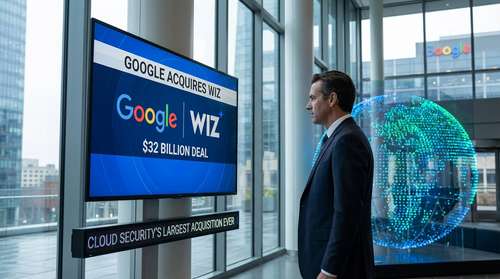
The ink is finally dry on the tech sector's most consequential merger of the decade. On Wednesday, March 11, 2026, Alphabet officially finalized the highly anticipated Google Wiz acquisition,. The all-cash transaction fundamentally alters the enterprise infrastructure landscape, bringing the New York-headquartered cybersecurity standout under the Google Cloud umbrella,. At a staggering price tag, the Wiz $32 billion deal easily ranks as Google's largest acquisition ever, dwarfing its 2012 purchase of Motorola Mobility for $12.5 billion and signaling a massive financial commitment to enterprise defense.
Inside Google's Largest Acquisition Ever
First announced in March 2025, the blockbuster transaction faced a year of intense regulatory scrutiny across multiple continents before clearing its final hurdles,. Following a swift Phase I clearance from the European Union last month and an early termination of the mandatory review period by the U.S. Department of Justice late last year,, the path was cleared for Wednesday's historic closure.
The financial ripple effects of the merger are massive. Wiz co-founders Assaf Rappaport, Yinon Costica, Ami Luttwak, and Roy Reznik—who founded the cloud-native security platform in 2020—are each expected to receive roughly $2.2 billion to $3 billion after taxes,,. Beyond the founders, major venture capital backers including Sequoia Capital, Index Ventures, and Insight Partners are realizing multi-billion dollar payouts. Furthermore, the transaction is projected to inject approximately 10 billion shekels ($3.2 billion) into Israel's state coffers through capital gains taxes, cementing it as the largest exit in the history of the Israeli tech ecosystem,.
Redefining Cloud Security Trends 2026
As organizations grapple with sophisticated, AI-generated attacks, the integration of Wiz into Google Cloud arrives at a critical juncture. When evaluating cloud security trends 2026, the demand for unified, intelligence-rich platforms capable of operating at machine speed is paramount. Google plans to fuse Wiz's comprehensive cloud graph and risk prioritization capabilities with its own robust security stack, which already includes Mandiant threat intelligence and Chronicle security analytics.
Google Cloud CEO Thomas Kurian emphasized the strategic vision behind the merger, stating that the ultimate goal is to make security a catalyst for innovation rather than a bottleneck,. "With this acquisition, we will deliver a unified security platform that simplifies the complex task of protecting multicloud environments in the AI era," Kurian noted following the deal's closure.
Sundar Pichai and the AI Defense Imperative
The acquisition aligns perfectly with Alphabet's broader strategic roadmap. Alphabet CEO Sundar Pichai framed the purchase as a necessary evolution of the company's core principles in an increasingly complex digital age,. "Keeping people safe online has always been part of Google's mission," Pichai explained on Wednesday. He added that as more governments and enterprises migrate critical workloads to the cloud and rapidly adopt generative AI, bringing Wiz and Google Cloud together will enable organizations to "innovate with confidence".
The Multi-Cloud Battlefield: Google Cloud vs AWS
Perhaps the most fascinating strategic element of the merger is how it impacts the ongoing Google Cloud vs AWS rivalry. Rather than locking Wiz's technology exclusively into the Google ecosystem, the search giant has explicitly committed to maintaining the startup's multi-cloud DNA. Wiz will continue to operate under its own brand and provide uninterrupted support for Amazon Web Services (AWS), Microsoft Azure, and Oracle Cloud,.
This neutral, cross-cloud posture is a deliberate wedge strategy. By owning the security layer that monitors enterprise workloads across competing infrastructures, Google establishes a broader footprint within the IT departments of companies that rely on heterogeneous cloud environments,. As Wiz CEO Assaf Rappaport highlighted, joining forces with Google provides the scale to protect customers globally at machine speed, while maintaining the open approach that drove the startup's initial hypergrowth,.
The Biggest Story in Cybersecurity News Today
For IT leaders and enterprise defenders following cybersecurity news today, the finalization of this megadeal resets the competitive baseline. Cloud breaches rarely stem from a single vulnerability; they are compound failures spanning configuration, identity, and runtime environments. By acquiring Wiz, Google is betting $32 billion that a unified, AI-driven platform is the only way to solve these compound problems at a global scale.
As the integration process begins, the broader tech industry will be watching closely. The success of this historic merger won't just be measured by the immediate tax windfalls or historic payouts, but by whether Google can effectively leverage Wiz to dethrone its rivals and become the undisputed leader in enterprise cloud security,.