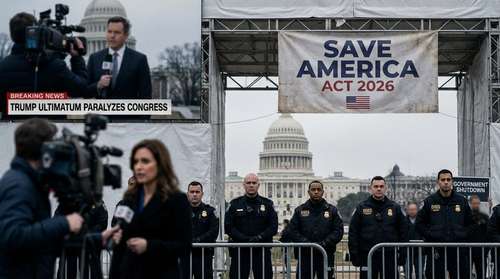
The halls of Congress have ground to a relentless halt as President Donald Trump issues a severe legislative blockade, paralyzing the federal government during a period of escalating global and domestic crises. In a high-stakes maneuver that is dominating US politics breaking news today, the president announced he will categorically refuse to sign any new legislation until the Senate passes the SAVE America Act 2026. This aggressive Trump voting law ultimatum arrives at a highly precarious moment for the nation, directly colliding with a worsening military conflict in Iran and the catastrophic fourth week of a partial Department of Homeland Security shutdown.
The Standoff: Trump's 'SAVE America Act 2026' Blockade
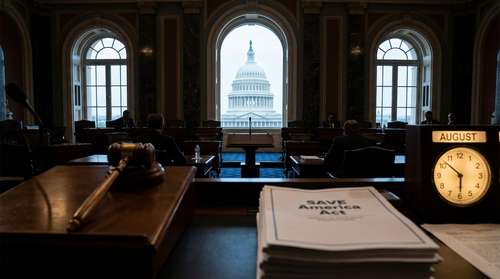
President Trump has drawn a definitive line in the sand, demanding the immediate passage of his cornerstone federal voting rules overhaul. "I, as President, will not sign other Bills until this is passed," Trump declared on his social media platform over the weekend, making it explicitly clear that the voting legislation supersedes all other congressional and national security priorities.
The House-passed legislation represents one of the most drastic shifts in election law in modern history. The bill mandates strict national voter ID requirements, requires documentary proof of citizenship—such as a passport or birth certificate—to register to vote, and implements a sweeping federal ban on no-excuse mail-in ballots. The only permitted exceptions for absentee voting would be for military service, severe illness, disability, or verifiable travel. Complicating matters further, conservative lawmakers have attached highly controversial provisions to the package, including restrictions on gender-affirming care for minors and bans on transgender athletes competing in women's sports.
The Push for a "Talking Filibuster"
For the SAVE America Act 2026 to survive the upper chamber, it requires 60 votes to overcome a filibuster—a nearly impossible hurdle given universal Democratic opposition. Senate Minority Leader Chuck Schumer (D-N.Y.) has fiercely branded the bill "Jim Crow 2.0," promising total gridlock and stating Democrats will not assist in its passage "under any circumstances". Consequently, Trump and his allies are intensely pressuring Senate Majority Leader John Thune (R-S.D.) to alter chamber rules and implement a "talking filibuster" to force the bill through with a simple majority. Thune has so far resisted the pressure campaign, noting a lack of unified party support to dismantle long-standing Senate traditions.
Travel Chaos Escalates in DHS Shutdown Update March 2026
The deliberate legislative stalemate is intensifying the very real fallout from the ongoing federal funding lapse. In the most recent DHS shutdown update March 2026, the Department of Homeland Security is now entering its 25th day without authorized funding. More than 100,000 essential workers across the agency—including TSA agents, Coast Guard personnel, and FEMA emergency staff—are currently executing their duties while missing multiple paychecks.
The tangible impact on everyday Americans is becoming impossible to ignore. As families travel for the spring break season, airports in Houston, Atlanta, and New Orleans have reported crippling, three-to-four-hour-long security lines due to severe TSA staffing shortages and elevated call-out rates. Even more critically, the funding freeze is actively hampering vital cybersecurity operations and maritime security exactly as the U.S. military enters its 12th day of an escalating conflict involving Iran. Bipartisan talks to resolve the DHS crisis have stalled entirely; as of Tuesday, Senate leaders and White House officials could not even agree to sit in the same room.
The Core of the Trump Midterm Election Strategy
This proposed federal voting rules overhaul is not just about legislative policy; it operates as the central linchpin of the Trump midterm election strategy. By focusing relentlessly on election integrity narratives, the administration is deliberately working to energize its conservative base ahead of the highly contested November elections. The president recently told Republican lawmakers that passing the stringent requirements will "guarantee the midterms".
However, voting rights advocates are sounding the alarm over the severe collateral damage the bill could inflict. Experts warn that the stringent documentation requirements could disenfranchise millions of legally registered, native-born voters. Specifically, advocates highlight the disproportionate impact on married women whose current legal names do not perfectly match their birth certificates, as well as low-income citizens who do not possess a valid U.S. passport.
National Guard Polling Places Poll Reveals Deep Divide
The administration's intense focus on election security extends far beyond the ballot box itself. Trump has previously suggested deploying military assets to monitor voting locations—a prospect that has fundamentally fractured the American electorate. A newly released National Guard polling places poll conducted by NPR, PBS News, and Marist perfectly highlights this deep partisan divide.
According to the striking National Guard polling places poll, exactly 46% of Americans support the idea of military personnel monitoring November's elections, while 54% remain fiercely opposed. The ideological split is incredibly stark: 73% of Republicans support the unprecedented measure, compared to a massive 75% of Democrats who completely oppose it. While election law experts continuously emphasize that federal deployment of armed troops to polling locations violates existing federal statutes, the escalating rhetoric continues to fuel severe anxiety surrounding the democratic process.
As the unwavering Trump voting law ultimatum effectively holds the United States Congress hostage, the American public is left bearing the painful brunt of the institutional dysfunction. With the military actively engaged overseas, national airports paralyzed by the relentless DHS shutdown, and the midterm elections rapidly approaching, the fierce battle over the SAVE America Act 2026 is undeniably poised to be the defining political showdown of the decade.