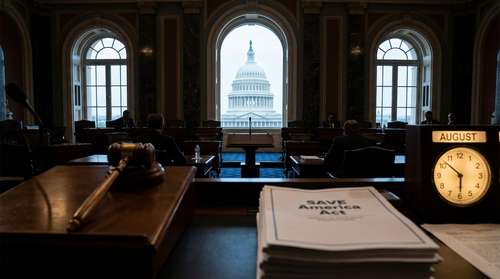
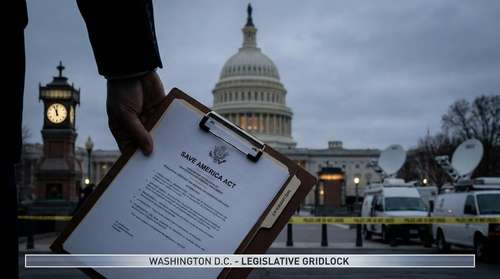
President Donald Trump has drawn a definitive line in the sand, declaring he will refuse to sign any future legislation until Congress delivers the SAVE America Act to his desk. Speaking at the House GOP's annual retreat at his Doral golf club in Florida, the president elevated the sweeping election integrity legislation to his absolute highest priority. In a fiery Sunday social media post, Trump stated the bill "supersedes everything else," demanding it move to the front of the legislative line and commanding lawmakers not to fail.
This abrupt executive maneuver throws the nation's capital into immediate chaos. By holding all other federal funding and legislative priorities hostage—including a stalled funding deal for the Department of Homeland Security—Trump's mandate virtually guarantees paralyzing Washington legislative gridlock just months ahead of the highly anticipated 2026 midterm elections.
Inside the Proof of Citizenship Voting Law
If enacted, the newly expanded measure would dramatically overhaul how Americans cast their ballots. While previous iterations focused primarily on initial registration processes, Trump explicitly warned lawmakers that he would not accept a "watered-down version" of the bill.
At its core, this proof of citizenship voting law would require voters to provide documentary evidence—specifically a passport or birth certificate—when registering for federal elections. Notably, standard government-issued driver's licenses, including REAL IDs, would not satisfy the strict requirements.
Perhaps the most contentious addition is a sweeping Trump mail-in voting ban. The proposed legislation seeks to eliminate standard mail-in balloting nationwide, restricting absentee voting strictly to active-duty military personnel, individuals with severe illnesses or disabilities, and those traveling away from their home precincts. Research from voting rights organizations indicates that over 21 million eligible citizens currently lack immediate access to the required documentation, while conservative proponents argue the stringent measures are absolutely necessary to secure the electoral process.
The Looming Senate Filibuster Showdown
The president's demands face a hostile reception in the upper chamber. Senate Minority Leader Chuck Schumer swiftly condemned the proposal, categorizing the legislation as an attempt to disenfranchise tens of millions of legitimate voters. Schumer made the Democratic position clear, stating his caucus will not supply the votes needed to pass the measure under any circumstances.
Because most legislation requires 60 votes to overcome procedural hurdles, the Republican majority faces a seemingly insurmountable mathematical challenge. This dynamic sets the stage for a historic Senate filibuster showdown. Conservative activists and key Trump allies are intensely lobbying Senate Majority Leader John Thune to implement a "talking filibuster" strategy. This approach would attempt to force the bill through a deeply divided chamber through sheer legislative attrition, essentially grinding the Senate floor to a halt until opponents relent.
Government Shutdowns and Unintended Casualties
The immediate casualty of this uncompromising stance is the basic functioning of the federal government. The Department of Homeland Security is already mired in a partial shutdown stretching beyond three weeks. Without presidential approval on subsequent funding bills, vital operations are beginning to fracture, and U.S. airports are reportedly heading toward a crisis situation.
White House aides have struggled to reconcile the president's singular focus on the SAVE America Act with the urgent need to fund national security operations and finalize crucial cabinet confirmations. Some Senate Republicans have privately expressed frustration over the ultimatum, noting that tying all legislative progress to a bill that currently cannot pass the Senate creates an inescapable trap. Yet, Trump has successfully unified his base behind the initiative, making it politically toxic for conservative lawmakers to publicly oppose his hardline strategy.
High Stakes for the 2026 Midterm Elections
The intense focus on election mechanics underscores the sheer political gravity of the approaching 2026 midterm elections. During his address to House Republicans in Miami, Trump explicitly linked the passage of these voting restrictions to the party's future electoral success. He forcefully argued that tightening voter verification and eliminating broad mail-in access is the only way to ensure Republican victories at the ballot box.
Voting rights organizations and election researchers counter that instances of noncitizen voting are statistically microscopic. They point to comprehensive state-level audits, such as a recent review in Utah that examined over two million registrations and found zero instances of noncitizen voting. Critics warn that the logistical hurdles created by mandatory documentary proof will heavily burden younger voters, minority communities, and lower-income Americans who often rely on flexible voting methods.
As the standoff deepens, the nation watches to see who will blink first. With a president willing to freeze all federal legislation and a Senate minority steadfastly refusing to budge, the path forward remains fraught with uncertainty.