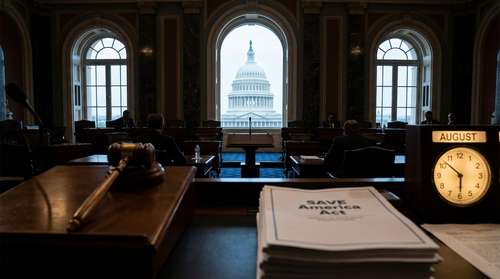
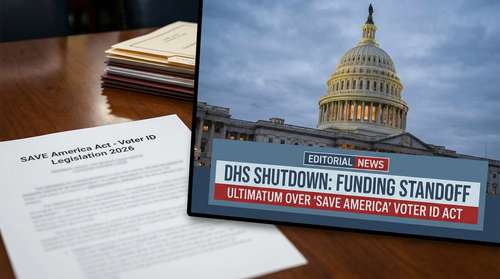
President Donald Trump has drawn an uncompromising line in the sand, triggering a severe Trump DHS shutdown by vowing to block all federal funding legislation until Congress passes his stringent election security bill. This Trump legislative ultimatum centers entirely on the SAVE America Act, a controversial measure that would mandate strict proof of citizenship and photo identification for all federal elections. Consequently, this government funding standoff has left federal workers without pay, paralyzing the Department of Homeland Security at a time when the United States is simultaneously navigating a volatile, escalating war with Iran.
The stakes could not be higher for lawmakers in Washington this week. As the crisis deepens, the Mike Johnson House majority finds itself walking a political tightrope—attempting to maintain party unity on foreign policy while domestic operations grind to a painful halt.
The Core of the Crisis: The SAVE America Act Explained
The Safeguard American Voter Eligibility (SAVE) America Act has become the defining piece of voter ID legislation 2026. Championed by Representative Chip Roy in the House and Senator Mike Lee in the Senate, the bill aims to fundamentally alter how Americans register and cast their ballots. It requires individuals to present documentary proof of U.S. citizenship—such as an unexpired passport or a birth certificate—when registering to vote, alongside a valid, REAL ID-compliant photo ID at the polling booth.
President Trump and influential allies have pushed hard for the legislation, arguing it is essential to secure the upcoming midterm elections against noncitizen voting. Speaker Mike Johnson vigorously defended the bill, stating, "Proof of citizenship and photo ID to vote; everyone in the country understands the necessity of that... And the only people that oppose it are people who want to cheat our system".
However, critics and voting rights groups have fiercely condemned the bill, labeling it a "dystopian" voter suppression tactic. Opponents warn the stringent requirements could disenfranchise millions of eligible voters, particularly married women who have legally changed their names and lack matching birth certificates, as well as lower-income citizens who do not have readily available passport documentation.
The Human Toll: DHS Workers Pay Suspended
Trump's refusal to sign any stopgap funding measures until his election demands are met has plunged the government into a partial paralysis. The most immediate casualty of this government funding standoff is the Department of Homeland Security. With the agency entering its fourth week of a funding lapse in March 2026, the ripple effects are being felt nationwide.
While some immigration enforcement functions were insulated by prior legislation, essential personnel across the department—including TSA agents, FEMA disaster response teams, Coast Guard service members, and Secret Service agents—are being forced to work without compensation. Public-facing operations are already showing signs of strain, evidenced by the recent suspension of the Global Entry program.
The suspension of DHS workers pay has generated widespread anxiety among the federal workforce. Missing even a single paycheck can devastate families managing mortgages, childcare, and basic living expenses. While back pay is typically guaranteed once a shutdown concludes, the unprecedented nature of this specific Trump legislative ultimatum offers little comfort to the public servants caught in the legislative crossfire.
Senate Gridlock and the "Talking Filibuster"
Despite the successful passage of the SAVE America Act in the lower chamber, the bill faces an impenetrable wall in the Senate. Democrats stand universally opposed to the legislation, setting the stage for total gridlock. Senate Majority Leader Chuck Schumer recently declared, "If Trump is saying he won't sign any bills until the SAVE Act is passed, then so be it: there will be total gridlock in the Senate".
Senate Majority Leader John Thune has acknowledged that the GOP lacks the 60 votes necessary to overcome a standard Democratic filibuster. To bypass this hurdle, President Trump has aggressively lobbied Senate Republicans to implement a "talking filibuster"—a grueling procedural maneuver that would force opponents to hold the floor continuously to block the vote. "It must be done immediately. It supersedes everything else," Trump declared on Truth Social. However, many senators remain wary of paralyzing the upper chamber's floor time for hundreds of hours, leaving the Trump DHS shutdown without a clear resolution.
Mike Johnson House Majority Navigates a Two-Front Battle
The domestic turmoil unfolds against the dramatic backdrop of the intense 2026 U.S.-Israel military campaign against Iran. Speaker Mike Johnson and his leadership team are fighting a grueling two-front battle. Just last week, the Mike Johnson House majority successfully defeated a War Powers Resolution that would have restricted the President's ability to conduct military strikes in the Middle East without congressional approval, demonstrating unwavering party unity on foreign policy.
Yet, holding the Republican coalition together on domestic issues is proving far more difficult. Several moderate Republicans are increasingly anxious about the political optics of defending a prolonged shutdown of national security apparatuses during an active overseas conflict. Retreating to closed-door strategy sessions in Florida this week, the House GOP must figure out how to satisfy the President's unyielding demands without alienating purple-district voters ahead of the November midterms.
What Happens Next for Voter ID Legislation in 2026?
With both sides deeply entrenched, the path forward remains highly obscure. The White House insists that overhauling the ballot box is the ultimate priority, signaling no intention to back down from the Trump legislative ultimatum. Conversely, Senate Democrats remain equally steadfast, refusing to negotiate on what they view as a massive assault on voting rights.
Unless a dramatic legislative compromise emerges, or Senate Republicans decide to utilize an unprecedented procedural workaround like budget reconciliation, the Trump DHS shutdown could stretch indefinitely. For now, the fate of the SAVE America Act—and the livelihoods of thousands of federal security personnel—hangs squarely in the balance of Washington's most volatile political standoff in recent history.