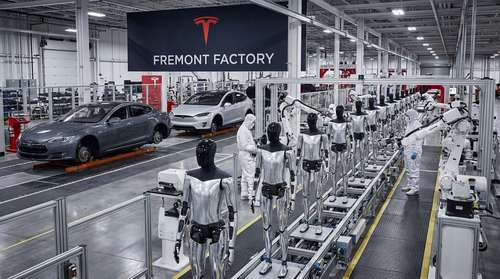
In a historic move that signals the end of one era and the dawn of another, Tesla has officially confirmed it will discontinue its flagship Model S and Model X vehicles by the second quarter of 2026. The announcement, made by CEO Elon Musk during the company's Q4 2025 earnings call, marks a decisive pivot toward Tesla Optimus mass production. The automaker plans to repurpose its legendary Fremont factory—the birthplace of the Model S—into a dedicated hub for manufacturing humanoid robots, targeting an annual output of one million units.
The End of an Era: Model S and X Retired
The Model S discontinued news comes as a shock to long-time enthusiasts, but the financial data presents a clear rationale. Once the crown jewels of the EV revolution, sales for both flagship models have plummeted. According to figures released in the earnings report, Model S sales fell by 52.6% in the fourth quarter of 2025 compared to the previous year, while the Model X saw a 34.2% decline. Combined, the two vehicles accounted for approximately 30,000 global deliveries in 2025—a fraction of the Fremont factory's 100,000-unit capacity.
"It is time to basically bring the Model S and X programs to an end with an honorable discharge," Musk stated during the call. He acknowledged that while these vehicles defined Tesla's early growth, the company's future lies not in premium electric sedans, but in automation and physical AI. The Model X retired 2026 timeline allows for a brief wind-down period before the assembly lines are completely dismantled to make way for the next generation of Tesla products.
Fremont Factory's Radical Transformation
The Tesla Fremont factory AI overhaul represents one of the most ambitious industrial pivots in modern history. Tesla has committed over $20 billion in capital expenditures for 2026 to support this transition, which involves stripping out traditional automotive assembly lines to install infrastructure for the Gen 3 Optimus robot. This shift underscores Musk's vision of Tesla evolving from a car manufacturer into a "physical AI company."
Musk described the new manufacturing goal as an "unprecedented ramp," aiming to produce one million humanoid robots annually at the California site. "This Optimus will really be a general-purpose robot that can learn by observing human behavior," Musk explained. The target manufacturing cost for each unit is set around $20,000, a price point that could disrupt labor markets globally if achieved. However, the CEO admitted that the humanoid robot workforce is still in its infancy, noting that no Optimus units are currently performing "useful work" autonomously in factories yet.
The Elon Musk AI Pivot: Betting the Farm on Robots
This strategic realignment goes beyond just factory floor plans; it fundamentally changes Tesla's business model. To support the "brain" of these robots, Tesla announced a controversial $2 billion investment in xAI, Musk's separate artificial intelligence startup. This partnership aims to integrate xAI's large language models, like Grok, directly into the physical AI company ecosystem Tesla is building. The goal is to give Optimus the cognitive ability to navigate complex environments and perform tasks based on verbal instructions or video demonstrations.
Critics point out the risks of abandoning proven revenue streams—even declining ones—for an unproven product category. Tesla's full-year 2025 revenue dropped to $94.8 billion, its first annual decline, piling pressure on the Elon Musk AI pivot to deliver tangible results quickly. Yet, the market reaction has been cautiously optimistic, with investors seemingly buying into the long-term potential of a labor-replacing product over a saturating luxury EV market.
What This Means for Current Owners
For existing owners, the retirement of the S and X raises questions about long-term support. Tesla has assured customers that parts and service will remain available, but the focus of software updates and engineering resources will clearly shift toward the Model 3, Model Y, and the upcoming Cybercab. As the Fremont lines go dark on the cars that started it all, the spotlight turns entirely to whether a metal humanoid can truly replace the machine that changed the automotive world.