The artificial intelligence boom has a hidden cost: astronomical energy consumption. Data centers powering modern generative models are currently maxing out power grids worldwide. But an unprecedented AI hardware breakthrough 2026 could fundamentally change how our infrastructure operates. Researchers have officially unveiled a hydrogen-ion semiconductor capable of self-learning and memory, directly mimicking the staggering efficiency of the human brain. This next-gen semiconductor technology addresses the critical power bottlenecks of traditional computing, unlocking a new frontier of energy-efficient AI that might just save our power grids. If you have been closely following the massive scale of data processing required today, this development changes the entire trajectory of the industry.
The Mechanics Behind Brain-Inspired Chips
For decades, traditional computer architectures have separated the processors that handle calculations from the memory modules that store data. This layout, known as the von Neumann architecture, requires data to constantly shuttle back and forth. The resulting traffic jam significantly slows down computation and consumes enormous amounts of electricity. To put this into perspective, the global server market is straining against the physical limitations of silicon and the soaring costs of electricity. Moving data across a motherboard generates immense heat, requiring robust cooling systems that further inflate energy demands.
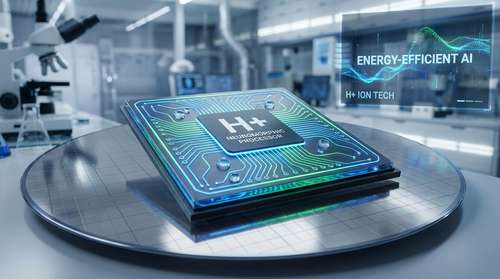
The newly developed device solves this by leveraging neuromorphic computing. By combining processing and memory into a single physical space, these brain-inspired chips operate much like biological synapses. South Korean researchers at the Daegu Gyeongbuk Institute of Science and Technology (DGIST), led by Senior Researcher Lee Hyunjun and Research Fellow Noh Heeyeon, engineered a two-terminal vertical structure that precisely controls the movement of lightweight hydrogen ions.
When a positive voltage is applied, hydrogen ions are injected into the semiconductor, increasing its electrical conductivity. Reversing the voltage pulls the ions back into a storage layer, decreasing conductivity. This analog approach allows the chip to retain memory and process information simultaneously, mirroring the synaptic pathways of a living mind.
Moving Past Traditional Semiconductor Limitations
Until recently, oxide-based memory devices relied heavily on manipulating oxygen vacancies—essentially creating microscopic defects in the material—to adjust conductivity. While effective in theory, manipulating oxygen defects struggled with long-term stability and uniformity across large arrays of devices.
By shifting the focus to hydrogen atoms, the research team achieved a massive leap in reliability. Hydrogen is incredibly light and highly mobile, allowing it to move quickly and precisely under an electric field without damaging the surrounding material structure. During rigorous laboratory testing, the hydrogen-ion semiconductor maintained its memory states without degradation and ran stably for over 10,000 repetitive operations.
Unlocking Analog Resistance for Neural Networks
Traditional digital memory stores information in binary format, switching strictly between ones and zeros. However, biological brains process information along a continuous spectrum. Because the hydrogen ion flow can be meticulously controlled through varying voltage strengths and frequencies, the new chip achieves analog multi-level resistance.
This capability is absolutely critical for sustainable machine learning, allowing the hardware to handle complex neural network computations organically. In initial handwritten digit recognition experiments, the device achieved an impressive 97% recognition accuracy. It essentially proves that manipulating hydrogen atoms electrically between stacked semiconductor layers works exceptionally well for high-level pattern recognition.
Paving the Way for Sustainable Machine Learning
The implications of this technology extend far beyond the laboratory. The current reliance on power-hungry graphics processing units (GPUs) and high-bandwidth memory (HBM) is largely unsustainable. Training a single large language model can easily consume enough electricity to power thousands of homes for a year. The rapid growth of generative AI has pushed demand for these components to unprecedented levels, creating a massive global hardware bottleneck.
Integrating energy-efficient AI hardware into the global technology infrastructure could drastically slash these power requirements. By eliminating the constant data transfer between separate processor and memory units, neuromorphic computing architectures can potentially reduce power consumption for large-scale AI training by over 90 percent.
Imagine edge computing devices—from autonomous vehicles to wearable medical sensors—capable of running advanced AI locally without draining their batteries or relying on constant cloud connectivity. The implementation of this next-gen semiconductor technology means you might soon see powerful, on-device AI that operates seamlessly on a fraction of a watt.
The Future of Global AI Infrastructure
Published as a cover paper in the prestigious journal ACS Applied Materials & Interfaces, this development establishes a clear roadmap for the commercialization of ultra-low-power, high-density hardware. The vertical two-terminal architecture specifically lends itself to simple manufacturing processes and high integration density, solving critical scalability issues.
As the industry races toward more advanced artificial intelligence, simply building larger data centers is no longer a viable long-term strategy. The transition toward neuromorphic designs and hydrogen-ion semiconductor applications represents a necessary evolution. By looking to the human brain for inspiration, engineers are finally building the foundational hardware required to support the next generation of intelligent systems sustainably.