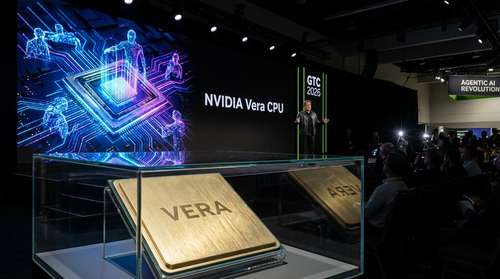
NVIDIA just made its boldest leap beyond traditional GPUs, signaling a monumental shift in how machines process information. At the highly anticipated NVIDIA GTC 2026 conference, the tech giant officially unveiled the NVIDIA Vera CPU, the world's first processor custom-built to power the rapidly expanding landscape of agentic AI. This specialized silicon promises to accelerate reinforcement learning and complex, multi-step reasoning, leaving general-purpose server chips far behind.
The stakes have never been higher. Standing before a packed arena at the SAP Center in San Jose, CEO Jensen Huang laid out a staggering vision for the company's future. He announced a highly ambitious NVIDIA $1 trillion target for AI hardware revenue through 2027, effectively doubling the firm's previous projections. The message to the industry was unmistakable: the era of retrieval-based computing is over, and the age of autonomous digital workers has arrived.
The Dawn of Agentic AI: Why the NVIDIA Vera CPU Changes Everything
For years, the artificial intelligence boom was defined by training massive language models. Now, the focus has shifted toward inference and sequential decision-making. Autonomous AI agents require systems that can plan tasks, execute multi-step workflows, use external tools, and learn from environmental feedback. Traditional computing architectures, designed largely for parallel throughput or standard single-threaded tasks, struggle to maintain efficiency under these unique workload patterns.
Enter the NVIDIA Vera CPU. Engineered specifically to tackle these bottlenecks, the processor delivers a massive leap in performance. According to NVIDIA's benchmarks, Vera operates 50% faster than conventional rack-scale CPUs while doubling energy efficiency for reinforcement learning workloads. This is not merely an incremental upgrade. For enterprises deploying large fleets of agents, these metrics translate directly to faster decision cycles and drastically reduced power consumption. What makes this processor unique is its architectural rhythm. Rather than just maximizing parallel throughput, the Vera CPU manages the intricate control flows and state-heavy logic that autonomous agents rely on.
- 88 Custom Olympus Cores: Delivering consistent, predictable performance tailored for multi-tenant environments.
- Spatial Multithreading: Allowing each core to run two tasks simultaneously to maximize throughput.
- Unprecedented Memory Bandwidth: Utilizing LPDDR5X memory to achieve up to 1.2 TB/s, halving power consumption compared to general-purpose processors.
Inside the Architecture: Building the Ultimate AI Infrastructure
Hardware breakthroughs rarely operate in a vacuum. The Vera CPU sits at the heart of the broader Vera Rubin platform, a comprehensive suite of seven advanced chips designed to function as a singular, unified supercomputer. By prioritizing deep codesign across compute, networking, and storage, NVIDIA is reshaping global AI infrastructure.
The integration capabilities are extraordinary. A single liquid-cooled NVIDIA Vera CPU Rack can house up to 256 processors. When connected via the next-generation NVLink 6 high-speed network, which reduces CPU-to-GPU data transfer latency to the microsecond level, the system can support tens of thousands of concurrent software environments. This is the exact type of robust infrastructure required to safely scale complex agentic models.
Uniting with Global Tech Leaders
NVIDIA is not waiting for the market to catch up. Major hyperscalers and cloud providers are already collaborating to deploy Vera into their data centers. Industry heavyweights like Meta, Oracle Cloud Infrastructure, Alibaba Cloud, and ByteDance are integrating the technology, while system manufacturers including Dell Technologies, HPE, and Supermicro prepare to bring Vera-powered servers to the broader enterprise market. Real-world testing is already validating NVIDIA's aggressive performance claims. For instance, Redpanda, a leading streaming data platform, recently benchmarked the Vera processor running Apache Kafka-compatible workloads. The results showed a dramatic 5.5x reduction in latency compared to other systems.
Jensen Huang's Vision and the NVIDIA $1 Trillion Target
The hardware specifications are impressive, but the financial implications discussed at GTC 2026 are what truly halted the trading floors. CEO Jensen Huang took the stage to declare that the inflection point for AI inference is officially here. His confidence in the Vera Rubin architecture culminated in the bold NVIDIA $1 trillion target, a cumulative revenue projection for AI infrastructure spanning 2025 to 2027.
'Every single software company of the future will be agentic, and they will be token manufacturers,' Huang told the crowd of thousands. The shift he described means that computing power now directly equals revenue for cloud providers. As machines transition from simply retrieving data to continuously generating tokens and executing autonomous tasks, the demand for specialized silicon will outpace anything the tech sector has previously witnessed.
Empowering Autonomous AI Agents with NemoClaw
Silicon alone cannot build a digital workforce. Alongside the Vera CPU, NVIDIA introduced NemoClaw, an open-source software stack engineered to simplify the deployment of autonomous AI assistants. This platform provides the essential guardrails and isolated sandbox environments necessary for agents to operate securely 24/7. By utilizing policy-based guardrails, organizations can grant digital workers access to sensitive corporate data without risking exposure to external networks.
By pairing the relentless processing power of the Vera CPU with the streamlined deployment tools of NemoClaw, developers are gaining the ability to build robust digital workers that operate seamlessly in the background. Whether it is managing enterprise supply chains, writing code, or orchestrating real-time analytics pipelines, the infrastructure is finally in place to support true artificial autonomy.
The announcements out of San Jose represent a definitive pivot. NVIDIA has evolved far beyond its graphics-card origins, positioning itself as the foundational architect of the next industrial revolution. With the Vera CPU entering commercial production and the trillion-dollar finish line in sight, the blueprint for the agentic future is completely drawn.