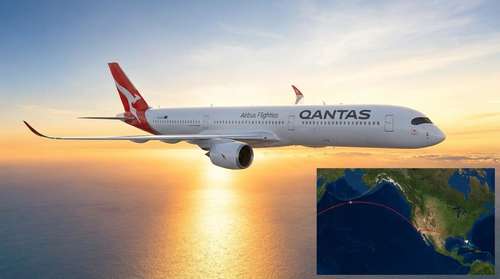
The future of global aviation arrived this week, and it stayed in the sky for over 24 hours. As part of the highly anticipated Qantas Project Sunrise, an advanced test aircraft just completed a grueling, globe-spanning journey that entirely rewrote the aviation history books. Departing from Australia on July 27, 2026, the milestone test flight flew unbroken across three continents and two oceans, officially setting the new longest nonstop flight record for a commercial aircraft. For industry professionals and weary travelers alike, this week's achievement is the definitive signal that the era of seamless, single-hop global travel is finally on our doorstep.
Smashing the Longest Nonstop Flight Record
The statistics behind this week's achievement are nothing short of staggering. The test aircraft, bearing the apt registration F-WULR, remained airborne for exactly 24 hours and 24 minutes. Pushing its engineering to the absolute limit, the jet traversed an astonishing 12,460 nautical miles, or 23,075.92 kilometers.
This massive feat decisively shatters the previous commercial distance benchmark, a 22-hour and 42-minute mark held by a Boeing 777-200LR since 2005. This was not merely an endurance stunt. It served as a rigorous real-world certification test designed to validate heavy takeoff weights and intricate fuel management strategies for upcoming ultra long haul travel. Engineers at Airbus required real-time telemetry to ensure the aircraft could safely manage extreme distances while maintaining strict safety reserves.
A Historic Melbourne to Toulouse Flight
Instead of taking the most direct great circle route home, the crew commanding the Melbourne to Toulouse flight purposefully flew the long way around to stretch the aircraft's endurance. Taking off from Melbourne Airport at 5:27 PM local time on July 27, the pilots pointed the nose northeast.
The epic trans-Pacific route carried the crew straight over the United States and Canada, before hopping the Atlantic Ocean and heading south past the United Kingdom. During this marathon transit, the pilots experienced two sunsets and two sunrises, perfectly encapsulating the Project Sunrise moniker. The journey concluded with a low-altitude go-around flypast and a celebratory water salute upon touching down at Airbus headquarters in France on the morning of July 28.
Dominating Flightradar24 Tracked Flights
Aviation enthusiasts and curious onlookers flooded the internet to witness the milestone in real-time. According to data providers, more than 3.6 million people tuned in to watch the aircraft, which operated under the callsign AIB35LR. This immense digital turnout made the journey the second-most-watched event in the history of Flightradar24 tracked flights, trailing only the 2022 transport of Queen Elizabeth II's coffin. The massive public interest underscores a heavy consumer demand for faster, more efficient global routing.
Inside the Specialized Airbus A350-1000ULR
Achieving this kind of extreme endurance requires serious hardware modifications. The Airbus A350-1000ULR is custom-engineered specifically to conquer these punishing international routes. To achieve its record-breaking range, engineers integrated an additional rear center fuel tank capable of holding 20,000 extra liters of aviation fuel.
Combined with advanced aerodynamics and highly efficient next-generation Rolls-Royce Trent XWB engines, the jet is built to comfortably manage unprecedented operational ranges. When it eventually enters commercial service, Qantas plans to configure the cabin with a remarkably low-density layout capped at just 238 passengers. This spacious design prioritizes legroom and includes a dedicated wellbeing zone where flyers can stretch, hydrate, and move around to combat extreme fatigue.
Honoring the Legacy of the Double Sunrise
The ambitious branding of Qantas Project Sunrise is a direct homage to the airline's wartime history. During World War II, Qantas operated covert Double Sunrise flights using stripped-down Catalina flying boats. Those perilous missions across the Indian Ocean lasted upwards of 33 hours, maintaining crucial communication links while forcing passengers to endure freezing, unpressurized cabins. Today's modern equivalent replaces that grueling austerity with state-of-the-art wellbeing zones, shifting the focus entirely to passenger health and absolute luxury during ultra long haul travel.
The Final Push for Direct Flights Australia to London
This successful 24-hour marathon is the definitive green light for Qantas's long-held vision of point-to-point global connectivity. The Australian carrier is expected to take delivery of the first of its 12 customized ULR jets by April 2027.
If the current regulatory timeline holds, travelers will be able to book direct flights Australia to London, alongside direct Sydney to New York services, starting in October 2027. These daily nonstop services are projected to take between 19 and 21 hours depending on high-altitude winds and exact routing. By eliminating traditional layovers in the Middle East or Asia, Qantas aims to save passengers several hours of total travel time, officially ending the grueling multi-leg nightmares of the past.