
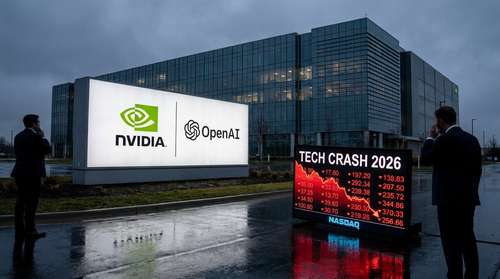
Global equity markets are experiencing a violent reset this week, driven by reports of an unprecedented Nvidia OpenAI financing guarantee that has sent shockwaves from Wall Street to Seoul. The arrangement, which would see the hardware giant backstop debt for its biggest customer, has forced investors to brutally reassess the sustainability of the artificial intelligence boom. Combined with sudden geopolitical pressures and fierce new overseas competition, the resulting panic has triggered a sweeping semiconductor market crash.
The $500 Billion OpenAI Ohio Data Center
The catalyst for the current market turmoil stems from advanced talks regarding a historic infrastructure buildout. Reports indicate Nvidia is negotiating to guarantee approximately $250 billion in debt financing to support a massive OpenAI Ohio data center. Developed by SoftBank's SB Energy subsidiary, this facility features staggering projected metrics:
- A 10-gigawatt power footprint situated in southern Ohio.
- An estimated total project cost of $500 billion.
- Potential additional financing of $350 billion specifically for Nvidia hardware.
For OpenAI, the lease agreement represents a strategic pivot toward controlling its own massive computing infrastructure rather than strictly renting cloud space from Microsoft or Amazon. For Nvidia, guaranteeing the lease secures long-term demand for its next-generation accelerators. However, placing up to a quarter-trillion dollars of contingent liability onto Nvidia's balance sheet for a private company lacking an investment-grade credit rating has severely rattled institutional investors.
Fears of a Circular Funding Dotcom Bubble
Wall Street's immediate reaction has been one of deep skepticism. Financial analysts are openly warning about a circular funding dotcom bubble. In the late 1990s, telecommunications equipment manufacturers routinely financed the aggressive expansion of upstart telecom providers. Telecom giants like Lucent and Nortel offered generous vendor financing to internet startups that ultimately lacked viable business models. When those startups went bankrupt, the equipment suppliers were left holding billions in worthless debt.
Market bears argue that Nvidia underwriting OpenAI's expansion creates an artificial demand loop. Analysts fear a similar dynamic could play out in the generative AI space if commercial monetization fails to keep pace with the staggering capital expenditures required to train next-generation models. If AI software revenue growth cools or consumer adoption plateaus, the foundational hardware orders could evaporate. Because Nvidia is essentially loaning the money used to buy its own products, any default on those massive obligations would strike a catastrophic blow to the company's financial health. This sudden realization of systemic vulnerability sparked the aggressive AI chip stock selloff 2026.
China's Breakthrough and the Samsung SK Hynix Stock Drop
While U.S. markets reeled from the infrastructure financing revelations, Asian semiconductor giants faced their own localized crisis. A massive Samsung SK Hynix stock drop wiped billions off the South Korean Kospi index, which plummeted nearly 11% in its worst one-day decline since March 2020. Samsung shares cratered by 13.4%, notching their steepest drop in almost two decades, while memory rival SK Hynix collapsed by 14.7%.
This localized bloodbath wasn't purely about the OpenAI data center fallout. Investors were simultaneously digesting a major breakthrough in China's homegrown chipmaking capabilities. The highly successful public market debut of Chinese memory-chip maker CXMT signaled that Beijing is rapidly closing the technological gap. Analysts now warn that CXMT could flood the market with domestic chips, threatening to create a severe oversupply that would crush the pricing power currently enjoyed by South Korean memory manufacturers.
A Perfect Storm for Global Tech
The combination of inflated U.S. infrastructure valuations and sudden Chinese supply threats created a toxic environment for chip stocks. The South Korean economy is disproportionately reliant on its semiconductor exports, making the Kospi index highly sensitive to global chip cycles. The dual headwinds of U.S. financial engineering concerns and China's sudden ascent in domestic memory production have forced a dramatic recalibration of growth projections for the entire region.
Navigating the Nasdaq Correction July 2026
The contagion quickly spread back to American shores, cementing a Nasdaq correction July 2026 as the tech-heavy index fell more than 10% from its early June highs. Semiconductors, which had previously powered the broader market upward, became the primary drag on global equities. Major players like Western Digital and Micron suffered severe single-day drops, while equipment manufacturer ASML lost significant ground in Europe.
Institutional portfolio managers are now rapidly de-risking. The prevailing sentiment has shifted from fear of missing out to capital preservation. This rotational shift is punishing companies previously viewed as untouchable market darlings. Tech executives are now facing intense pressure to demonstrate immediate return on investment for their massive data center buildouts, a stark departure from the growth at any cost mentality that defined the market just months prior.
Whether this broader semiconductor market crash represents a healthy valuation reset or the bursting of a historical bubble hinges entirely on the finalized terms of the Ohio campus deal. If the tech industry can prove its infrastructure spending is backed by sustainable enterprise revenue rather than financial engineering, equities may find a floor. Until then, heightened volatility will remain the dominant theme across global exchanges.