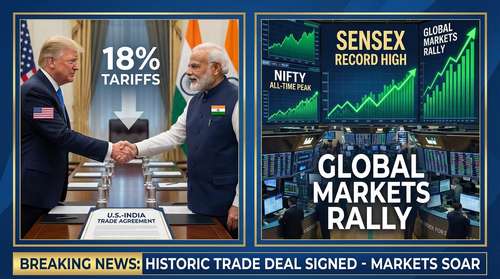
In a watershed moment for global commerce, U.S. President Donald Trump and Indian Prime Minister Narendra Modi have finalized a landmark India-U.S. trade deal, dismantling the contentious tariff regime that had gripped bilateral relations since mid-2025. The agreement, announced early Tuesday, February 3, 2026, slashes reciprocal tariffs on goods to a flat 18%, effective immediately. The news triggered an explosive global market rally today, with India's Sensex and Nifty indices opening at fresh record highs as investors celebrated the end of the looming trade war.
Markets Erupt: Sensex and Nifty Smash Records
The financial reaction was instantaneous and electric. Following months of volatility driven by the "August Crisis" of 2025, markets roared back to life. The Sensex and Nifty hit record highs in 2026 within minutes of the opening bell. The GIFT Nifty signaled the surge early, trading above 26,190, and domestic indices followed suit with a massive 4.5% gap-up opening.
Market analysts are calling this the "Valentine's Rally" arriving early. The BSE Sensex surged past the 86,000 mark, reclaiming lost ground and charting new territory, while the Nifty 50 cemented its position above 26,000. "This is not just a relief rally; it's a structural repricing of the India-U.S. economic corridor," said Rajesh Kumar, a senior strategist at Mumbai-based Equinox Capital. "The removal of the punitive 50% duty removes the single biggest overhang on Indian exporters, particularly in the tech and pharma sectors."
Inside the Trump-Modi Agreement: 18% is the New Zero
The core of the Trump Modi agreement is the dramatic reduction of import duties. Under the previous "Reciprocal Trade Act" enforcement initiated in 2025, Indian exports to the U.S. faced a staggering 50% tariff wall—comprising a 25% reciprocal base rate and an additional 25% penalty linked to geopolitical disputes, specifically regarding Russian oil imports.
Under the new terms detailed by the White House and India's Ministry of External Affairs:
- The 18 percent tariff reduction applies reciprocally, meaning U.S. goods entering India and Indian goods entering the U.S. will face a standardized, lower duty.
- The punitive 25% "surcharge" introduced in August 2025 has been completely rescinded.
- India has committed to lowering non-tariff barriers for American agricultural exports, a long-standing demand of the Trump administration.
President Trump took to social media to hail the deal, stating, "Out of friendship and respect for Prime Minister Modi, we have agreed to a deal. The 50% is GONE. We are down to 18%, and we are selling more American apples, cars, and energy than ever before!" Prime Minister Modi reciprocated, thanking the President for the "wonderful announcement" that benefits 1.4 billion Indians.
Boost for American Agriculture and Indian Industry
While financial markets cheered, the real economy is poised for significant shifts. For the United States, the deal opens the floodgates for American agricultural exports. U.S. apple growers in Washington state and dairy farmers in the Midwest—who had been hit hard by India's retaliatory tariffs—are expected to see immediate relief. The agreement reportedly includes specific quotas for U.S. dairy access, a historically sensitive issue in Indian trade negotiations.
For India, the reprieve is critical for the textiles, gems, and jewelry sectors, which operate on thin margins and were facing an existential threat from the 50% duty. "This saves roughly 2 million jobs in the textile belt," estimated the Confederation of Indian Industry (CII) in a preliminary note. Furthermore, the IT and pharmaceutical sectors, which drive a significant portion of India's export revenue, will see their cost competitiveness restored in the U.S. market.
Geopolitical Implications: The Russian Oil Pivot?
The removal of the 25% penalty tariff—originally imposed due to India's purchase of Russian crude—suggests a major geopolitical pivot. While official statements were careful to frame this as a trade victory, sources suggest New Delhi provided assurances regarding the diversification of its energy basket. The deal implies a softening of the friction point regarding India's strategic autonomy, with Washington likely accepting a roadmap for reduced reliance on sanctioned Russian energy in exchange for deeper economic integration.
What's Next for Global Trade?
This India-U.S. trade deal signals a potential thaw in the protectionist wave that defined late 2025. With the U.S. and India—two of the world's largest democracies—finding common ground, pressure mounts on other trade blocs to finalize similar agreements. For now, however, all eyes remain on the ticker tape, as the global market rally today rewrites the record books.