
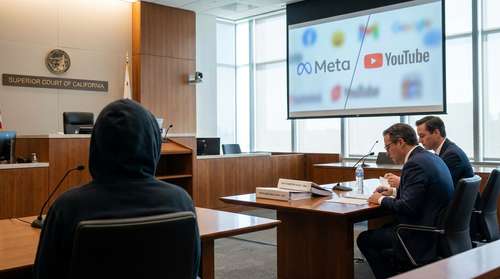
A historic legal battle has commenced in Los Angeles Superior Court as social media giants Meta and YouTube face a jury for the first time over allegations that their platforms were deliberately designed to addict children. The trial, which began jury selection on January 27, 2026, marks a pivotal moment in the ongoing scrutiny of Big Tech, with opening arguments expected to set the stage for a six-to-eight-week showdown. While co-defendants TikTok and Snap reached last-minute settlements, Meta and YouTube remain in the courtroom to defend against claims that their algorithms and design features—such as infinite scrolling and variable reward schedules—have fueled a youth mental health crisis.
The Allegations: Negligent Design vs. Free Speech
At the heart of this social media addiction trial is a lawsuit brought by a 19-year-old plaintiff identified only as "K.G.M." She alleges that she was hooked on these platforms at the age of 10, leading to severe psychological harms including depression, anxiety, body dysmorphia, and suicidal ideation. Her legal team argues that these outcomes were not accidental byproducts of user interaction but the result of calculated negligent design.
The plaintiff's case draws a sharp distinction between the content posted by users and the mechanisms used to deliver it. By focusing on features like infinite scroll, autoplay, and algorithmic recommendations, the lawsuit seeks to bypass the liability shields traditionally afforded to tech companies. "This is about product defect, not speech," legal experts have noted, comparing the strategy to past litigation against the tobacco industry. The core argument is that these companies engineered a "feedback loop" that prioritizes engagement over user safety, effectively exploiting vulnerable developing brains for profit.
Section 230 and the "Tech Giant Liability" Defense
Meta and YouTube are mounting a vigorous defense, heavily relying on Section 230 of the Communications Decency Act, which has historically protected internet platforms from being held liable for content generated by third parties. Their legal teams argue that the harms described by the plaintiff are inextricably linked to the videos and posts she viewed—content that is protected speech under the First Amendment.
Furthermore, the defense contends that there is no medical consensus on "social media addiction" as a clinical diagnosis. In pre-trial motions, attorneys for the tech giants have signaled they will present evidence of their safety tools, such as time-limit reminders and parental controls, to demonstrate their commitment to youth safety. They argue that attributing complex mental health struggles solely to platform usage ignores other critical factors, such as academic pressure and real-world social dynamics.
TikTok and Snap Settle: A Strategic Exit?
Just days before jury selection began, the landscape of the trial shifted dramatically. TikTok, owned by ByteDance, agreed to a settlement with the plaintiff on the eve of the trial, following a similar move by Snap Inc. (Snapchat) a week earlier. While the financial terms of these settlements remain undisclosed, the exits of these two major players leave Meta and Google-owned YouTube to face the jury alone.
Legal analysts suggest these settlements might be strategic, allowing TikTok and Snap to avoid the unpredictability of a jury verdict in such a politically charged environment. "Settling allows them to avoid a potentially catastrophic precedent," noted one industry observer. However, for Meta and YouTube, the decision to proceed to trial indicates a willingness—or perhaps a necessity—to test the strength of their Section 230 defenses in front of a jury for the first time in a youth harm lawsuit of this magnitude.
A "Bellwether" Case with National Implications
This trial is considered a "bellwether" case, meaning its outcome will likely predict the trajectory of thousands of similar lawsuits currently pending in state and federal courts. Known as JCCP 5255 in California, this coordinated proceeding involves claims from families, school districts, and state attorneys general, all alleging that social media platforms have created a public nuisance and a mental health epidemic.
If the jury finds in favor of K.G.M., it could open the floodgates for billions of dollars in liability and force a fundamental redesign of how social media apps operate. Conversely, a victory for Meta and YouTube would reinforce the current legal framework that shields platforms from responsibility for how their products are used. With Mark Zuckerberg expected to testify, the trial promises to offer an unprecedented look into the internal decision-making processes of the world's most powerful tech companies.
What to Watch For in the Coming Weeks
As opening statements commence, observers should pay close attention to how the jury reacts to the specific "design defect" arguments. Will they see the algorithm as a product feature comparable to a faulty car brake, or will they view it as a neutral publisher of information? The answer to that question could redefine the internet for the next generation.