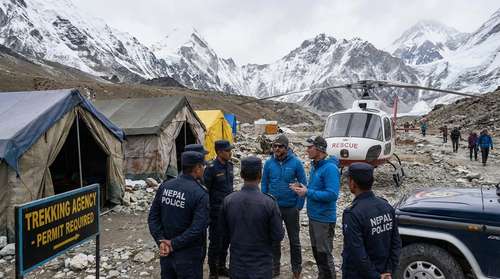
In a massive crackdown that has sent shockwaves through the global adventure tourism industry, Nepal’s Central Investigation Bureau (CIB) has arrested six prominent travel and mountain rescue executives for orchestrating a sprawling $20 million insurance fraud scheme. The arrests, carried out in late January 2026, mark the culmination of a multi-year investigation into a syndicate accused of fabricating helicopter rescues, forging medical reports, and systematically looting international travel insurance providers.
The $20 Million Deception: Uncovering the Network
The sting operation, led by CIB Chief and Additional Inspector General (AIG) Manoj Kumar KC, targeted three major operators in Kathmandu: Mountain Rescue Service Pvt. Ltd., Nepal Charter Service Pvt. Ltd., and Everest Experience and Assistance Pvt. Ltd. Investigators allege that between 2022 and 2025, these companies submitted thousands of fraudulent claims for high-altitude evacuations that either never happened or were grossly manipulated.
"This was not a series of isolated incidents but a well-oiled machine of organized crime," stated AIG KC during a press briefing in Kathmandu. "The investigation has uncovered a network that treated the Himalayas as a private ATM, exploiting the safety of tourists for criminal profit."
Among those arrested are Jayaram Rimal and Bibek Pandey of Mountain Rescue Service, Rabindra Adhikari and Bibek Raj Thapaliya of Nepal Charter Service, and Mukti Pandey and Subhash KC of Everest Experience and Assistance. They face charges ranging from organized crime and money laundering to offenses against the national interest.
Anatomy of a Himalayan Travel Fraud
The scale of the alleged fraud is staggering. According to CIB data released following the arrests, the syndicate is responsible for hundreds of fake claims. Mountain Rescue Service Pvt. Ltd. alone is accused of staging 171 fake rescues out of 1,248 reported operations, syphoning approximately $10.3 million from insurers. Similarly, Nepal Charter Service allegedly falsified 75 of their 471 missions to claim over $8 million.
The scam operated on several levels of deception. In some cases, operators would reportedly pressure trekkers complaining of minor altitude symptoms to agree to a helicopter evacuation, often promising that insurance would "cover everything." In more brazen instances, the rescues were entirely fictional—ghost flights created using forged flight manifests and counterfeit hospital admission records.
The "Single Flight, Multiple Bills" Tactic
One of the most lucrative tactics exposed by the CIB was the "single flight, multiple billing" scheme. Operators would pack a single helicopter with multiple trekkers—sometimes four or five—who genuinely needed transport or were coerced into it. However, instead of splitting the cost, the companies would bill each trekker's insurance provider for the full price of a private charter flight.
"We found instances where a single helicopter flight was billed to five different insurance companies as five separate rescue missions occurring at the same time," a CIB spokesperson revealed. "They were charging $4,000 to $6,000 per person for a flight that cost them a fraction of that to operate."
A Recurring Nightmare for Nepal's Tourism
This is not the first time the Nepal mountain rescue scam has made headlines. A similar crisis in 2018 exposed widespread corruption involving guides, helicopter companies, and hospitals. While the government promised strict reforms then, the 2026 arrests indicate that the fraud has not only persisted but evolved into a more sophisticated operation.
The fallout has been severe for legitimate travelers. In response to the soaring volume of fraudulent claims, international insurance providers have drastically raised premiums for Himalayan trekking policies. Coverage that cost $1,200 a few years ago can now run upwards of $2,500, with some major insurers threatening to stop covering Nepal entirely if the fraud continues unchecked.
Industry insiders worry that the scandal could irreparably damage Nepal's reputation as a safe trekking destination. "Trust is the currency of adventure tourism," says Deepak Joshi, a Kathmandu-based tourism analyst. "When travelers fear they might be used as pawns in an insurance scam, they will take their business to the Andes or the Alps."
Safety in 2026: What Trekkers Need to Know
For those planning to visit the Himalayas in 2026, the arrests serve as a stark warning but also a sign of progress. The enforcement action shows that Nepal is finally getting serious about cleaning up the sector. However, travelers must remain vigilant.
Experts recommend that trekkers avoid "budget" operators who offer treks at prices too good to be true, as these companies often rely on fake helicopter rescues to make up their profit margins through insurance kickbacks. Additionally, trekkers should always contact their insurance provider directly before agreeing to any evacuation, unless it is a life-or-death emergency.
As the legal proceedings against the six arrested executives begin, the world is watching. The outcome of this case will likely determine whether the 2026 trekking season is remembered as a turning point for accountability or another chapter in the saga of high-altitude fraud.