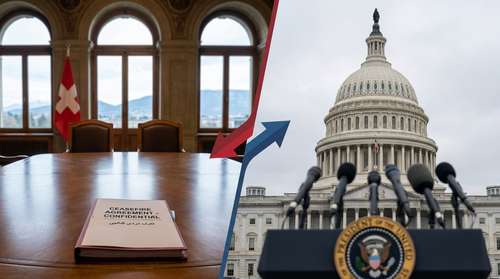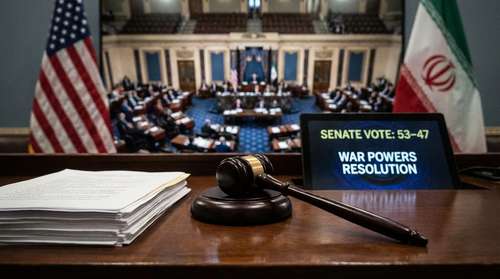
A critical National security alert today follows a defining moment on Capitol Hill. The U.S. Senate has formally blocked a crucial War Powers Resolution vote, effectively granting President Donald Trump an unobstructed path to escalate the ongoing Trump Iran war 2026. The decisive 53-47 decision removes the final legislative hurdle just as the administration weighs a highly dangerous ground mission to neutralize and seize Iranian enriched uranium stockpiles, aiming to permanently dismantle Tehran's nuclear weaponization capabilities.
The Senate Iran Conflict: Partisan Lines Hold Firm
The legislative battle over executive military authority culminated on Wednesday when Republicans successfully defeated the measure spearheaded by Senator Cory Booker. The broader Senate Iran conflict has highlighted deep, intractable partisan divides over the joint U.S.-Israeli military campaign known as Operation Epic Fury. The vote tally held almost strictly to party lines, demonstrating the GOP's unified stance behind the White House's military strategy.
There were only two notable outliers in the chamber. Republican Senator Rand Paul, a consistent critic of unauthorized foreign interventions, voted in favor of restricting the president's war powers. Meanwhile, Democratic Senator John Fetterman broke ranks with his party to vote against the measure, supporting the administration's continued military flexibility.
Lawmakers backing the resolution argued that Congress must reclaim its constitutional duty to declare war and authorize armed conflicts. Conversely, the White House and its congressional allies maintain that tying the Commander-in-Chief's hands during an active combat scenario endangers American lives. In a recent letter to Congress, President Trump defended the military actions, asserting that previous diplomatic solutions had failed and the threat had reached an unmanageable level.
Evaluating the Iran Nuclear Mission Trump
Following weeks of intense aerial bombardments under Operation Epic Fury—a campaign that has already targeted Islamic Revolutionary Guard Corps facilities and reportedly resulted in the death of Supreme Leader Ayatollah Ali Khamenei—intelligence reports indicate the situation remains volatile. Recent hearings involving Director of National Intelligence Tulsi Gabbard highlighted ongoing debates about the exact status of Tehran's capabilities. Defense officials believe that deep underground uranium reserves may still be accessible to Iranian forces, prompting a shift in tactical planning.
This reality has accelerated the planning for a specialized Iran nuclear mission Trump and his top military advisors are currently reviewing. Rather than relying solely on airstrikes, which have limitations against deeply buried bunkers, the Pentagon is reportedly drawing up contingencies for a targeted tactical operation. The primary objective is to physically secure, extract, or irreparably destroy highly enriched uranium before it can be transferred to secondary, undisclosed locations.
Executing a physical seizure of nuclear material presents unprecedented logistical and tactical challenges. Specialized units, likely operating in tandem with nuclear disposal experts, would need to navigate fortified subterranean networks. The risk of radiological exposure, coupled with the threat of asymmetrical retaliation, makes this one of the most hazardous military propositions in modern American history. Despite these risks, administration officials argue the alternative is entirely unacceptable.
The Reality of US Ground Troops Iran
The most controversial aspect of this proposed strategy is the potential deployment of US ground troops Iran. Up to this point, the administration has largely relied on naval superiority and precision airstrikes. However, executing a physical uranium seizure would require elite Special Operations forces operating in heavily defended, hostile territory.
White House Press Secretary Karoline Leavitt has carefully avoided ruling out a ground presence. While she noted earlier this month that boots on the ground were not part of the immediate plan, she confirmed that all strategic options remain actively on the table to ensure Iran's pathway to a nuclear weapon is completely severed. Furthermore, Secretary of War Pete Hegseth has indicated that the mission is laser-focused on destroying Iran's nuclear infrastructure, signaling that the military is preparing for complex, multi-layered engagements that could include ground elements.
Ramifications for 2026 Midterm Election Politics
This legislative outcome will undoubtedly send shockwaves through 2026 midterm election politics. With the war entering its fourth week and no definitive exit strategy publicly announced, domestic patience is rapidly becoming a central campaign issue. Democratic challengers are already framing the defeated War Powers Resolution as a blank check for an endless, unauthorized war, hoping to mobilize voters who are weary of prolonged foreign conflicts.
On the other side of the aisle, Republicans are pointing to the undeniable necessity of neutralizing a top-tier global threat. They argue that decisive action against Iran's nuclear ambitions demonstrates formidable leadership—a message they believe will resonate strongly with voters who prioritize national security and definitive military strength over diplomatic caution.
As military planners finalize the logistics for what could be the most perilous phase of the conflict yet, the failed Senate intervention ensures the White House maintains full operational control. The coming weeks will reveal whether this unchecked executive authority leads to a decisive strategic victory or draws the United States deeper into a highly unpredictable Middle Eastern theater.