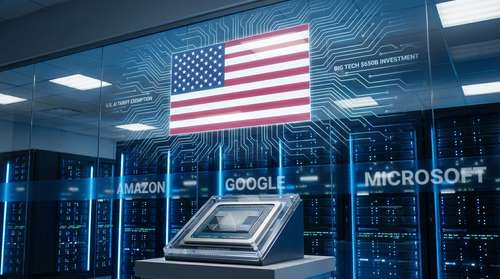
In a decisive move that reshapes the 2026 economic landscape, the U.S. government has reportedly agreed to exempt major technology giants including Amazon, Google, and Microsoft from impending AI chip tariffs. This policy carve-out, emerging from high-stakes negotiations in Washington this week, is designed to safeguard a staggering $650 billion AI data center investment wave that administration officials now view as critical to national security. The decision effectively shields the domestic buildout of artificial intelligence infrastructure from the 25% levies threatening the broader semiconductor supply chain, provided these companies adhere to strict U.S. manufacturing commitments.
The $650 Billion Bet: Why Washington Blinked
The sheer scale of capital injection planned by America's tech titans has forced a pragmatic pivot in U.S. semiconductor policy 2026. Combined estimates for 2026 capital expenditures (capex) from Alphabet, Amazon, Microsoft, and Meta have swelled to between $650 billion and $700 billion. This capital is almost exclusively earmarked for next-generation AI infrastructure, including the sprawling server farms required to train models like GPT-6 and Gemini Ultra.
Sources familiar with the discussions indicate that slapping a 25% tariff on imported AI accelerators would have effectively taxed American innovation, potentially stalling projects like OpenAI and Microsoft’s $500 billion "Project Stargate." By granting these Big Tech tariff exemptions, the administration ensures that the hardware powering these "AI factories"—specifically advanced GPUs and custom silicon—can flow into U.S. data centers without prohibitive penalties. The exemption comes with a catch: it applies strictly to hardware deployed within U.S. borders, incentivizing the on-shoring of data processing power.
TSMC’s $165 Billion Arizona Gambit
Central to this deal is a massive, renewed commitment from the world’s most important chipmaker. TSMC US production plans have expanded significantly, with the company confirming a total investment target of $165 billion for its Arizona "Megafab" cluster. This figure represents a dramatic increase from earlier projections and includes the construction of advanced packaging facilities essential for AI chips.
Bringing CoWoS to American Soil
The real linchpin of the agreement isn't just the wafer fabrication; it's the packaging. TSMC has agreed to bring its proprietary Chip-on-Wafer-on-Substrate (CoWoS) technology to Arizona. This advanced packaging is the bottleneck for producing Nvidia’s Blackwell and Rubin chips. By locating this critical step in the U.S., TSMC provides the administration with a strategic win: a self-sufficient supply chain for high-end AI silicon that no longer relies entirely on the Taiwan Strait.
The Nvidia Factor: HBM4 Supply Shortages
While tariffs dominated the headlines, a quieter crisis accelerated the need for these exemptions: a looming Nvidia HBM4 supply shortage. As Nvidia transitions to its next-generation architecture, it requires massive quantities of HBM4 (High Bandwidth Memory), a component that only a few manufacturers like SK Hynix and Samsung can produce at scale.
Industry insiders report that Alphabet, Amazon, and Microsoft AI capex plans were already under pressure from these component scarcity issues. A 25% tariff on top of rising component costs could have made the unit economics of new data centers untenable. The exemption provides a crucial buffer, allowing these companies to absorb the premium prices commanded by HBM4 shortages without the additional burden of import taxes. This ensures that Nvidia's allocation of these scarce chips continues to flow primarily to U.S. hyperscalers rather than foreign competitors.
A New Era of "Domestic Exemption" Policy
This development signals a maturation in U.S. semiconductor policy 2026. The administration is moving away from blunt protectionism toward a more surgical "Domestic Exemption" strategy. Under this framework, tariffs serve as a barrier to foreign access to advanced technology, while domestic entities building critical infrastructure get a pass.
For investors and industry watchers, the message is clear: the U.S. government is unwilling to let trade wars slow down the AI arms race. By carving out exemptions for its national champions, Washington is effectively subsidizing the AI data center investment boom, betting that the long-term economic superiority gained from leading the AI revolution outweighs the short-term revenue from tariffs.