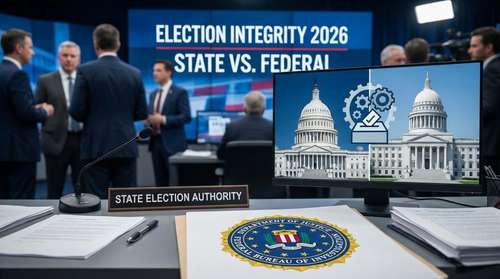
State election officials across the country are rapidly mobilizing legal defenses this week following President Trump’s controversial proposal to “nationalize” voting systems ahead of the 2026 midterm elections. The escalating standoff comes just days after a stunning 31-point swing in a Texas special election handed Democrats a surprise victory in a deep-red district, a result the President has reportedly blamed on state-level mismanagement. With reports emerging over the last 48 hours of potential federal “test runs” involving the seizure of voting machines by FBI agents in key battleground counties, fears of a constitutional crisis are mounting among legal scholars and state governors.
Federal Election Interference Concerns Escalate
The controversy ignited earlier this week when President Trump, appearing on a podcast with former FBI official Dan Bongino, explicitly called for Republicans to “take over the voting” in at least 15 strategic locations, including Democratic strongholds like Detroit, Philadelphia, and Atlanta. “The Republicans should say, ‘We want to take over,’” Trump stated, arguing that federal intervention is necessary to defy historical midterm trends that typically favor the opposition party.
This rhetoric has translated into immediate action. In what critics are calling a “test run” for 2026 federal election interference, FBI Director Kash Patel and Director of National Intelligence Tulsi Gabbard reportedly authorized a raid on an election hub in Fulton County, Georgia, seizing 2020 ballots and voting records. Sources indicate that similar operations may be planned for other contested districts, ostensibly under the guise of “election integrity” investigations. The move has sent shockwaves through the legal community, as the U.S. Constitution explicitly grants states the authority to administer elections.
Texas Special Election Shockwave
The urgency of the Administration’s push appears linked to Saturday’s political earthquake in Texas Senate District 9. In a special election that has rattled GOP strategists, Democrat Taylor Rehmet defeated Republican Leigh Wambsganss by approximately 14 points in a district President Trump carried by 17 points just two years ago. This massive 31-point swing is being viewed as a bellwether for the 2026 midterm elections, signaling potential voter backlash.
Political analysts suggest the Administration’s pivot to “nationalizing” the vote is a direct response to this vulnerability. “The Texas result shows that the traditional map is shifting,” says political strategist Sarah Jenkins. “The White House isn't just reacting to fraud; they are reacting to a political reality where their hold on safe districts is slipping.”
State Election Authority Strikes Back
In the last 48 hours, state leaders have moved from verbal condemnation to active defense preparation. California Governor Gavin Newsom and Attorney General Rob Bonta announced they are preparing emergency legal filings to block any federal agents from interfering with state election infrastructure. “We would win that on Day One,” Bonta told reporters, citing clear constitutional protections.
Similarly, officials in Michigan and Minnesota are “gaming out” scenarios involving federal law enforcement at polling places. Minnesota Secretary of State Steve Simon revealed that his office is treating the threat of federal interference with the same gravity as a “bomb threat or weather disaster,” coordinating with local law enforcement to ensure state sovereignty is maintained. Michigan Governor Gretchen Whitmer issued a stern warning: “Any attempt by the federal government to take over Michigan elections should be viewed as an attempt to take away Michiganders’ constitutional right to vote. It won’t happen on my watch.”
Legal and Constitutional Implications
Legal experts warn that any executive order attempting to federalize election administration would likely trigger an immediate constitutional crisis. The Elections Clause of the Constitution delegates the “Times, Places and Manner” of holding elections to state legislatures. While Congress has some oversight powers, the President does not have unilateral authority to seize voting machines or manage local vote counts.
House Minority Leader Hakeem Jeffries condemned the proposal on Sunday, stating that Democrats would use every legislative tool available to stop what he termed an attempt to “steal” the midterms. “This is not about election integrity 2026; it is about election subversion,” Jeffries said. As the 2026 political crisis deepens, the nation watches to see if the Department of Justice will proceed with further seizures or if the courts will intervene to halt the expansion of federal power.