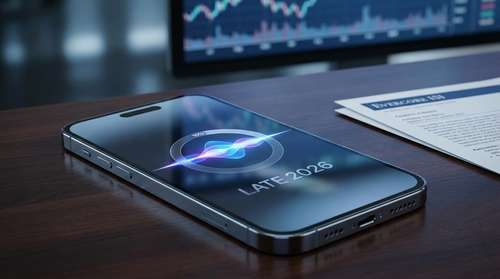
The long-awaited "Her" moment for iPhone users has been put on hold yet again. In a significant blow to Apple's generative AI roadmap, a new report from Evercore ISI analysts warns that Apple Intelligence 2.0—the company's next-generation AI suite—will miss its anticipated March launch window. Instead, the comprehensive Siri AI overhaul and advanced on-device capabilities are reportedly delayed until late 2026, pushing the most transformative features to the next major operating system cycle.
Evercore ISI Report: A "Multi-Phase" Setback
According to the latest investor note from Evercore ISI, led by analyst Amit Daryanani, Apple has encountered persistent "testing snags" that have forced a revision of the release timeline. The report, which sent Apple (AAPL) shares sliding nearly 5% in early trading—their sharpest single-day decline since April 2025—indicates that the complexities of integrating Large Language Models (LLMs) with strict privacy guardrails are proving more difficult than anticipated.
Daryanani maintains an "Outperform" rating with a $330 price target, but cautions that the delay signals a shift in strategy. Rather than a singular, blockbuster release this spring (originally pegged for the iOS 19.4 cycle), Apple is now expected to adopt a "multi-phase rollout." This means users might see minor tweaks by mid-year, but the "complete overhaul" of Siri that understands personal context and executes complex cross-app actions will not arrive until the fall of 2026, likely debuting alongside the iPhone 18 lineup.
Why the Apple AI Delay? Privacy vs. Performance
The core of the delay appears to be a conflict between performance and Apple's non-negotiable stance on user privacy. Sources cited in recent reports suggest that Apple privacy AI protocols—specifically those governing the "Private Cloud Compute" infrastructure—are creating latency issues.
Engineers testing the Siri AI overhaul reportedly found the assistant "sluggish" when handling multi-step commands. More concerningly, in beta environments, Siri was frequently failing to process complex queries on-device, defaulting to third-party integrations like ChatGPT more often than intended. Apple’s leadership is reportedly unwilling to release a flagship AI product that relies too heavily on external partners for core functionality, necessitating the push to late 2026 to bolster their proprietary models.
Impact on iOS 19 Features and the iPhone 17 Cycle
This setback leaves the current iOS 19 features list feeling incomplete. When the iPhone 17 launched in late 2025, it was marketed heavily on the promise of "Apple Intelligence 2.0" arriving within six months. Users were promised a Siri that could "see" what was on their screen and take action across apps—features that are now effectively kicked down the road.
For consumers, this means the current iteration of Apple Intelligence will remain largely unchanged for the next few months. Features like improved notification summaries and basic writing tools are functional, but the "agentic" capabilities—where Siri acts as a true digital concierge—are now a 2026 tech trend for the end of the year rather than the beginning. Analysts warn this could dampen the tail end of the iPhone 17 supercycle, as tech-savvy buyers may now choose to wait for the iPhone 18 and iOS 20 to ensure they get the hardware optimized for the delayed software.
The Competitive Landscape: Falling Behind?
The delay comes at a precarious time. Competitors like Google and OpenAI have continued to accelerate their voice-native AI capabilities. By pushing the Apple Intelligence 2.0 release to late 2026, Cupertino risks looking like it is falling behind in the AI arms race. However, Evercore's Daryanani notes that Apple's massive installed base allows it to play the long game.
"The critical importance of user privacy means Apple is prioritizing data protection and seamless integration over speed," the report states. While the market reaction has been negative in the short term, the consensus among long-term investors is that a delayed, polished product is preferable to a botched launch that compromises user trust.
What to Expect Next
Despite the doom and gloom of the delay, some features are still on track. The "Visual Intelligence" upgrades for camera control are performing well in betas, and we may still see incremental improvements to Genmoji and Image Playground before the summer. But for the true Siri AI overhaul, iPhone users will need to exercise a virtue that is becoming increasingly rare in the tech world: patience.