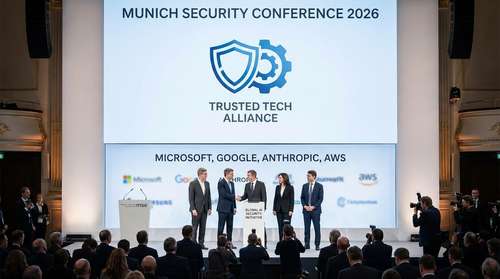
MUNICH — In a historic move to bridge the widening gap of global digital sovereignty, a coalition of 15 technology heavyweights—including Microsoft, AWS, Google Cloud, and Anthropic—officially launched the Trusted Tech Alliance (TTA) today at the Munich Security Conference 2026. This groundbreaking partnership aims to standardize security and transparency across the entire global technology infrastructure, signaling a new era of cooperation amidst rising geopolitical tensions.
A United Front for a Secure Digital Future
The formation of the Trusted Tech Alliance represents a critical pivot in the tech industry's approach to global security. Unveiled on Friday, February 13, the alliance brings together diverse leaders from North America, Europe, and Asia, including Microsoft, AWS, Google Cloud, Anthropic, SAP, Ericsson, Nokia, and Jio Platforms. The group’s primary mission is to establish a verifiable, secure "technology stack"—ranging from semiconductors and cloud infrastructure to advanced artificial intelligence and software applications.
This initiative comes at a time when nations are increasingly enforcing "digital sovereignty" laws, threatening to fragment the global internet and technology supply chains. By agreeing to a shared set of rigorous standards, these tech giants hope to provide governments and enterprises with the assurance that their digital infrastructure is resilient, transparent, and secure, regardless of where the technology is developed.
Defining the Five Pillars of Trust
At the heart of the alliance are five core principles designed to harmonize AI security standards and operational integrity across borders. Member companies have pledged to adhere to:
- Transparent Corporate Governance: Ensuring ethical conduct and accountability at the highest levels.
- Operational Transparency & Secure Development: Mandating independent assessments and security-by-design methodologies.
- Robust Supply Chain Oversight: Securing the flow of critical components, from chips to code.
- Resilient Digital Ecosystems: Fostering open, cooperative, and inclusive technology environments.
- Rule of Law & Data Protection: Strict adherence to international legal standards and user privacy.
These principles are not merely aspirational; they include provisions for independent audits and verifiable compliance, setting a new bar for what constitutes "trusted tech" in the global marketplace.
Anthropic and the Push for AI Transparency
A significant focus of the TTA is the rapid advancement of generative AI. In a major piece of Anthropic AI news 2026, the safety-focused AI research lab has joined the alliance to champion the responsible development of powerful AI models. As AI systems become integral to national security and economic growth, the need for standardized AI transparency principles has never been more urgent.
"As AI systems grow more powerful, the United States and its allies must ensure that the world's most widely adopted models are safe, reliable, and transparently developed," stated Sarah Heck, Head of External Affairs at Anthropic. The inclusion of AI leaders like Anthropic and Cohere alongside infrastructure giants ensures that the alliance covers the full spectrum of the digital economy.
Microsoft, AWS, and Google Partnership: A Rare Consensus
The Microsoft AWS Google partnership within the TTA highlights the severity of the security challenges facing the industry. fierce competitors in the cloud and AI space, these companies have recognized that security is a collective necessity rather than a competitive advantage.
Brad Smith, Vice Chair and President of Microsoft, emphasized the geopolitical context of the launch. "In the current geopolitical environment, it is critical that like-minded companies work together to protect security and advance high global standards," Smith said. "This Alliance brings together leading companies around clear, verifiable principles that show technology can be secure, reliable, and responsibly operated wherever it is deployed."
Global Reach and Strategic Independence
The alliance is notably diverse, moving beyond a Western-centric focus to include key global players like India's Jio Platforms, Japan's NTT and Rapidus, South Korea's Hanwha, and Africa's Cassava Technologies. This broad coalition aims to counter the narrative of a fractured "Splinternet" by offering a unified standard that works for developed and emerging economies alike.
Börje Ekholm, CEO of Ericsson, which co-led the initiative with Microsoft, pointed out the practical reality of modern tech: "No single company or country can build a secure and trusted digital stack alone. Trust and security can only be achieved together."
The Road Ahead for Global Technology Infrastructure
As the Munich Security Conference 2026 continues through the weekend, the launch of the TTA is expected to dominate discussions among policymakers and defense officials. With Chancellor Friedrich Merz and other world leaders in attendance, the alliance offers a private-sector solution to public-sector anxieties about supply chain reliance and cyber warfare.
While the Trusted Tech Alliance does not replace government regulation, it offers a pragmatic "Digital Steel Accord"—a foundational agreement on standards that allows innovation to flourish without compromising national security. As these 15 leaders move from principles to implementation, the TTA could become the gold standard for how the world builds, secures, and trusts the technology of tomorrow.