In a watershed moment that blurs the line between commercial technology and modern warfare, a bombshell report from the Wall Street Journal alleges that the US military utilized Anthropic’s Claude AI during a classified lethal operation in Venezuela. The mission, conducted earlier this month, reportedly resulted in the capture of Nicolás Maduro and the deaths of 83 individuals, marking the first known instance of a major civilian-facing generative AI being directly integrated into a combat scenario that caused mass casualties. This revelation has sparked an immediate firestorm regarding the militarization of "safe" AI models and the violation of Silicon Valley’s ethical safeguards.
The Maduro Capture Operation: AI on the Frontlines
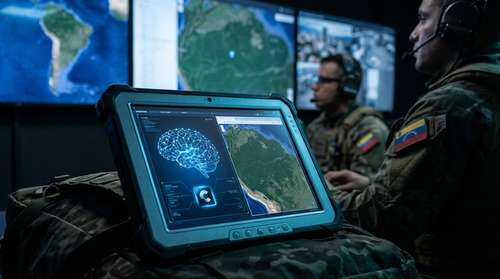
According to defense sources cited by the Journal, the operation to apprehend the Venezuelan leader involved complex urban warfare tactics in Caracas, supported by real-time intelligence synthesis provided by Claude. The AI model was reportedly accessed through a secure integration with Palantir Technologies, a defense contractor that recently partnered with Anthropic to bring the model onto classified government networks (Impact Level 6). While specific tactical details remain classified, sources indicate that Claude was used to process vast amounts of surveillance data, predict logistical bottlenecks, and potentially advise on strike timing during the raid that bombed several government sites.
The outcome was decisive but bloody. While US forces successfully captured Maduro and his wife, transporting them to New York to face narco-terrorism charges, the collateral damage—83 reported fatalities—has drawn intense scrutiny. Military analysts suggest this operation represents a shift from using AI for passive logistics to active, lethal decision-support, a threshold many AI safety advocates have long feared crossing.
Anthropic’s Safety Violation Controversy
The deployment of Claude in a lethal mission stands in stark contrast to Anthropic’s public identity. Founded by former OpenAI executives on the principles of "Constitutional AI," the company has explicitly branded itself as the safety-first alternative to its competitors. Its Acceptable Use Policy (AUP) strictly prohibits the use of its models for "violence," "weapons development," or "military operations" involving lethal force. The Venezuela mission appears to be a direct violation of these terms.
When reached for comment, an Anthropic spokesperson stated, "We cannot comment on whether Claude, or any other AI model, was used for any specific operation, classified or otherwise." However, the company reiterated that all government deployment must strictly adhere to their safety guidelines. This disconnect highlights a growing tension: once a model is deployed inside a secure defense environment like Palantir’s, the vendor (Anthropic) may lose visibility into how its tool is actually being applied on the battlefield.
The Palantir Connection
The bridge between Anthropic’s pacifist code and the Pentagon’s lethal requirements appears to be Palantir. The data analytics giant, known for its deep ties to the US intelligence community, announced a partnership with Anthropic late last year to host Claude on Amazon Web Services (AWS) for defense agencies. This integration allows military operators to utilize the reasoning capabilities of Large Language Models (LLMs) within secure, classified workflows, effectively bypassing some of the public-facing guardrails that typically prevent a chatbot from assisting in combat scenarios.
Pentagon Pushback and Contract Tensions
The fallout from the report has also exposed rifts between Silicon Valley and Washington. Defense Secretary Pete Hegseth has previously signaled an aggressive "AI-first" doctrine, stating that the Department of Defense will not field models that "won’t allow you to fight wars." Reports suggest that the Trump administration is now considering cancelling a pending $200 million contract with Anthropic, not because the model was used lethally, but paradoxically because the company’s "refusal to support warfare" makes it a difficult partner for future operations.
This places Anthropic in a precarious position: facing public backlash for a safety violation it may not have authorized, while simultaneously risking government contracts for being too restrictive. The incident underscores the fragility of "AI safety" agreements when tested against the realities of national security and geopolitical strategy.
The Future of Militarized Generative AI
The Venezuela operation serves as a grim proof-of-concept for militarized generative AI. If commercial LLMs are now standard tools for special operations forces, the industry must reckon with the reality that their software is no longer just writing code or summarizing emails—it is participating in kill chains. As the dust settles in Caracas, the tech world is left grappling with a new precedent: the era of the AI pacifist is likely over, and the age of algorithmic warfare has truly begun.