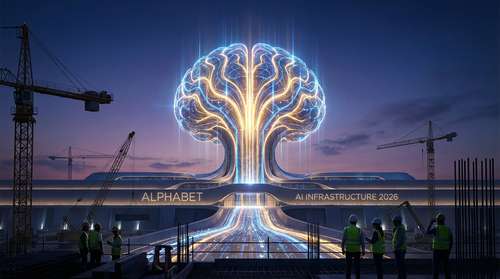
Alphabet sent shockwaves through Silicon Valley and Wall Street on Thursday, unveiling a staggering capital expenditure plan that redefines the stakes of the modern technology era. In a move that signals an "all-in" commitment to artificial intelligence, the tech giant projected its Alphabet AI spending 2026 will soar between $175 billion and $185 billion. This historic investment, nearly doubling its 2025 outlay, aims to secure Google’s dominance in a future defined by generative AI, even as investors recoiled at the immediate price tag.
The High Price of Dominance
The numbers announced during Alphabet’s Q4 2025 earnings call are nothing short of astronomical. For context, the projected $185 billion cap is roughly equivalent to the entire GDP of countries like Hungary or Kuwait. CFO Anat Ashkenazi confirmed that approximately 60% of this Alphabet capex guidance is earmarked for technical infrastructure—specifically, the servers and custom silicon required to train and run massive next-generation models. The remaining 40% will fuel a global Google data center investment spree, expanding the physical footprint needed to power these energy-hungry systems.
"We are in a very, very relentless innovation cadence," CEO Sundar Pichai told analysts, defending the expenditure as a necessity rather than a choice. The message is clear: in the AI infrastructure race, the only risk greater than overspending is underinvesting. This aggressive posture comes despite the company already spending $91.4 billion in 2025, a figure that itself had raised eyebrows just a year ago.
Gemini’s Explosion: 750 Million Strong
Justifying this massive capital injection is the explosive growth of Google’s consumer AI ecosystem. Pichai revealed that Google Gemini monthly users have now surpassed 750 million, a metric that has surged by 100 million in just the last quarter alone. The catalyst for this growth appears to be the recent launch of Gemini 3, which has reportedly accelerated adoption across Google’s search and workspace products.
While these numbers are impressive, the comparison to rivals remains a focal point for the industry. With OpenAI’s ChatGPT boasting over 900 million weekly active users, Google is playing a fierce game of catch-up. However, the integration of Gemini into the Android ecosystem and the Chrome browser is beginning to yield the "practical business results" Pichai promised, creating a sheer volume of data demand that requires the massive infrastructure build-out now underway.
Wall Street Balks at the Bill
Despite beating revenue expectations with a robust $113.8 billion in Q4—driven by a 48% surge in Google Cloud revenue—the market’s reaction was immediate and harsh. Tech stock market news wires lit up with reports of Alphabet shares sliding 5% in early trading. Investors are grappling with the reality of "depreciation drag," where the costs of these massive assets hit the balance sheet before the revenue fully materializes.
Analysts are split on the strategy. Some view the hyperscale cloud spending as a defensive moat that will eventually crush smaller competitors unable to match Google’s checkbook. Others worry that the return on investment (ROI) for such massive outlays remains theoretical. "The market is asking for profit margins today, but Google is buying the next decade," noted one analyst on the call.
The Silicon and Energy Arms Race
Beyond the dollars, this investment signals a deepening of the vertical integration strategy at Google. A significant portion of the 2026 budget will likely support the deployment of the rumored seventh-generation Tensor Processing Units (TPUs) and the energy infrastructure to run them. As hyperscale cloud spending hits unprecedented levels, access to power and custom silicon has become the new bottleneck.
Google’s gamble is that by controlling the entire stack—from the $185 billion infrastructure to the 750 million-user application layer—it can squeeze out efficiencies that rivals relying on third-party hardware cannot match. Whether this bet pays off will determine not just the future of Alphabet’s stock price, but the shape of the internet itself for the coming decade.