
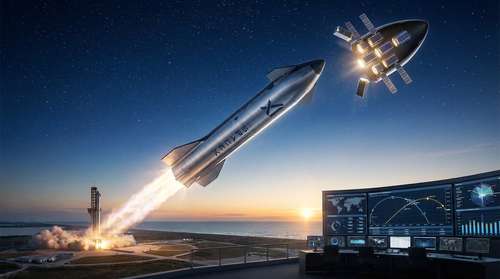
In a move that fundamentally reshapes the future of both aerospace and artificial intelligence, Elon Musk has officially merged SpaceX with his AI startup, xAI, to form a new entity focused on building the world's first planetary-scale orbital compute network. The announcement, made early Thursday, outlines an audacious plan to deploy up to one million AI-dedicated satellites using the Starship launch system. This "Orbital Data Center" initiative aims to bypass Earth's crumbling energy grids by moving power-hungry model training into low Earth orbit (LEO), where solar energy is abundant and cooling is limitless.
The Unavoidable Logic of the SpaceX xAI Merger
For industry analysts, the SpaceX xAI merger is less of a surprise and more of an inevitable convergence of necessity. As AI models like Grok grow exponentially in size, terrestrial energy infrastructure has failed to keep pace. Recent reports indicate that AI data centers could consume up to 10% of global electricity by 2030, a load that existing grids simply cannot sustain without massive delays.
"The constraint on AI isn't silicon anymore; it's watts," Musk stated during the press briefing at Starbase. "On Earth, we are fighting for permit approvals to build power plants. In orbit, the sun never sets, and the vacuum provides infinite cooling. We are merging these companies to build the ultimate engine for intelligence."
By vertically integrating the launch capability of SpaceX with the computational hunger of xAI, the new conglomerate aims to reduce the cost of orbital compute deployment by orders of magnitude. The plan relies entirely on the rapid reusability of Starship, which is now targeting a cadence of daily launches to ferry these heavy, server-grade payloads to orbit.
Solving the AI Energy Crisis from Space
The core proposition of the orbital data centers initiative is simple physics. Space-based solar power is up to 40% more efficient than terrestrial panels due to the lack of atmospheric interference and the ability to remain in near-constant sunlight. Furthermore, the vacuum of space offers a unique thermal environment where heat—the enemy of high-performance GPUs—can be radiated away efficiently without the need for water-guzzling cooling towers.
Traditional data centers on Earth face a "thermal wall" and an "energy wall." AI energy consumption solutions have largely focused on incremental efficiency gains, but Musk's approach sidesteps the problem entirely. By lifting the infrastructure off-planet, xAI can train next-generation Grok models on clusters that would otherwise require the dedicated output of a nuclear power plant on Earth. This space-based cloud computing architecture promises to deliver sovereign, low-latency intelligence to any point on the globe via laser interlinks, similar to the existing Starlink backbone.
Starship: The Workhorse of xAI Grok Orbital Infrastructure
The sheer scale of the project depends on the Starship AI satellite launch capabilities. Unlike traditional communications satellites, these new "compute sats" are essentially flying server racks, heavy with shielding and H100-class processors. Only Starship, with its 150-ton payload capacity to LEO, can economically loft the millions of tons of hardware required to build this "brain in the sky."
Technical Challenges and Timeline
Despite the high confidence, the engineering hurdles are significant. Radiation shielding for sensitive 3nm chips in the harsh environment of LEO is a non-trivial challenge. Engineers at the newly merged HQ are reportedly testing liquid-metal shielding and novel error-correcting memory architectures to prevent cosmic ray bit-flips from corrupting training runs. The first prototype constellation, dubbed "Neural Shell," is slated for deployment in late 2026, with the full million-satellite mesh targeted for the early 2030s.
Market Impact: A New Trillion-Dollar Frontier
This development sends shockwaves through the tech sector, particularly for cloud giants like Microsoft and Amazon, who are earthbound by real estate and utility contracts. Elon Musk tech news 2026 has been dominated by this pivot, as it potentially renders terrestrial hyperscale data centers obsolete for the heaviest training workloads.
Competitors are already reacting. Startups like Lumen Orbit have been validating the concept of xAI Grok orbital infrastructure on a smaller scale, but the SpaceX merger creates a vertically integrated behemoth that controls the launchpad, the satellite bus, and the AI model itself. If successful, this initiative won't just make xAI the dominant force in artificial intelligence; it will make Earth's orbit the new silicon valley, quite literally.