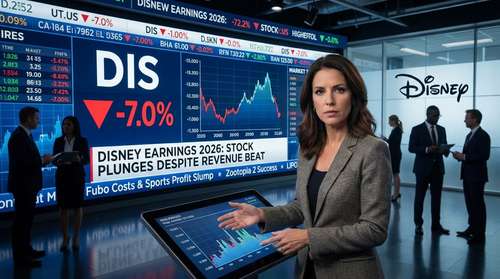
The Walt Disney Co. (DIS) saw its shares crater over 7% this week, trading near $104, as investors reacted to a complex fiscal first-quarter earnings report that combined record-breaking revenue with alarming profit squeezes. Despite posting a revenue beat of nearly $26 billion and celebrating massive box office wins from Zootopia 2 and Avatar: Fire and Ash, Wall Street focused heavily on a 23% slump in sports profits and the rising costs associated with its new majority stake in FuboTV. The financial turbulence arrives at a critical juncture, with intensified speculation that Parks Chairman Josh D'Amaro could be named as Bob Iger's successor as early as this week.
Disney Earnings 2026: A Revenue Beat Shadowed by Rising Costs
On the surface, Disney's fiscal Q1 2026 numbers looked robust. The entertainment giant reported revenue of roughly $26 billion, a 5% increase year-over-year that edged out analyst expectations. Adjusted earnings per share (EPS) came in at $1.63, also topping forecasts of $1.58. However, a deeper look reveals why the Disney stock plunge occurred.
While top-line growth was healthy, the bottom line took a hit from strategic maneuvers. Adjusted EPS actually fell 7% compared to the prior year. The primary culprit was the company's Entertainment segment, where operating income plummeted 35% to $1.1 billion. This sharp decline was driven by higher marketing expenses for theatrical releases and, crucially, the integration costs of Disney streaming profitability initiatives, specifically the recent deal involving FuboTV.
The FuboTV Factor and Streaming Struggles
A significant weight on this quarter's earnings was Disney's acquisition of a majority stake in FuboTV. By combining certain Hulu + Live TV assets with Fubo, Disney now holds a controlling 70% interest in the operations. While this move is a long-term play to consolidate the live TV streaming market, the immediate impact was a drag on margins.
Investors were rattled by the "integration costs" and higher programming expenses that accompanied this deal. Although the direct-to-consumer (streaming) business saw revenue climb, the path to sustained, high-margin profitability remains rocky. The market's negative reaction underscores a growing impatience with the costs required to build a streaming dominance that can rival Netflix, even as Disney+ churn rates improve for bundled subscribers.
Disney Sports Profit Decline: The ESPN Problem
Perhaps the most concerning metric for investors was the Disney sports profit decline. The Sports segment, anchored by ESPN, saw operating income sink 23% to just $191 million, despite a 1% tick up in revenue to $4.91 billion. This segment has long been a cash cow for the House of Mouse, making the double-digit drop particularly jarring.
Two main factors drove this slump:
- Rising Rights Costs: The cost of securing live sports broadcasting rights continues to skyrocket, eating into margins even as ad revenue holds steady.
- YouTube TV Blackout: A temporary carriage dispute with YouTube TV last fall resulted in a blackout of Disney networks. Management revealed this standoff cost the sports division approximately $110 million in operating income—a one-time hit that nonetheless devastated the quarter's growth narrative.
Box Office Juggernauts: Zootopia 2 and Avatar
Amid the gloom of the stock sell-off, Disney's film studio provided a glittering silver lining. CEO Bob Iger touted the company's "strong box office performance," headlined by two billion-dollar hits. Zootopia 2 box office numbers were nothing short of historic, with the animated sequel grossing over $1.7 billion worldwide, cementing its place as one of the highest-grossing animated films of all time.
Similarly, Avatar: Fire and Ash continued James Cameron's streak of dominance, crossing the $1 billion mark and proving that Disney's IP engine is still firing on all cylinders. These theatrical wins drove a 7% increase in Content Sales/Licensing revenue. However, the high costs of marketing these blockbusters meant that much of this revenue didn't translate immediately into operating income, further confusing the "good news, bad news" narrative of the quarter.
Josh D'Amaro: The Next Disney CEO?
Overshadowing the financials is the feverish speculation regarding leadership. Industry insiders and recent reports suggest that the Disney board is on the verge of announcing Josh D'Amaro as the next CEO. D'Amaro, currently the Chairman of Disney Experiences, has been the architect behind the theme parks' record-breaking $10 billion revenue this quarter.
With Bob Iger's successor being a topic of intense debate since his return in 2022, D'Amaro is seen as the safe yet forward-looking choice. His division is the only one showing consistent operating income growth (up 6% to $3.3 billion), effectively subsidizing the streaming transition. If confirmed, D'Amaro's appointment could stabilize investor sentiment, providing a clear roadmap for the post-Iger era.
What Investors Should Watch Next
Despite the 7% drop, Disney reiterated guidance for double-digit adjusted EPS growth for fiscal 2026. The company plans to repurchase $7 billion in stock and invest heavily in content. For investors, the key will be watching if the Disney streaming profitability targets are met without further margin compression, and if the new CEO—whether D'Amaro or a dark horse—can articulate a strategy that balances the lucrative legacy of theme parks with the expensive future of digital media.