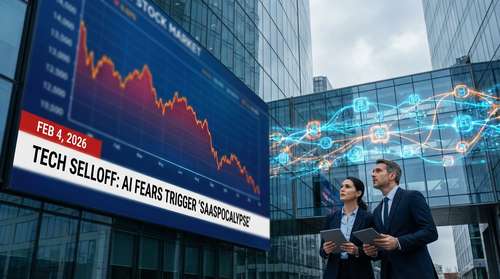
Wall Street is reeling from what analysts are already calling the "SaaSpocalypse." On Wednesday, major U.S. technology indices faced a brutal downturn as the Nasdaq Composite plunged, driven by a massive selloff in software stocks. The catalyst? Growing panic that autonomous AI agents are no longer just productivity tools, but direct replacements for the human workers who power the traditional Software-as-a-Service (SaaS) economy. Leading the decline were household names like LegalZoom and Expedia, which saw their share prices decimated as investors aggressively repriced the future of the software industry.
The 'Anthropic Effect': A Wake-Up Call for Investors
The market turmoil began following reports of new capabilities in agentic AI models, specifically the release of Anthropic's "Claude Cowork" suite earlier this week. These new autonomous agents demonstrated an unprecedented ability to handle complex, multi-step workflows—from legal contract drafting to travel management—without human intervention. For investors, the implication was immediate and terrifying: if an AI agent can autonomously execute tasks that previously required teams of humans, the need for expensive, per-seat software licenses evaporates.
"This is the 'Chegg moment' for the entire enterprise software sector," said Sarah Jenkins, a senior tech analyst at Vertex Capital. "For a decade, the investment thesis was simple: companies hire more people, they buy more software seats, and revenue grows. That equation broke today. If an AI agent does the work of five junior employees, you don't need five Salesforce or Zoom licenses anymore. You might not even need one."
LegalZoom and Expedia Lead the Crash
The selloff was most acute in sectors relying on information arbitrage and administrative workflows. LegalZoom shares plummeted over 20% in early trading after demonstrations showed AI agents successfully navigating complex state filings and trademark applications faster and cheaper than existing software solutions. Similarly, Expedia Group faced a sharp double-digit decline as the market digested the reality of "autonomous travel agents"—AI systems capable of booking complex itineraries directly via APIs, bypassing traditional consumer interfaces and their ad-heavy business models.
It wasn't just niche players taking the hit. Giants like Salesforce, Adobe, and Workday also saw significant multiple compression. The fear is that the "per-seat" pricing model, the golden goose of the SaaS industry for the last 20 years, is fundamentally incompatible with an AI-first workforce.
The Death of the 'Per-Seat' Model
The core of the panic lies in the "efficiency paradox." Traditional software companies generate revenue based on headcount. However, the promise of autonomous AI is to reduce headcount. As companies deploy AI agents to cut costs, their spend on seat-based software naturally contracts.
Analysts are now warning that the software industry faces a painful transition period. To survive, SaaS companies must pivot from charging for access (seats) to charging for outcomes (work completed). "The market is realizing that 'efficiency' is actually deflationary for software revenues," noted a morning research note from Morgan Stanley. "Unless these companies can successfully monetize the AI agents themselves, they are looking at a future of shrinking Total Addressable Markets (TAM)."
Hardware vs. Software: The Great Divergence
While software stocks bled, the divergence within the tech sector became starker than ever. Semiconductor and infrastructure stocks, including Micron Technology and ASML, remained relatively resilient, hitting new highs in some cases. The market's logic is ruthless but clear: the AI agents eating the software world still need massive amounts of compute power to run.
"We are seeing a capital rotation from the application layer to the infrastructure layer," explained David Chen, a portfolio manager at FutureTech Global. "Investors are betting on the pick-and-shovel makers—the chips, the data centers, the energy providers—while fleeing the companies that simply sell tools to humans who might not be there in five years."
What's Next for the Software Industry?
As the dust settles on this historic selloff, the question remains: is this an overreaction or the new normal? Optimists argue that software companies have reinvented themselves before, transitioning from on-premise servers to the cloud. However, the shift to Agentic AI represents a more existential threat. It challenges the very definition of a "user."
For now, volatility is the only certainty. As February 4, 2026, goes down in history as the day the market finally priced in the AI disruption, software CEOs are likely convening emergency meetings to answer one question: How do you sell software to a machine?