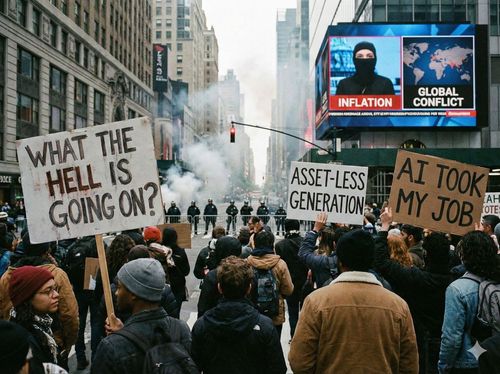
If you had fallen into a deep coma in late December 2019 and woken up today, in January 2026, the world you opened your eyes to would look visually familiar, yet essentially alien. The buildings are the same buildings, the cars are the same cars. But the "Operating System" of humanity has been swapped out. The air itself feels different, more charged, more flammable, and far more dangerous.
We stand at the exact midpoint of this decade, offering a rare vantage point to stop and ask the question that has echoed in the mind of every sane person over the last five years: What The Hell Is Going On?
This is not merely a sequence of "bad news." Human history has always been paved with disasters and wars. What distinguishes the 2020s is the density. We have undergone a compression of fifty years of history into just five. We have experienced five tectonic fractures, security, geopolitical, economic, moral, and existential, each of which alone would be enough to define a generation and leave a deep scar. We, defying all statistical logic, received them all at once.
This is what the world looks like after being dismantled and reassembled before our eyes.
The Security Fracture: The Great Silence & The Altered Social DNA
It all began with a betrayal by nature. Or rather, with the shattering of the illusion of human superiority, the arrogant belief that modern man had defeated biology and controlled nature without challenge. The COVID-19 pandemic was not just a viral event or a morbidity statistic; it was a collective psychological trauma that reshaped the human psyche.
In an instant, globalization, the great engine of our era, turned from an asset into a lethal liability. The planes that shrunk the world spread death. The silence that descended upon the world's great cities in March 2020 was deafening. It was a moment of cognitive shock: it turned out that our complex, technological, and "invincible" civilization was actually a house of cards, capable of being toppled by a microscopic organism in a matter of weeks.
But the real damage was not medical; it was social. The pandemic altered the DNA of human interaction. It birthed the "Epidemic of Loneliness", according to WHO data, the first year of the pandemic saw a 25% increase in the prevalence of anxiety and depression globally. We were imprisoned in our homes and became entirely digital creatures, with screens replacing touch. We learned to fear the breath of the person standing next to us. The concept of "Social Distancing" shifted from a technical-medical term to a way of life and a deeply ingrained psychological habit.
The long-term result is a sense of existential transience. The close encounter with death and the sudden halt of the rat race birthed the "YOLO" phenomenon and "The Great Resignation" of 2021-2022. Tens of millions quit their jobs not because of wages, but out of the crushing realization that the future is not promised, and there is no point in delaying gratification or suffering for a pension we might never live to see. The pandemic taught us that we are fragile, and this existential fear still bubbles beneath the surface, quietly managing us.
The Geopolitical Fracture: The Narrative War & The Collapse of Truth
We had barely recovered from the biological trauma when the old world order collapsed with a thunderous crash. This is the fracture that officially ended Francis Fukuyama's "End of History" theory. The naive belief that the West had won, that liberal democratic values were the default, and that international trade would prevent wars, was shattered on two brutal fronts: Russia's invasion of Ukraine in February 2022, and the eruption of the Middle East with the October 7th massacre in 2023.
The diplomatic conclusion was sharp: A Global Arms Race. The world returned to the language of force. Global defense budgets broke all-time records (surpassing $2.4 trillion), with pacifist nations like Germany and Japan amending constitutions and arming themselves in panic. But the deeper change is not in tanks, but in minds.
The world has split into camps based on identity and narrative, not facts or consistent morality. We are witnessing a dangerous phenomenon of "Selective Morality," structured entirely on templates of "Oppressor vs. Oppressed." The progressive West has adopted a simplistic narrative of colonialism, through which all global conflicts are judged, regardless of historical reality.
This is the reason for the cognitive dissonance we see on the streets of London and New York: crowds will march for Palestinians in Gaza, ignoring brutal massacres, simply because Palestinians fit the narrative of the "weak" and "victims of the West." Conversely, those same protesters will remain completely indifferent to protestors in Iran being murdered by their regime, or to genocide in Sudan, because it does not fit the anti-colonial narrative. Political identity has superseded humanity; we choose a side based on the story we want to tell ourselves about the world, not based on justice.
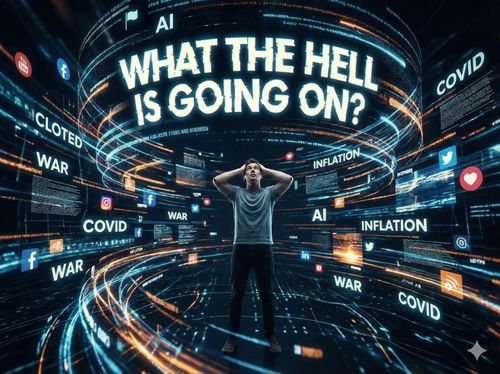
The Economic Fracture: An Asset-less Generation Seeking Meaning
For a decade and a half, the Western world lived on financial steroids: zero interest rates and cheap money printed endlessly by central banks. It created an illusion of abundance, but the bill came due in the middle of the decade, and it was brutal. Runaway inflation and high interest rates broke the basic social contract upon which the middle class was built.
But beyond the dry numbers, a deep sociological fracture has occurred within the younger generations (Gen Z and Millennials). The crushing realization is that the bourgeois dream is dead. In most major Western cities, the ratio between median income and housing prices has reached peak levels not seen since World War II. A young, educated, working individual in London, Toronto, or New York understands that the ability to acquire a significant asset, an apartment, a house, land, has become impossible. They have become "The Asset-less Generation."
And this is the critical point for understanding the chaos in the streets: When you have no economic asset to hold onto, you cling to the only asset you have left, your Identity.
The economic vacuum and the hazy future drive millions to seek belonging and meaning elsewhere. Political, gender, or ideological identity becomes the "New Real Estate" of the soul. Young people adopt extreme ideologies and go out to burn the streets not just for "justice," but to feel they own something, that they are part of something bigger, that they have a grip on reality. Political radicalization is a direct side effect of economic despair; ideology is the only home they can afford to buy.
The Moral Fracture: The Suicide of the West
Simultaneously, the liberal West stood before the mirror in the mid-decade and was horrified by what it saw. A decade of "Open Borders" policies, stemming from post-colonial guilt and a moral naivety of "inclusion," blew up in the West's face.
Nations once considered beacons of safety and tranquility, such as Sweden, lost their identity and security. Sweden became the capital of shootings and bombings in Europe, with crime rates soaring by hundreds of percent, a direct result of massive immigration from third-world countries without any demand for integration. "Parallel Societies" formed within Europe, zones where state law does not apply, and liberal values like women's and LGBTQ rights are trampled under extreme conservative immigrant culture.
This is the most acute crisis of trust between the citizen and the state in the modern era. The average Western citizen feels that the elites have abandoned their personal safety and national identity in the name of a twisted "morality" and Political Correctness that prevented any real discussion of the problem. The result is a political earthquake: the rise of the Hard Right and nationalist parties in the Netherlands, France, Italy, and Germany. This is not merely "racism" as the establishment media tries to portray it, but a cry of distress from populations feeling like strangers in their own homes. Classical Liberalism discovered, perhaps too late, that tolerance of intolerance is a recipe for cultural suicide.
The Existential Fracture: The AI Economic Guillotine
And here comes the final blow. Into a battered generation, asset-less, insecure, and confused about its identity, enters the Generative AI revolution. This is no longer a futuristic philosophical debate about "machine consciousness," but an immediate, tangible existential fear.
Reports from investment banks like Goldman Sachs and the IMF speak of hundreds of millions of jobs at risk and the disruption of about 40% of the global labor market. The fear is no longer science fiction, but the realization that very soon, this technology will take over 50% of white-collar jobs.
The implication is devastating for a generation that has already lost the ability to buy a home. If they have no assets, and AI threatens to take away their ability to earn a living from knowledge work, what is left? The computer writes, codes, draws, and analyzes better than us. For a humanity used to defining its self-worth through "work" and "creation," the knowledge that a machine can replace us with the push of a button is the final fracture of reality. This generation lacks the mental or economic stability required to cope with a shift of this magnitude.
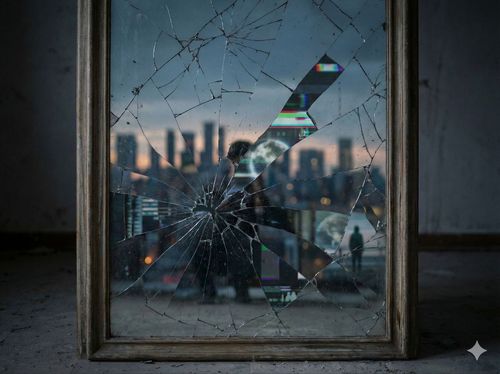
The Parabola of History vs. The Great Unknown
So, what the hell is going on?
We are looking at a humanity that has taken blow after blow. A generation lying on the canvas, bleeding from its assets, its identity, and its personal security, now required to face the "reality break" of Artificial Intelligence.
But if we lift our heads from the chaos for a moment and look at a broad historical perspective, we see a somewhat comforting pattern. Human history has never been a linear line, but a Parabola. A pendulum swinging from extreme to extreme. Humanity has always known how to correct itself. After the total darkness of the Middle Ages came the Renaissance; after the unimaginable horrors of the World Wars in the first half of the 20th century, came decades of prosperity, liberalism, and flourishing.
Historical law dictates that it is precisely the most extreme events and the inconceivable density we have experienced in the last five years that will eventually lead to a Correction, to calm, and to a new equilibrium. The bad times must end, because that is the nature of history, after radicalization comes centering.
Except this time, there is one terrifying asterisk.
The great question hovering over 2026 is: Are we at the bottom of the parabola, moments before the long-awaited ascent? Or has the AI revolution changed the laws of historical physics?
Is this technology such a dramatic variable, an "Alien Intelligence" entering the system, that it breaks the familiar pendulum and prepares a future that I, as a human being relying on history books, simply cannot predict? It is possible that this time, the old rules of "after the bad comes the good" are no longer valid, because the main player on the field is no longer just the human.