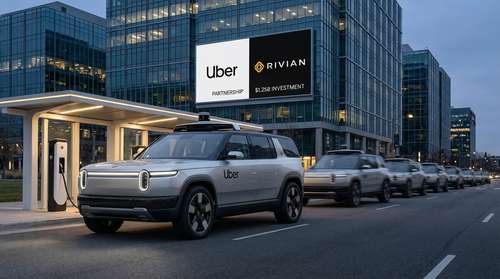
The landscape of urban mobility is shifting at breakneck speed. In a move that fundamentally redefines the future of ride-sharing, the blockbuster Uber Rivian partnership announced this week promises to bring up to 50,000 unsupervised electric vehicles to city streets. In the most significant self-driving car news of the year, ride-hailing giant Uber has committed to invest up to $1.25 billion into electric vehicle manufacturer Rivian. Together, they aim to accelerate the deployment of a fully autonomous robotaxi network that will forever change how we commute.
Building the Uber Autonomous Fleet
This aggressive push into vehicle automation is far more than a limited pilot program; it is a full-scale commercial takeover strategy. According to the strict terms of the Uber Rivian partnership, Uber and its fleet operators will initially purchase 10,000 of the newly minted Rivian R2 SUVs. These vehicles are slated to hit the road as early as 2028, with initial commercial deployments targeting the dense, high-demand urban centers of San Francisco and Miami.
If early operations go according to plan, the companies retain an exclusive option to roll out an additional 40,000 vehicles beginning in 2030. By the end of 2031, the ultimate goal is to have the expanded Uber autonomous fleet operating seamlessly across 25 major cities in the United States, Canada, and Europe. This massive rollout represents an escalation in the robotaxi wars, putting direct pressure on early movers like Alphabet's Waymo, Elon Musk's Tesla, and Amazon's Zoox.
Unpacking the Uber Investment in Rivian
Securing capital in the fiercely competitive electric vehicle market is notoriously difficult. The Uber investment Rivian just secured provides a massive cash infusion precisely when the automaker needs it to scale production capacity and finalize its artificial intelligence development.
A Milestone-Driven Approach
The financial architecture of the deal is highly calculated. Uber is putting an initial $300 million on the table immediately following the contract signing, pending standard regulatory approvals. The remaining capital, which brings the total up to the $1.25 billion ceiling, will be distributed progressively through 2031. However, those future payouts are directly tied to strict, predetermined autonomous performance milestones.
Rivian recently adjusted its profitability timeline, informing investors that the increased research and development spend required to hit these rigorous autonomous targets will delay immediate core profits originally expected in 2027. Yet, Wall Street reacted with overwhelming positivity. The electric vehicle maker's shares surged nearly 10% in premarket trading on the day of the announcement, fueled by investor confidence that Uber's financial backing comfortably covers the extra R&D costs.
The Rivian R2 Self-Driving Advantage
Why did Uber choose Rivian instead of solely relying on its existing tech partners? The answer lies in vertical integration and cutting-edge sensor technology. Unveiled in late 2025 and launching for consumers later this year, the smaller, more affordable R2 SUV—starting at roughly $48,490—is packed with next-generation hardware designed explicitly with autonomy in mind.
The Rivian R2 self-driving architecture features an incredibly robust sensor suite: 11 high-resolution 65-megapixel cameras, five advanced radars, and a central lidar unit. All of this immense visual data is processed entirely in-house by two of Rivian's proprietary RAP1 AI chips, which are capable of delivering 1600 TOPS of computing performance.
Uber CEO Dara Khosrowshahi emphasized this exact advantage in his statements to the press. He noted that Rivian's unique approach of designing the vehicle, the compute platform, and the software stack simultaneously gives Uber the conviction to set such ambitious targets. For RJ Scaringe, Rivian's Founder and CEO, this expanded Uber Rivian partnership rapidly accelerates the company's path to Level 4 autonomy. As analysts evaluate the state of autonomous robotaxis 2026, it is overwhelmingly clear that owning the entire hardware-software ecosystem is a massive competitive moat.
Reshaping the Future of Ride-Sharing
Uber famously abandoned its internal self-driving division back in 2020, opting instead to pivot toward a platform-centric model. Today, the Uber application functions as the ultimate global dispatcher for various autonomous providers. While they already route users to Waymo vehicles in Austin or upcoming Zoox cars in Los Angeles, the integration of 50,000 Rivian R2s represents the undisputed crown jewel of this broader strategy.
Having a dedicated, exclusively integrated fleet of this size ensures that users in key markets will soon experience driverless rides as standard practice rather than a quirky novelty. Furthermore, deploying fully electric SUVs aligns perfectly with broader mobility sustainability targets, moving the platform closer to its zero-emission operations goals.
Through the unique structure of the Uber Rivian partnership, combining Rivian's consumer driving data and manufacturing prowess with Uber's unmatched experience in managing the complexities of commercial mobility, both companies are uniquely positioned to win the transport race. For everyday commuters, the wait to ride in the future won't be much longer. With the technological and financial foundations firmly set, the transition from human drivers to seamless, algorithmic transport is officially shifting into high gear.