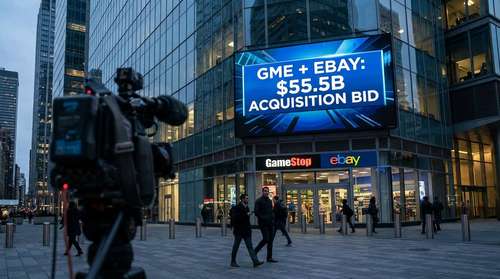
In a move that has thoroughly stunned Wall Street, video game retailer GameStop has submitted a massive $55.5 billion unsolicited offer to acquire the pioneer online marketplace, eBay. This proposed GameStop eBay acquisition represents a dramatic and unexpected pivot for the brick-and-mortar chain, transforming it from a celebrated meme-stock phenomenon into an aspiring e-commerce titan. With eBay's board of directors currently reviewing the proposal, the financial world is watching closely to see if this colossal retail pairing will actually materialize.
The Details of the Blockbuster eBay Takeover Bid
The unsolicited proposal, officially submitted on Sunday evening, values the online auction giant at roughly $55.5 billion. Under the terms of the deal, GameStop is offering $125 per share, split evenly between cash and GameStop common stock. This aggressive offer represents a 46% premium over eBay's unaffected closing price on February 4, 2026—the exact day GameStop quietly began accumulating what is now a 5% economic stake in the marketplace.
According to the latest GME stock news, GameStop's leadership is not waiting around for a polite decline. CEO Ryan Cohen has already warned that he is fully prepared to take this offer directly to shareholders if the board rejects the terms. This looming threat of a GameStop hostile takeover adds immense pressure on eBay's leadership, who stated publicly that they had no prior discussions with the retailer before the massive bid was made public.
Financial Skepticism: A Minnow Eating a Whale?
Analysts were quick to point out the stark size and revenue difference between the two entities. GameStop currently holds a market capitalization of around $12 billion, whereas eBay is valued at nearly $49 billion. Wall Street insiders and legal experts have likened the proposed transaction to a "minnow attempting to eat a whale".
To fund the cash portion of the deal, GameStop plans to utilize its $9.4 billion in cash reserves and liquid investments, alongside a "highly confident" commitment letter from TD Securities for up to $20 billion in third-party debt financing. To bridge the remaining multi-billion dollar gap, the company plans to issue additional stock. Despite the bold financial maneuvering, firms like Bernstein and Morgan Stanley have voiced skepticism regarding the feasibility of this massive e-commerce merger 2026. Even "Big Short" investor Michael Burry expressed concern over how a company of GameStop's size could effectively digest such a massive acquisition.
The Ryan Cohen GameStop Strategy: Revitalizing Retail
Why does a video game retailer want to purchase a sprawling online resale platform? The core of the Ryan Cohen GameStop strategy hinges on combining physical retail infrastructure with digital marketplace dominance. Cohen believes that GameStop's footprint of approximately 1,600 retail locations across the United States can serve as a vital, localized physical network for eBay.
These retail stores would be transformed into national hubs for product authentication, fulfillment, intake, and emerging live commerce trends. In a retail environment where physical touchpoints are increasingly valuable for digital marketplaces—especially for high-fraud items like trading cards and sneakers—this physical synergy could solve some of eBay's longstanding logistical bottlenecks.
Furthermore, Cohen's proposal includes an aggressive plan to trim the fat at eBay. GameStop claims it can deliver $2 billion in annualized cost reductions within the first twelve months. This includes slashing $1.2 billion from sales and marketing, arguing that eBay's recent excessive ad spending has failed to significantly grow its active buyer base. GameStop also plans to cut $300 million from product development and $500 million from general and administrative costs.
GameStop vs Amazon: Building a New E-Commerce Giant
Ultimately, the endgame appears to be a direct GameStop vs Amazon rivalry. In a recent interview, Cohen noted that eBay should be worth hundreds of billions of dollars, positioning it as a legitimate alternative to Amazon's e-commerce dominance. By streamlining digital operations and integrating thousands of localized drop-off and authentication centers, the newly combined company hopes to capture a commanding share of the fast-growing resale market.
However, industry experts remain cautious about the reality of integrating these two distinct cultures. While there is an overlapping interest in pop-culture collectibles and video games, eBay's largest revenue drivers—such as auto parts, luxury watches, and designer handbags—fall completely outside GameStop's traditional expertise. Management experts note that when two companies lack fundamental, broad-based business overlap, the chances of an acquisition creating long-term shareholder value drop significantly.
What Happens Next?
As of this week, eBay's board of directors is carefully reviewing the unsolicited proposal to determine the best course of action for its shareholders. If the board resists or attempts to implement a poison pill defense, Cohen has made it exceptionally clear that a protracted proxy fight is on the table.
Whether this unprecedented acquisition reshapes the global retail landscape or becomes a fascinating footnote in corporate history, it has undeniably proven that GameStop's ambitions extend far beyond selling video games. Investors and consumers alike will be watching the ticker tape closely as the battle for eBay unfolds.