
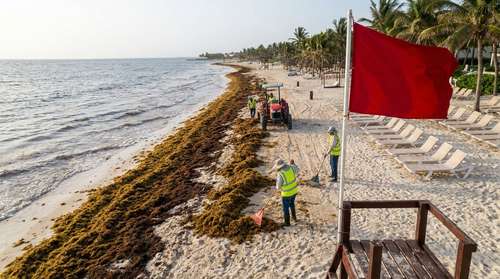
The pristine white sands of the Riviera Maya are facing an unprecedented challenge this week. If you are planning a Caribbean getaway, the latest Cancun sargassum forecast May 2026 brings concerning news: authorities have officially declared a Mexico beach red alert today. The massive influx of invasive brown macroalgae has overwhelmed local defense systems, designating 15 iconic stretches of sand in northern Quintana Roo as critical red zones. With peak vacation season rapidly approaching, this record-breaking bloom is already forcing millions of tourists to rethink their coastal itineraries.
The Record-Breaking 2026 Seaweed Crisis
Environmental scientists at Mexico's National Laboratory of Earth Observation (NALOT) project a staggering 40 million metric tons of sargassum biomass developing in the Atlantic Ocean this year. For local officials, that translates to an exhaustive, seemingly endless cleanup effort. Over 25,000 metric tons of the invasive gulfweed have already been collected from the shoreline this week alone. The situation has grown so severe that state and federal governments anticipate managing up to 130,000 metric tons before the year ends—a massive 30% jump from the previous season's already record-breaking numbers.
Sargassum is a buoyant, rootless macroalgae that forms massive floating island ecosystems out in the deep ocean. While it provides vital shelter for marine life like turtles and fish at sea, it becomes a severe ecological threat once it hits the shallows. As the thick mats blanket the coast, they block crucial sunlight from reaching fragile coral reefs and deplete oxygen levels in the water, aggressively suffocating local marine ecosystems.
Barrier Collapse and Military Intervention
The latest Playa del Carmen seaweed update is particularly grim following a major infrastructure failure over the weekend. On May 2, strong southeasterly winds combined with heavy ferry wakes completely destabilized a crucial 5-kilometer offshore containment net. Once the primary defense was compromised, the algae slipped beneath the barriers, dumping massive waves of sargassum directly onto downtown beaches.
To combat the localized crisis, the Mexican Navy has been fully mobilized to assist desperate municipal workers. Federal Maritime Terrestrial Zone (Zofemat) crews are currently working around the clock, pulling roughly 100 tons of the rotting algae from the sand every single day in the hardest-hit zones just south of the maritime terminal. Despite the heavy machinery and tireless manual labor, the sheer volume of arriving biomass makes it nearly impossible to keep the central beaches entirely clear.
Health Hazards and Travel Advisories
The immediate crisis extends far beyond ruined vacation aesthetics. Decomposing sargassum releases hydrogen sulfide under the hot Mexican sun, producing a noxious sulfur smell that drives beachgoers away and can cause severe respiratory irritation for vulnerable individuals. Furthermore, NALOT researchers warn that the algae actively absorbs heavy metals like arsenic, mercury, and cadmium from the ocean waters. This toxic absorption makes the rotting mats hazardous to both marine life and humans who wade through them.
The persistent nature of the bloom has prompted several independent travel agencies to issue informal Mexico summer travel warnings, advising clients to manage their expectations and avoid areas with heavy accumulation. Daily monitoring is now an essential part of the modern travel experience in the region. Visitors are heavily relying on the Caribbean sargassum tracker 2026, an updated network of satellite imagery and local webcams that maps the movement of these floating mats in real-time. By checking the tracker each morning, you can identify which coves and bays are free of the brown tide before you even leave your hotel room.
Where to Find Clear Waters
Despite the severe coastal impact along the mainland, your highly anticipated vacation does not have to be ruined. Finding safe beaches in Quintana Roo simply requires a bit of flexibility, local knowledge, and daily monitoring. Because the massive algae blooms ride westward ocean currents, west-facing islands like Isla Mujeres and the western shores of Cozumel typically remain entirely shielded from the onslaught, boasting the crystal-clear turquoise waters the region is famous for.
Additionally, luxury properties across the Riviera Maya have heavily invested in private maritime fleets and specialized offshore nets to protect their shoreline. When booking your stay, inquire specifically about their sargassum resort clean zones. Top-tier resorts often employ hundreds of workers in their dedicated cleanup brigades, utilizing heavy machinery and specialized amphibious vessels to clear the shoreline before guests even wake up. If the beach does temporarily get overwhelmed by a sudden shift in the wind, many of these resorts feature stunning architectural pools, elevated rooftop terraces, and expansive lush courtyards that provide a luxurious alternative to the sand.
Embracing Inland Alternatives
If you are arriving this week while the red alerts remain active, the best strategy is to pivot and embrace the region's incredible inland wonders. When the beaches are temporarily choked with macroalgae, head deep into the Mayan jungle to swim in the spectacular, crystal-clear waters of natural cenotes. Alternatively, use the beach closure days to explore ancient archaeological ruins like Chichen Itza, Tulum, and Coba. Mother Nature is inherently unpredictable, but with real-time tracking and a willingness to explore beyond the immediate shoreline, the Mexican Caribbean still offers an unforgettable, world-class escape.