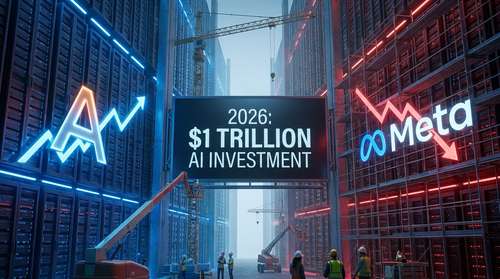
The financial world just witnessed the most expensive wager in corporate history. During this week's Q1 reporting cycle, the world's largest technology conglomerates confirmed a staggering reality: combined commitments to the next generation of computing have crossed the $1.3 trillion threshold. The sheer scale of Big Tech AI spending 2026 has reshaped market expectations, triggering a brutal divergence in how Wall Street values massive capital expenditures. As tech giants deploy unprecedented capital to dominate the emerging market for autonomous enterprise AI agents, investors are demanding immediate returns. This tension sparked a violent market reaction, defining a week where aggressive spending strategies were either handsomely rewarded or severely punished.
Alphabet AI Cloud Growth Silences the Skeptics
If there were lingering doubts about the monetization of artificial intelligence, Alphabet just crushed them. The search giant reported blockbuster Q1 figures, highlighted by massive Alphabet AI cloud growth that sent its market capitalization soaring past $4.5 trillion. Google Cloud revenue eclipsed $20 billion for the first time, notching a remarkable 63% year-over-year increase.
More importantly, the company's backlog nearly doubled sequentially to $460 billion, proving that enterprise demand is fundamentally outstripping supply. CEO Sundar Pichai noted that the company remains completely compute-constrained in the near term. Alphabet executives didn't hesitate to lean into this momentum, revising their full-year capital expenditure guidance to a jaw-dropping $180 billion to $190 billion. Because the company demonstrated a clear pipeline of external customers ready to buy up this capacity, the market embraced the spending hike, sending Alphabet's stock up nearly 10% following the announcement.
Meta Stock Slump May 1: The Cost of Internal Innovation
The reception for Mark Zuckerberg's empire couldn't have been more different. Meta raised its own 2026 capital expenditure guidance to a range of $125 billion to $145 billion, citing higher component prices and the need to massively scale compute for future AI models. But unlike Alphabet's cloud business, which directly sells infrastructure to other corporations, Meta's investments are largely internalized to power its recommendation algorithms and proprietary generative tools.
Wall Street balked at the price tag. The resulting Meta stock slump May 1 wiped roughly $175 billion off the company's valuation as shares plunged 10%. Investors remain terrified of the timeline required to achieve profitability from these massive data center build-outs, particularly when the end product relies on an unproven consumer revenue model rather than guaranteed cloud contracts. While Meta's core advertising business remains incredibly strong, the sheer magnitude of their long-term infrastructure bet left the market deeply unsettled.
The $1.3 Trillion AI Infrastructure Investment Era
The divergent paths of these two behemoths illustrate a broader theme across the recent Magnificent Seven earnings calls. The four major hyperscalers—Amazon, Microsoft, Meta, and Alphabet—collectively dropped $131 billion on data centers in the first quarter alone, a figure that dwarfs the inflation-adjusted cost of the Manhattan Project.
Tech companies are no longer just buying graphics processing units; they are aggressively acquiring power grids, cooling technologies, and vast tracts of real estate. Total Big Tech AI spending 2026 is projected to hit an astounding $725 billion across just four companies, pushing cumulative global AI infrastructure investment well over the $1.3 trillion mark. Microsoft, for its part, announced a $190 billion projection, while Amazon maintained a staggering $200 billion capital commitment to keep Amazon Web Services competitive.
Surging Data Center Construction Costs
Building the physical foundation for next-generation computing is becoming prohibitively expensive. Executives across the industry repeatedly highlighted how soaring data center construction costs are eating into profit margins. Supply chain bottlenecks for memory pricing, specialized networking equipment, and high-voltage power transformers have forced hyperscalers to commit capital years in advance.
"We are seeing unprecedented internal and external demand for AI compute resources," noted Alphabet CFO Anat Ashkenazi during their earnings call. This dynamic creates a formidable moat, meaning only a handful of corporations on the planet can actually afford to play the game. The rising costs ensure that the barriers to entry in the foundation model space are virtually insurmountable for new entrants.
Powering the Autonomous Digital Worker
Why are these companies willing to risk investor wrath to build these facilities? The answer lies in the shift from basic generative chatbots to autonomous, action-oriented systems. The tech sector is racing to deploy enterprise AI agents—digital workers capable of executing complex, multi-step workflows across an organization's software stack without human supervision.
Training and running these agentic systems requires exponentially more compute power than processing a simple text query. The hyperscalers know that whoever controls the foundational infrastructure for these digital workers will essentially collect a tax on the future of corporate productivity. While the short-term market turbulence may cause temporary heartburn for some shareholders, the long-term stakes of this $1 trillion arms race are simply too high for Big Tech to slow down.