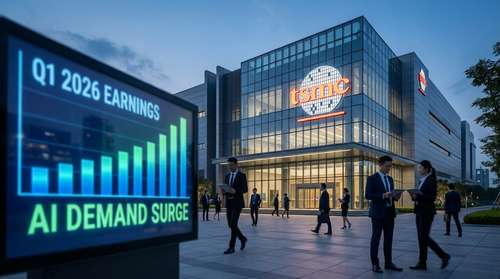
In a financial quarter that underscores the relentless momentum of artificial intelligence, Taiwan Semiconductor Manufacturing Co. (TSMC) has once again redefined industry expectations. On April 16, 2026, the foundational giant of global silicon reported a staggering 57% year-over-year profit increase, cementing its status at the forefront of the tech earnings season leaders. Driving these massive TSMC Q1 2026 earnings is an unprecedented AI chip demand surge that shows zero signs of cooling off, pushing the company's quarterly revenue to a record-breaking $35.5 billion.
As the primary foundry for tech titans like Nvidia, Apple, and AMD, TSMC's financial health operates as the ultimate barometer for the broader technology sector. The latest numbers definitively prove that the massive capital pouring into data centers, deep learning models, and hyperscaler infrastructure is translating directly into unprecedented foundry profits.
An Unprecedented AI Chip Demand Surge
The core catalyst behind this quarter's massive beat is the insatiable global appetite for high-performance silicon. When evaluating AI industry financial results, TSMC captures the lion's share of the manufacturing upside. Lead times for the most advanced AI chips have reportedly stretched past 50 weeks, a glaring indicator that structural demand is vastly outpacing current supply capabilities across the globe.
Advanced packaging, particularly TSMC's CoWoS (Chip-on-Wafer-on-Substrate) technology, remains a critical bottleneck that the company is aggressively working to resolve. AI accelerators now account for an increasingly massive percentage of TSMC's total wafer revenue, shifting the company's center of gravity away from traditional consumer electronics and firmly toward enterprise artificial intelligence infrastructure.
Market Reactions and Taiwan Semiconductor Stock News
Following the early Thursday morning release, Taiwan Semiconductor stock news dominated trading floors from Wall Street to Taipei. Investors had long debated whether the foundry's aggressive international expansion plans and complex manufacturing investments would temporarily weigh down profit margins. Instead, TSMC successfully leveraged its pricing power and unmatched node yields to deliver a 57% profit spike.
This financial performance effectively silences skeptics who feared the cost of expanding overseas—including massive ongoing projects in Arizona and Japan—might erode the bottom line. The stock market's reaction reflects a growing consensus that TSMC's premium valuation is entirely justified by its monopolistic grip on cutting-edge production.
Defining Semiconductor Market Trends for the Next Decade
These blowout figures represent more than just a successful three-month stretch; they highlight fundamental shifting semiconductor market trends where advanced nodes command astronomical pricing premiums. While competitors like Samsung and Intel are fighting to secure volume orders for their latest architectures, TSMC is leveraging this current windfall to maintain its aggressive development cycle.
The company has already smoothly transitioned its 2-nanometer (N2) class chips into volume production late last year, setting the stage for broader smartphone and high-performance computing adoption. To maintain its lead, TSMC's immediate manufacturing roadmap includes several critical milestones:
- N2 Volume Expansion: Ramping up 2nm capacity at the Fab 22 facility in Kaohsiung to meet aggressive client deadlines.
- N2P Rollout: Introducing a performance-enhanced variant of the 2nm architecture in the second half of 2026.
- A16 Node Debut: Launching a next-generation architecture featuring "Super Power Rail" backside power delivery for complex AI processors.
This relentless development cadence ensures that competitors face a daunting, rapidly moving target.
Capitalizing on Global Chip Manufacturing 2026
To maintain its absolute dominance in global chip manufacturing 2026, TSMC is deploying a jaw-dropping capital expenditure budget projected between $52 billion and $56 billion for the year. This capital will fund not only domestic expansion in its core Taiwanese hubs but also the continued diversification of its geographic footprint.
The sheer scale of these investments highlights the immense financial and technical barriers to entry in modern chipmaking. A single advanced node wafer can now command upwards of $20,000 to $30,000, depending on the specifications and packaging requirements. TSMC has effectively built a financial flywheel: AI profits fund the R&D for next-generation nodes, which in turn secure the next decade of AI manufacturing contracts.
Ultimately, TSMC's $35.5 billion first-quarter haul demonstrates that the artificial intelligence revolution is built on very tangible, highly profitable silicon. As long as the world's leading cloud providers and technology giants remain locked in a generational AI arms race, Taiwan Semiconductor Manufacturing Co. stands ready to supply the foundation—reaping historic, record-shattering profits along the way.